
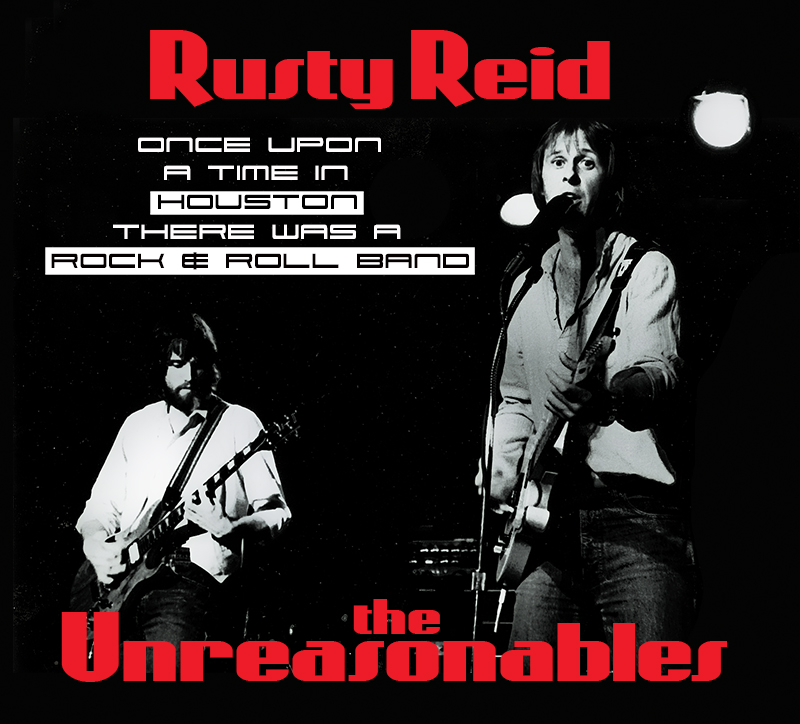
 2025: THE UNREASONABLES Northern Latitudes Records Copyright © 2025 Rio Paso Music (BMI)
FORTY-SOMETHING YEARS LATER, RUSTY'S 1980s-ERA HOUSTON ROCK BAND EMERGES FROM THE DARK! The Unreasonables is a compilation of demos recorded by Rusty Reid and mates between 1978-1982.
After a few years as a band member, in the late 1970s I wanted to get back to my original vision of myself as a solo artist. I just needed a crack ensemble of players to make it happen. That was easier imagined than bringing to fruition. Houston's musical landscape as the Seventies closed and Eighties began was fragmented into its lounge, party, country, blues, R&B, TexMex, dance, singer-songwriter, rock, punk nodes. As with most local music scenes, there was a lot of derivative copying of successful acts. When MTV launched in the summer of 1981, the pop-rock-punk-New Wave field got even worse in that regard. It was into this niche that I wanted to play, and likely only escaped fully plunging into copycat territory myself through the freedom I allowed bandmates to add their individual stamp to the songs. The problem all along was me. I was all over the map in terms of what I wanted it to sound like. We never actually achieved the sound I had in my head for these songs. I wanted a steady keyboard player and some harmony singers. The Universe said, "Nope and nope!" So guitars and more guitars it was. Given that there was virtually no money to be gained in joining the project, it is rather remarkable that we did somehow gather an ensemble of crack players (including a few who would go on to some notoriety... see notes below) and bumble into a sound all our own. Hopefully the skill and spirit of the individual players comes through on these comparatively crude recordings, as they each succeed in making the songs theirs, as well as ours. Alas, innately, the Unreasonables became a revolving door of players coming in and going out. Actual paying gigs awaited their departure, so it was disband and regroup over and over again. The original idea for these recordings was to consider them demos, get signed to a record deal, and re-record them. Yeah, that didn't happen. This batch of songs is in chronological order of recording, following the evolution of the band. This is the "sound" we came up with. These recordings are very close to live performances. We did a couple of takes, and that was that. The seven songs on this album with the David Turner, Brent Waters and Ed Martinson lineup are part of a batch of sixteen songs we recorded in two days! Of the nine other songs from that batch, four ("Oh Well, "No Deposit, No Return," "Too Many Poor," "My Troubles Have Just Begun") appear in re-recorded form on other of my albums. In late 1982, I made the decision to return to Los Angeles, and folded up the Unreasonables. We had fun, but had not accomplished much to speak of. We played around a bit, but weren't one of the popular bands in Houston. We didn't have many fans. We didn't release any records. We didn't get signed to a record deal. We did do a lot of recording, always in a tiny studio that we could afford, but I was rarely completely satisfied with the recordings. The Unreasonables had not achieved the goals I was shooting for. Before I left for L.A., I reunited the last version of the Unreasonables to record a final ten songs in a couple of days. These sessions were our best. We had finally made the jump up to 24 tracks. When I released my first album, "NWXSW" in 2001, I selected four of those recordings ("Miss Independent," "If You Were Me," "That's the Thing About That," and "I Want to Believe") to include, and re-recorded two other Unreasonables songs, "Hot as a Pistol" and "Hurricane," which are included here in their original form. The rest of the Unreasonables recordings were stashed away, all but forgotten. Many decades later, I heard from some former bandmates. It was cool but unexpected when they recounted the good times we had, and proclaimed their love for some of those songs. "What happened to those recordings?" they wanted to know. So I went digging through my jungle of boxes to find them. I wasn't expecting to find anything worthwhile, remembering them as too subpar in recording quality to be releaseable. But after having the old master multi-track tapes digitized and imported into my home studio, I was pleasantly surprised. True, the recordings aren't Electric Ladyland quality, but they were workable. In bringing them back to life, I realized we were better than I recalled!
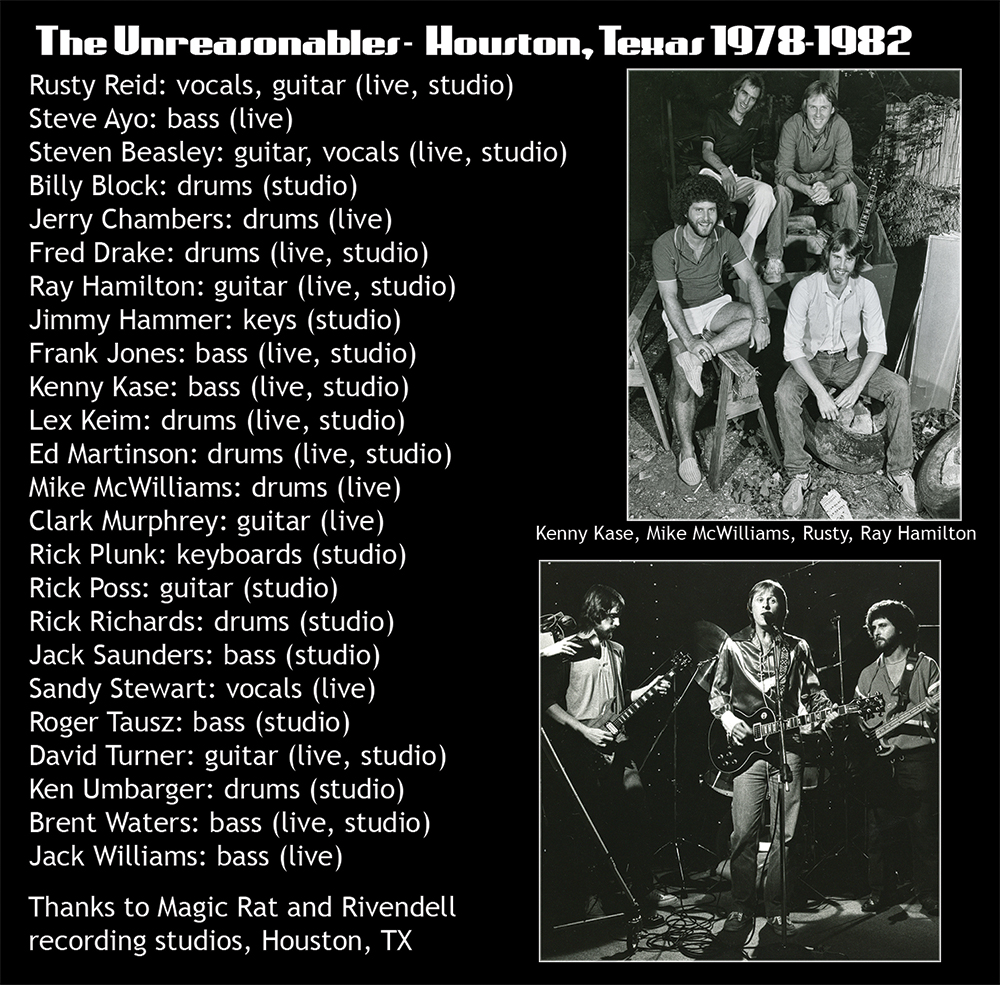
The Unreasonables had no financial backers, no press agent, no hangers-on, no producer guru, no posh studio, no real plan. It was just us, me and a handful of other Houston lads, thrashing away at quirky songs destined to never go anywhere. But what do you know? Once upon a time in Houston, there was a rock and roll band. And through the miracles of technology, out of the vault of time they rise and ride again. Special thanks to all the bandmates and Magic Rat Studio. You made me sound good. Wherever in the world you are, I hope you are well and happy. I have the fondest memories of our too short time together. If you'd like to hear more Unreasonables, check out my first album, "NWXSW," for the tracks "If You Were Me," "That's the Thing about That," "Miss Independent" and "I Want to Believe," all recorded in Houston with the final band of Unreasonables.
BUY "THE UNREASONABLES" - signed by Rusty 
ALSO AVAILABLE AT - DISCOGS

AMAZON MUSIC
Not too familiar with the sounds of Rusty Reid & The Unreasonables, then it's about time to join the party, as the artist recently released a massive album that spans such an amazing variety of classic and indie rock with genuine and aesthetically vintage tonalities, along with songwriting that feels driving but inviting at the same time.
The release is called The Unreasonables, and wastes very little time jumping in with its insanely catchy rock staples with the very first track, "Hot as a Pistol.
Right off the bat, you get this driving and sort of fuzz tone, almost garage rock-sounding guitar, and the riff is addictive and classic.
You also have soulful guitar work in the underbelly of this track on an almost constant basis, along with drums that drive everything, but also give the track and the entire album, for that matter, a lot of life.
I can't express enough how the soundscape of this record hits this amazingly vintage tone. The aesthetic was aimed for and nailed 100%.
A great example is just how the drums were actually recorded. You have this classic drum tone and sound throughout the record that really helps the vintage classic rock aesthetic come through in shining colors.
The guitar worked throughout the entire record is outstanding, delivering loads of soul, inventive, slightly outside-the-box but very familiar-feeling riffs and segments.
This is a very guitar-driven record, as again, it is pure rock and roll, classic rock, indie rock, and more.
There are even elements of old school punk in there at times. Not all the songs share this attribute, but some of them certainly do, and I just think it's outstanding how there was so much attention paid to the arrangements and how the energy of the songs comes through the way they were meant to.
There's something about the way this record was built and recorded that makes you feel like you're in the room and in the moment with them.
It seems almost like everything was recorded live on the floor, and everyone involved was feeding off of each other's energies the entire time.
The record is packed with melodic hooks and almost anthemic choruses that give you bouts of nostalgia because you feel like you're listening to a record that was released in the late 70s or early 80s.
Now, this is a huge record. The album as a whole spans 19 songs, and a lot of them stand on their own two feet as singles extremely well, but listening to the whole album is a real doozy.
This is an album you don't want to miss any songs from because if you like a few of them, you're going to love the whole record.
Listening to a few tracks off of this will give you a bit of an idea or gist of what you may expect on the full album; however, it will not give you the entire spectrum of what the record has to offer.
There's so much going on, so many layers of great guitar work, melodic and soulful vocal performances, massive hooks left and right, and one of my favorite aspects about the record is that it gives you instrumental or guitar hooks as well.
Guitar hooks are an imperative part of rock music, in my opinion. Over the years, I've seen this aspect sort of drop out, and I have never liked it.
Great guitar work is the essence of rock, and to have an album that brings back guitar hooks that are just as catchy as the choruses at times is brilliant.
This is an album that brings back a lot of what we've been missing, and genuine rock music, and it's something that a lot of indie rock bands strive to achieve.
The difference is that we're listening to something that feels authentic from a certain time. It's a different era of rock music that I'm hearing on this record, and it comes through so aesthetically perfect that I can't tell the difference.
This is an album worth listening to from start to finish. You get such a lush and full-bodied experience by doing it this way, and so many songs on the record stand tall, amongst a lot of the stuff that you hear on the radio in the past, and these days as well.
If you are a fan of this late '70s or early '80s era of classic rock music then you're going to love this record. Some songs and approaches make me think of bands like Tom Petty and the Heartbreakers, for example.
This, to me, was a high point in rock music, and it's amazing that Rusty and his band can capture that feeling so well.
This was done with outstanding attention to the little details. The tones of the instruments, the way it was recorded, the songwriting, it all came together like puzzle pieces.
Check this record out because if you're a fan of rock music and any facet, you're going to absolutely love this. There's almost no record more genuinely rock than this one that I've heard in a long time.
While you do that, check out our interview with Rusty below so you can find out more about where this record came from and Rusty himself.
Don't forget where you heard this first.
Rusty Reid Uncovers a Forgotten Rock Treasure with The Unreasonables.
Occasionally, music history presents us with the tale of opening a time capsule. Rusty Reid's "The Unreasonables" is just such a treasure - a forgotten double album of sharp hooks, insurgent melodies, and unapologetic rock attitude, made decades past and only now given its life. It is no retro project; it is a rebirth. Four decades or so on from when it was first adhered to and put on the back burner, the album is an epiphany and a miracle, a reminder of what could have been and what still very much is.
Reid, an American singer-songwriter from Texas living in the Pacific Northwest today, is a seasoned artiste for his introspective indie-folk and country-rock discography. But The Unreasonables shatters that vision. This is not a thinking or philosophical record. It's an elemental, sweat-drenched explosion of rock and roll - lusty, raw, alive. No sweeping manifestos, no incendiary epics. Simply a band tearing along at full cry, sawing out riffs and melodies with the kind of freedom you get when you don't think anyone's paying attention.
It starts with "Attitude Change," a catchy, sassy pop-rock jangle that gets the tone just right - hooky, confident, and frayed at the edges. It's the sort of track that would've fit neatly between Tom Petty and The Pretenders on FM radio in the early '80s, the sort you crank up loud in the car with the windows down. "Piece of the Action" comes with swing and swagger, sultry rhythm and sneer grin. "Shock Me" turns it up, a thudding come-on tune that's like a neon light turning on, and "Let's Just Talk" chills the temperature just enough to show the doubt behind the bluff.
It's easy to imagine The Unreasonables having held their own during their era - much the same as groups like The Cars, Dire Straits, and The Romantics all did the best they could to straddle radio-friendly hooks with subtlety strangeness. And yet, hearing it today, there's still something contemporary to it too. The snappiness of the melodies, the rough-around-the-edges sincerity, the lack of overproduction - it's precisely what modern rock could use more of.
There is also something oddly cinematic about this re-discovery. The tale of a lost group, an unreleased album that did not get heard, and a musician who carried that specter in silence all these years - it's like a sub-plot from Almost Famous or a strand out of Richard Linklater's Everybody Wants Some!!. You can almost envision a stack of reels unopened in a garage, the tape slightly gritty but otherwise unmolested, waiting for someone to press play once more.
Rusty Reid has ever written with intent, usually putting politics or philosophy in his work, but The Unreasonables takes all that away. It is the sound of passion - passion over dogma, beat over brain. What is remarkable is how up-to-date it still is. Melodies have not aged at all. Guitars are crunchy and thumping. Vocals come alive with sarcasm and humor.
Reid's decision to finally put out The Unreasonables is both nostalgic and defiant. In an era of music culture beset by algorithmic sheen and streaming numbers, here's an album from a previous age of purpose - where a group could plug in, play from the heart, and let the tape run. It's sloppy, human, and full of personality.
For readers of old-style rock storytelling, The Unreasonables lie between the peppery bite of The Kinks and blue-collar heartland romance of Bruce Springsteen's early albums. It has that same stubbornness and humanity - songs by people who weren't attempting to be famous, but real.
Hearing it today is like discovering a letter written some time in the past but with the ability to speak to the present. It's not revival. It's confirmation that great music never truly dies - it merely awaits the moment when it will be re-rediscovered.
And here is finally, then: The Unreasonables. Rusty Reid and his long-forgotten band didn't disappear - they were patiently waiting for the world to catch up.
RUSTY REID BRINGS OLD SONGS BACK TO LIFE. a confident, character rich album where time, patience, and a great band, met in style
the unreasonables feels like a record that has waited for the right moment.these songs have history in them, written years ago, carried forward quietly, and now finally given the space to breathe and come alive in full colour.
based between texas roots and the pacific northwest, rusty reid has spent years writing, recording, and refining his craft, building a catalogue shaped by classic pop, rock, and americana instincts. there is a sense of long-earned confidence here, not flashy or rushed, but grounded in experience and trust in the song.
written and recorded across a restless stretch of late 70s and early 80s Houston, these songs began life without a plan for longevity. They were captured quickly, often live, shaped by shifting band line-ups, limited resources, and the urgency of musicians chasing a sound they could feel but not quite hold. At the time, they were meant as stepping stones, demos for a future that never arrived. Years later, revisited with fresh ears and care, they reveal something deeper that's incredibly enjoyable to delve into.
the absolute pick of the bunch is "let's just talk", which anchors the record beautifully. jangling guitars, locked in rhythm, and a vocal that knows exactly when to lean in give it that unmistakable elvis costello and fab four energy. it is smart, conversational, and slightly wry.
"attitude change" is a personal favourite. a real driving belter of a tune, built for long stretches of road and creeping volume knobs. it is quirky and full of character, moving with an easy confidence that feels completely earned. there is joy in how relaxed it sounds, like a band trusting the groove and letting the song carry itself.
then "hurricane" kicks things up another gear. it opens with a fun, instantly likeable guitar riff before exploding into another full blown rusty banger. everything snaps into place, drums pushing hard, guitars bright and alive, chorus landing clean and strong. it is energetic, playful, and impossible not to picture on a stage in front of a packed room.
across the album, these older songs feel renewed rather than revisited. arrangements stretch, backing vocals drift in at just the right moments, and nothing feels boxed in. you can hear a band enjoying the process, letting imperfections add character rather than sanding them down.
by the end, there's a slight feeling of regret that this band didn't take things further. and i'm left wishing i'd seen these songs live when they were first finding their shape. you can hear how well they would translate, loud, loose, and full of connection.
the unreasonables is generous, confident, and a really fun listen. proof that when good songs are given time, care, and the right people around them, they do not age, they arrive. we love it.
thank u for making this rusty reid.
WE REVIEW THE NEW ALBUM FROM RUSTY REID - THE UNREASONABLES.
There's something quietly gutsy about dragging your old demos out into the daylight and saying, "Yeah, this was me. Take it or fuck off." The Unreasonables isn't a nostalgia cash-grab or a glossy archive job; it's a box of half-rusted tools from the late '70s and early '80s, still sharp enough to draw blood if you grab them wrong. Rusty Reid's long-buried Houston project finally seeing sense-checking daylight feels less like a lost classic and more like a forensic examination of a restless mind that never quite sat still long enough to become fashionable.
Straight out the gate, Hot as a Pistol and Hurricane come swinging with wiry guitar lines and that clipped, almost impatient rock urgency that screams "band with something to prove and no patience for polish." There's grit here, real grit, the kind you can't fake with plug-ins or tape hiss presets. Crossfire and Coldhearted lean into a tougher, bar-room rock feel, all elbows and side-eye, while Impatient does exactly what it says on the tin - pacing back and forth, itching to explode, occasionally tripping over its own momentum in a way that feels more human than sloppy.
As the record rolls on through You're Not the One and Shock Me, you start to hear the real strength of these recordings: personality bleeding through technical limitation. The guitars are everywhere because they had to be, not because it was a trend, and the result is a thick, occasionally cluttered sound that still manages to feel alive. Excuses and Enough Is Enough hit a more cynical stride, the songwriting tightening up even if the recordings themselves remain defiantly rough around the edges. That's where this collection starts to earn its keep.
By the time Piece of the Action and Calcasieu Sue roll in, the band sounds more comfortable occupying its own weird lane, not quite punk, not quite classic rock, not slick enough for MTV but too sharp to be dismissed as pub-rock filler. Only Right Girl and Me and You flirt with melodic clarity, and you can almost hear the version of this band that might've existed with better funding and a bit more luck. Try to Do That to Me and Attitude Change bristle with attitude but occasionally suffer from overcrowding - too many ideas fighting for the same slice of sonic real estate.
That restlessness becomes both the album's charm and its biggest flaw. Let's Just Talk and How Much More feel like sketches for songs that deserved another pass, while Edge of the End hints at something more expansive that never quite gets the space it needs. Closing track The Way She Does Me wraps things up with a shrug rather than a bang, but maybe that's the point - these were never meant to be definitive statements.
What The Unreasonables does brilliantly is document a band in motion, not a finished product. The downside is that some listeners will wish Rusty had curated harder or trimmed the fat. Nineteen tracks of demos is a big ask, and a tighter selection might've landed harder. Still, there's an honesty here that modern "lost album" releases often lack. This isn't myth-making; it's self-interrogation. Flawed, raw, occasionally frustrating - and all the better for it.
Rusty Reid delivers a refreshing reminder of rock's instinctive roots with "Attitude Change," a standout single from his album, "The Unreasonables."
There's an immediate retro spark in its rhythm that feels unfiltered and human.
The drums snap with that loose, earthy quality you'd expect from a smoky '70s session-never locked into a mechanical grid, always shifting slightly as if powered by intuition rather than precision. Those subtle rhythmic turns give the song an unpredictable edge while keeping it firmly grounded in groove.
The guitars stay clean yet assertive, driving the momentum through percussive strumming rather than distortion. It's a choice that works beautifully here because it allows the song's pulse to shine through. Instead of hiding behind walls of sound, Reid leans into space, texture, and tone. His vocals carry an easy confidence, rich but never showy, riding on top of the band's groove like a storyteller guiding you down a winding road.
There's a distinctly psychedelic undertone drifting through the track too. The rhythmic push and pull, paired with flashes of color in the arrangements, give the piece a slightly hallucinatory shimmer without dragging it away from its rock backbone. It's the kind of song that feels instinctive and artfully shaped-alive, loose, and full of movement.
Several other tracks on The Unreasonables highlight Reid's knack for contrast. "Let's Just Talk" begins with a hypnotic, repetitive figure that gradually blooms into a wide-open chorus, creating a striking interplay between restraint and release. "Crossfire" rides the opposite path-a hazy, psychedelic-leaning ballad touched by subtle western inflections, perfect for a long drive into nowhere. Then there's "Shock Me," which crackles with infectious energy. It keeps you guessing through sharp rhythmic detours, including an abrupt stop at the 43-second mark that feels almost mischievous.
The Unreasonables captures the kind of rock energy that's instinctive, textured, and rich with personality-music that grooves because it chooses to breathe.
Rusty Reid is an American indie-folk-pop-country-rock singer-songwriter, originally from Texas, now based in the Pacific Northwest. His fourth album, "The Unreasonables," displays a different side of Rusty. No philosophical, political or spiritual songs here. just raw, primal, lustful rock and roll with his band of crack players, The Unreasonables.
Rusty Reid Unearths Lost Rock Firepower With The Unreasonables.
Sometimes music takes the long way around before finding its moment. In the case of Rusty Reid's newly released album The Unreasonables, that detour lasted over four decades. What began as a project in the late 1970s has finally emerged from the vaults, fully realized, polished, and burning with the kind of rock and roll spirit that feels both nostalgic and startlingly fresh. Released on August 31, 2025, the 19-track double album is not only a testament to Reid's versatility as a songwriter but also a rare gift: a time capsule that roars back to life with an intensity that refuses to fade.
Reid, known primarily for his indie-folk, country, and philosophically infused songwriting, takes a sharp detour here. The Unreasonables is not about musings on spirituality, politics, or philosophy. Instead, it is primal, unvarnished rock and roll. These are songs about lust, desire, frustration, fire, and heartbreak-raw emotional states that don't need lofty interpretation to cut deep. This is Reid and his band of crack players, also dubbed The Unreasonables, diving headfirst into melody-driven rock, delivering track after track of hook-heavy anthems that feel like they've been waiting patiently for their rightful place in the sun.
The album bursts open with Hot as a Pistol, a swaggering opener that sets the tone immediately. Guitars blaze with bluesy grit, and the rhythm section locks into a groove that feels like it could carry the entire record on its back. Reid's voice doesn't plead or whisper-it commands, straddling that sweet spot between grit and clarity. The song's fiery attitude declares what the rest of the album proves: this is rock and roll that doesn't apologize for being bold, brash, and alive.
Tracks like Hurricane and Crossfire follow with equal force, balancing power and melody in ways that recall the greats of 70s and 80s rock radio. They are anthemic but not overblown, the kind of songs that demand windows rolled down and volume cranked up. There's a universality to their themes-turbulent love, clashes of willpower-that resonates as strongly now as it would have back then.
But Reid and his band don't stop at pure adrenaline. The album shifts gears on songs like Coldhearted and You're Not the One, where sharp lyrics bite into failed love and disillusionment. The instrumentation stays tight, hooks never stray, but there's an emotional weight beneath the energy. In these moments, Reid shows that even in a collection designed for primal impact, his gift for storytelling remains intact.
What makes The Unreasonables so compelling is its sheer breadth. Nineteen tracks is a bold statement in any era, but this album earns every minute. Songs like Shock Me and Piece of the Action lean into playful, almost tongue-in-cheek rock bravado, while Impatient and Enough Is Enough bring a harder edge that hints at punk urgency without abandoning melody. Calcasieu Sue, meanwhile, veers into swampy rock territory, drenched in Southern character and groove, while Only Right Girl and Me and You tap into a more romantic, almost pop-rock sensibility.
By the time the album reaches Attitude Change and Let's Just Talk, it's clear Reid wasn't afraid to play with tones and textures, even while keeping the overall sound firmly rooted in classic rock tradition. The songs balance between muscular instrumentation and memorable choruses, never meandering, always moving forward. How Much More ramps up intensity again, bristling with urgency, before Edge of the End and The Way She Does Me close the record with powerful statements. The latter, in particular, sticks like a signature-catchy, lustful, and joyfully alive.
Listening to The Unreasonables is a strange and thrilling experience. On one hand, it feels unmistakably of its time, steeped in the aesthetics of a bygone rock era. On the other, its release now makes it feel rebellious in a different way. Where so much of modern rock gets lost in polish or drifts toward genre hybrids, Reid's record is defiantly straightforward. It's an album that remembers the power of riffs, choruses, and raw emotion-an album unafraid of hooks and unashamed of its primal energy.
The story behind its creation only adds to its mystique. What if, Reid seems to ask, a band crafted something with real hit potential, then shelved it for reasons lost to history? What happens when that work is finally unearthed decades later? The answer is an album that plays less like a dusty artifact and more like a live wire finally given the chance to spark.
For longtime fans of Rusty Reid, this album might come as a surprise. His earlier works established him as a thoughtful, philosophical writer, one who used music as a platform to examine the big questions of life. With The Unreasonables, he shows another side of his artistry, one driven not by questions of meaning but by the raw, universal truths of desire, frustration, and joy. It is a reminder that even the most reflective songwriters have roots in primal energy, and Reid embraces those roots with abandon here.
At nineteen tracks, The Unreasonables feels like a feast, and while it's easy to pick out highlights, the true magic lies in the cumulative effect. It's the sense of a band playing with chemistry and urgency, track after track, like they know these songs might never see the light of day again unless they make every note count. That urgency translates into a record that doesn't let go, even when the final chord fades.
The Unreasonables is more than an album. It's a resurrection, a second life for music that might have been lost forever. It's proof that good songs don't age-they wait, biding their time, ready to strike when the world is finally listening. Rusty Reid and his band have delivered something both timeless and timely, an album that embodies the reckless joy of rock and roll while carrying the weight of history.
Forty years late, but right on time, The Unreasonables isn't just a collection of songs. It's a reminder of why rock matters, why hooks still hit, and why sometimes the most unreasonable thing is to let music like this stay silent. Now, it finally has its chance to live, and it does so with fire.
What Makes the Unreasonables Work Is Not Nostalgia; It's Intention.
There are two kinds of nostalgia records. One kind treats the past like a museum exhibit: everything behind glass, perfectly preserved, spiritually dead. The other treats it like a toolbox; something you can reach into, grab a sound, and start building something new with it. The Unreasonables belongs firmly in the second camp. This is not a man unearthing forgotten tapes and hoping we clap politely. This is a modern record that very deliberately retreats into older sounds because it believes, and correctly if I may add, that something important got lost along the way.
Rusty Reid may have written these songs decades ago, but what we hear now isn't a relic; it's a curated act of resistance against a present-day music industry that has sanded every emotional edge smooth. In an era of hyper-polished, algorithm-optimized pop, The Unreasonables sounds almost rebellious in its commitment to guitar-driven storytelling, big melodies, and emotional directness. It wears its Springsteen, Elvis and Beatles DNA proudly, not as cosplay but as a statement: this is what rock used to do when it actually cared about people.
The opening stretch of"Hot as a Pistol," "Hurricane" and "Crossfire" is built on propulsion. These are songs that move. Not in the sense of club beats or TikTok hooks, but in the sense of forward momentum, like a car on a long night drive when something important is about to happen. The guitars are bright but never brittle, the rhythms tight but human and Reid's voice sits comfortably at the center, guiding everything without dominating it. This is classic pop-rock architecture, updated just enough to feel present rather than embalmed.
One of the album's great strengths is how well it understands pacing. The Unreasonables is nineteen tracks long, but it doesn't feel bloated. That's because Reid knows how to alternate between urgency and reflection. "Coldhearted" and "Impatient" pull things inward, shifting the emotional lens from motion to frustration. These aren't grand, cinematic heartbreak anthems; they're smaller, more uncomfortable songs about wanting something and not quite knowing how to get it. The production wisely refuses to inflate them into melodrama. They're allowed to stay tense, unresolved, and human.
That refusal to overproduce is one of the album's quiet victories. Modern pop is obsessed with making everything feel big. Reid does the opposite. His songs feel inhabited. You can hear the room around them. You can hear the spaces between the notes. It makes the record feel less like a product and more like a place you've been invited into.
As the album moves through "You're Not the One," "Shock Me," "Excuses," and "Enough Is Enough," it becomes clear that The Unreasonables is less about romance as fantasy and more about romance as negotiation. These songs are about power, vulnerability, miscommunication, and emotional boundaries. They never collapse into cynicism, but they also refuse to pretend love is simple. That complexity is what keeps them interesting long after the first listen.
The middle of the record, featuring cuts like "Piece of the Action," "Calcasieu Sue" and "Only Right Girl" introduces a warmer, slightly more playful energy. Here the Beatles influence comes through most clearly, not in imitation, but in the way melody is treated as a form of emotional truth. These are songs that understand how joy, longing, and optimism can coexist without canceling each other out.
By the time we reach "Me and You" and "Try to Do That to Me," the album has narrowed its focus again, becoming more intimate, more psychologically detailed. This culminates in "Let's Just Talk," one of the record's defining moments. It's built on a jangly New Wave pulse that feels both retro and oddly current, capturing the fragile tension of emotional proximity without ever resorting to cliché. The song doesn't rush to resolution; it lets uncertainty do the heavy lifting.
"How Much More" and "Edge of the End" widen the lens once again, shifting from interpersonal drama to something closer to existential fatigue. These tracks feel like the moment in a long conversation when both people lean back and realize how much has already been said and how much still hasn't. And when "The Way She Does Me" closes the album, it does so not with a triumphant finale, but with a kind of hard-won emotional clarity.
What makes The Unreasonables work is not nostalgia; it's intention. Reid is not trying to recreate the past; he's trying to recover a way of making music that valued storytelling, melody, and emotional honesty over metrics and marketability. In that sense, this album feels almost radical. It's a reminder that rock music doesn't have to be ironic, minimalist, or self-aware to be relevant. Sometimes it just has to be sincere and well-made.
In a cultural moment obsessed with the new, The Unreasonables makes a compelling case for the old, not as something to worship, but as something to build from. And that might be the most quietly subversive thing a record can do.
For this review, we are going to be looking at an incredible album by an incredible artist. Rusty Reid released his album, "The Unreasonables" late last year, and this is one you have got to hear.
Rusty is an American singer-songwriter who combines multiple genres including, indie, folk, pop, country and rock. This album is a special one, with nineteen different tracks, some that were created over 40 years ago but have finally been produced for us all to hear.
Let me start off by saying, every single track in this collection is amazing! Although I'd love to speak on every track, today I am going to be focusing on my four favourites.
Kicking it off we have, "Hot As A Pistol". This is the first song to feature, and it is amazing. Following a rock, country style, you will instantly be hooked. We are welcomed to a catchy beat, electrifying guitars and stunning vocals. "Hot As A Pistol" is a perfect start, as we are left eager to see what else Rusty has in store.
One track that I personally love is, "Let's Just Talk". This is another catchy, and talented song. The beat of this one is unique, groovy and unreliable and this enables the track to be quite intriguing. One thing about this track that really stands out is Rusty's vocals. He, without a doubt, has a brilliant voice. He has a warm, yet husky voice that fits smoothly with this style.
Another track that caught my attention was, "Edge Of The End". With a more relaxed and stripped backs style, this song just lets you not only enjoy the music but the vocals too.
And finally, to finish the album we have, "The Way She Does Me", which is, of course, a fantastic tune too. It allows the collection to be ended on a softer, and wholesome note. Following a soft-rock style, the track is one that can be enjoyed, sung to and will even get your head bopping along.
So, what are you waiting for? Head over to Spotify and be sure to check out Rusty Reid's newest album, "The Unreasonables" and I can assure you will love it just as much as I do!
Anything that captures even the smallest something of Elvis Costello while still plowing its own creative furrow through the sonic landscape is fine with me. And that is the sonic juggling act that Rusty Reid performs here with "Attitude Change." It might head in a more rock and roll direction, with something of the old school rather than the new wave about it, but there is also something of the same energy and attitude, the same infectiousness and use of dynamic drive found at its heart.
But that just means that Rusty Reid knows how to put a great song together, and if you are going to draw comparisons, you could do a lot worse. Sure, "Attitude Change" is more jangly and jaunty, less angular and running less on the nervous energy that drove young Declan's early music, but there is a lot of creative common ground.
And if the song is excellent, the backstory is equally as enjoyable. The song was recorded some forty years ago, as part of the double album The Unreasonables, which never saw the light of day and has only now been made available. And as a creative time capsule, it is revealing. This is Rusty Reid before the political stance and the more worldly, mature ideology; the younger man, yet to concern himself with the bigger issues, less involved in the world at large.
And it proves one thing. Even without the more poignant messages and the urge to enlighten the listener, when he was just happy to write about what most younger artists are concerned with -life, love, romantic loss, and longing, as well as everyday life and their own personal concerns -his songs are equally as compelling and infectious. I guess it is a talent that has always been there, he just uses it for a greater good now.
The talented Seattle-based artist Rusty Reid turns up the heat and delivers a rousing indie/classic rock sound with his new song 'Attitude Change' that you definitely shouldn't miss!
What immediately catches your ear is the unmistakable guitar riff, which quickly captures the listener's attention with its powerful, warm, distorted sound. This is complemented by the lively, expressive, and clearly defined vocals in focus, as well as the fast rhythms of the drums, which create an atmospheric atmosphere.
'Attitude Change' embodies an absolutely timeless style and impresses with a certain retro aesthetic. It could undoubtedly be an indie record from the 70s that hasn't lost any of its shine even today in 2025. If you like their style, we encourage you to discover the complete album 'The Unreasonables' with a total of 19 tracks on Spotify. A true gem of singer/songwriter and rock music!
Rusty Reid, a Texan singer-songwriter now based in the Pacific Northwest, returns with his new single "Attitude Change ," from his album The Unreasonables . From the very beginning, the song captures the listener's attention with a crystal-clear guitar line that transports the listener to a world that is both intimate and expansive. This first impression already heralds a rich and authentic musical journey.
The rhythm is driven by precise and energetic drumming, which perfectly structures the song. The lo-fi mix adds a retro dimension, evoking 80s rock, while maintaining a contemporary freshness. This production choice gives the song a warm, organic, and irresistibly catchy texture.
Rusty Reid's vocals add extra depth. His harmonies, both soft and punchy, reinforce the song's emotion and accentuate the mix's vintage charm. The artist elegantly blends his folk, pop, and country-rock influences, creating a unique and captivating atmosphere.
With "Attitude Change ," Rusty Reid confirms his talent for merging tradition and modernity. Every chord, every sonic nuance, testifies to his ability to deliver a sincere and immersive listening experience. This single will appeal to both fans of musical nostalgia and those looking for new, contemporary indie-folk sounds.
Rusty Reid - "Attitude Change": A Time Capsule with Timeless Spark. Rusty Reid's "Attitude Change" arrives with a story as compelling as its sound. Originally recorded some forty years ago for a double album that never saw release, the track is finally stepping out into the light, carrying with it the charm of its era and the fresh resonance of a rediscovered gem. On first listen, it's impossible not to feel the pull of its jangly, sunlit guitars and driving rhythm-a sound that nods to the rock and roll lineage of Tom Petty while carrying just enough of that clever, melodic flair reminiscent of early Elvis Costello. Reid's composition doesn't merely trade on nostalgia, but thrives on timeless qualities: hooks that land, a groove that rolls, and vocals that cut through with warmth and honesty.
At its core, "Attitude Change" is a rock song in the purest sense. It rides on the effortless chemistry between acoustic and electric guitars, intertwining lines that shimmer without crowding one another. Beneath it all, a buoyant bassline keeps the track grounded while lending it a sense of momentum, like a car cruising down a sunlit highway. The drumming is steady and unfussy, driving the beat forward without stealing the spotlight. This instrumental interplay creates the perfect canvas for Reid's vocal delivery, which falls somewhere between conversational drawl and confident storytelling. There's no excess, no attempt to dazzle with vocal acrobatics-just a straightforward, unpretentious voice that's approachable and assured.
Thematically, "Attitude Change" captures the outlook of a younger Reid-before his songwriting turned to broader political and philosophical landscapes. Here, he's writing in the familiar terrain of youth: love, life, longing, and the everyday struggles that define early adulthood. It's refreshing to hear him in this mode, unconcerned with global commentary, simply chasing the joy of writing a great song. And that's exactly what "Attitude Change" delivers: a track that balances jaunty energy with emotional accessibility, making it as infectious today as it would have been in its original era. The lyrics don't overcomplicate the picture; instead, they reflect the straightforward honesty of rock at its best-relatable, memorable, and tinged with charm.
There's also something liberating about the production itself. It doesn't rely on the gloss of modern overproduction, instead leaning into an organic, lived-in feel. You can almost imagine the song being born in a late-night studio session or hammered out in a barroom set-its raw edges and jangling chords feel like a reminder of rock's essential vitality. In an age where so much music is polished within an inch of its life, "Attitude Change" is a refreshing throwback that still manages to feel current. It's music that doesn't need bells and whistles to resonate. It stands tall on rhythm, melody, and spirit.
As a gateway into Reid's newly unearthed double album "The Unreasonables," "Attitude Change" plays a special role. It invites listeners to hear the artist in a different light, offering a glimpse of his younger self before the weight of politics and philosophy defined his songwriting trajectory. Yet even stripped of those layers, Reid's talent is unmistakable. This song embodies the raw, lustful, alive-in-the-moment energy that has always been at the core of rock and roll. And while the album promises nineteen tracks of expansive storytelling, it's here, in "Attitude Change," where Reid's heart beats loudest-a rediscovered anthem that proves great songs never lose their spark, no matter how long they've been waiting in the wings.
Rusty Reid drops new record 'The Unreasonables.' Rusty Reid has been a cherished figure in the alternative country landscape for decades, blending the melodic ease of country rock with lyrical writing that's thoughtful and politically astute. Spending time between Houston, Los Angeles and Seattle, his career has resulted a catalogue that balances Americana warmth with indie energy while tackling themes of love, determination personal growth and modern liberal politics. His songs acts as a vehicle for storytelling and reflection, inviting listeners into a dialogue as much as an engaging musical journey.
His first full-length statement came with NWXSW in 2001, a record that established him as a relevant voice within the alternative country scene. From that starting point, Rusty built a discography of albums, singles and remixes while his reputation grew on the back of songs that were accessible yet profound, driven by memorable hooks while probing into political, social and philosophical areas. Over the years, this balance of catchy melodies and incisive commentary has earned him a dedicated audience around the world and across generations.
Now, however, Rusty Reid revisits a different corner of his story that predates much of his recorded catalogue. After more than four decades, The Unreasonables finally sees the light of day, arriving as an expansive nineteen-track double album but unlike the projects for which he has become known, this one is stripped of politics, philosophy or spirituality. Instead, it's pure primal, lustful rock and roll, played with the crack band that gave the project its name.
The story of The Unreasonables begins in Houston at the close of the 70s, where Rusty sought to shift back from band life to his vision of a solo artist. What he needed was a group of talented musicians to bring the sound in his head to life, yet pinning down exactly what that sound was proved to be the project's biggest challenge. Houston's musical ecosystem at the time was fractured; country, blues, R&B, TexMex, punk and singer-songwriter circles all vying for space and the launch of MTV in 1981 only amplified a wave of derivative pop rock and new wave copycats.
Rusty and his bandmates avoided slipping fully into imitation by giving each member the freedom to stamp their individuality on the songs. The resulting sound was guitar-driven by necessity and what might have been a limitation instead became a strength, as the skill and spirit of the players shone through.
Kicked off by the twangy plucks of guitar on opener "Hot as a Pistol," the surge of energy rises with the full arrangement, setting up a grooving rock n' roll jam capped by Rusty's expressive vocal leads carrying instantly catchy hooks amongst the dash of bright guitar lines. Tracks like "Shock Me" bring infectious blues rock swagger with grooving riffs and commanding vocal work propelled by the steady march of drums and storytelling lyricism.
"Piece of the Action" brings smouldering vibes where slick percussion and smokey guitar rhythms form an engrossing backdrop for superb lead guitar flickers and theatrically performed vocals to shine above. With "Attitude Change," Rusty leans into a bright pop-focused sound, dialling back the distortion to craft a charming jam of lively rhythms and memorable melodic songwriting.
On "Let's Just Talk," the band crafts hypnotic off-beat groove as rhythmic vocal lines glide above to create a jumpy pop rock outing that's original and timeless throughout. Closing the record with "The Way She Does Me," Rusty showcases his more tender side with a laid back track brimming with gentle instrumentation and heartfelt lyrics delivered via alluring melodies, offering a stunning finale to his superb album.
With The Unreasonables, Reid resurrects a long-buried chapter, presenting a time capsule of shaking rock energy that serves as both a reminder of his creativity and a celebration of the ensemble spirit that helped shape his path. The album brings the past into the present via a truly enjoyable musical experience that finally has its long overdue moment.
Rusty Reid finds his groove on a timeless single, "Attitude Change." With "Attitude Change," Rusty Reid delivers the kind of song that makes you want to roll down the windows, crank the volume, and let all your stresses ease. It's a 3 minute burst of feel good rock and roll, alive with the spirit of classic Americana and the timeless drive of jangling guitars.
Reid, an American indie-folk-pop-country-rock singer and songwriter originally from Texas and now settled in the Pacific Northwest, has never been shy about blending genres. Here though, he strips away the heavier themes he's explored in past work and leans fully into a different energy. The result is a highlight that feels effortless yet meticulously crafted.
The track rides on a bedrock of guitar interplay with both electric and acoustic weaving together with the kind of natural chemistry you'd expect from a band that's been playing in smoky bars and late night studios for years. There's a rolling bass line that anchors the song while still leaving space for the guitars to shimmer, and the drum work is locked into the groove without ever overstepping.
Reid's vocal delivery carries a clear Tom Petty vibe, not in imitation but in spirit. It's the kind of unpretentious drawl that feels both conversational and commanding. He doesn't need vocal theatrics to get his point across rather his voice works like another instrument in the mix. It's got that classic charm about it that lets you linger on every word sung.
It's not just the catchiness of it all that has us absolutely loving this single. Reid isn't trying to reinvent the wheel, he's making music that harkens back to a simpler time, but still with a touch of modernity to bring it into the 21st century. There's a sense of liberation that comes when a song doesn't need to be overthought or overproduced. It's rock and roll as it was meant to be. Raw, lustful, and alive in the moment, that's exactly what you're gonna get.
Though the track stands tall on its own, it also serves as a gateway to Reid's new album The Unreasonables, an ambitious 19-song, 69-minute ride that shows off the full range of his songwriting. But "Attitude Change" is where the heart beats loudest, a song that feels destined to be played on repeat long after the last note fades.
Obviously we urge you to check out the song, but we've got a sneaking suspicion you're going to be listening on. So please, click those links below to check it out, follow along, and of course to stay tuned for all the latest. Enjoy!
Rusty Reid Uncovers Decades-Old Lost Album 'The Unreasonables.'
Guess what, Rusty Reid is back on our pages! Only, this time not regarding his solo project, but rather about a band he used to lead during his youth. The story behind it is truly interesting. The group apparently recorded a double album packed with power-pop, rock-leaning songs, then walked away from it and left it unreleased. Reid takes it with a grain of philosophy: "Time-travel forty-something years back and listen to a woulda, shoulda, coulda rock band that fell through the cracks and was never heard."
Well, that very same album, 'The Unreasonables', has now been released into the wild, championed by Northern Latitudes Records and Rio Paso Music Publishing. In it, we find a whopping nineteen tracks, all oscillating between fuzzy guitar euphoria and more posed, poppy efforts. We don't have exact dates for the recording sessions, but we suspect it was the early 80s, as 'The Unreasonables' holds a certain 70s flair, a wholesome rock'n'roll imprint that makes it quite nostalgic and retro.
In terms of quality, it still holds its weight, as does the songwriting, with Reid showcasing his lifelong passion for music. Truthfully, they are all catchy songs, and who's to say they wouldn't have been hits of their era? Everything sounds great, and while their appeal today might be limited, especially for younger generations, keen listeners out there might find it welcoming and heartwarming.
Rusty Reid channels playful rebellion and bold confidence in Attitude Change.
We previously featured Rusty Reid when he shared an inspiring ode to his sister with Our Love's With You, so when we heard that the talented artist was back with Attitude Change from his album, The Unreasonables, we were curious, to say the least, and couldn't wait to listen and share our experience.
The track draws us in with a timeless guitar rock soundscape and a vocal performance that reminds us of a fusion of early Elvis and The Beach Boys as Rusty sings the situational lyrics, "I don't like the way you've been treating me, baby, don't like the food you've been feeding me lately, seems like you'd rather make love to the TV."
In essence, the song is about dissatisfaction in a relationship. Rusty feels neglected and unappreciated. Instead of care and attention, he is being ignored, even replaced by distractions like television!
Philosophically, Attitude Change speaks to the need for awareness and a conscious presence in human connections. When one person withdraws into habits or routines, love and intimacy begin to fade. The song questions whether Rusty's partner is truly living fully or just going through the motions.
The repeated call for an "attitude change" is a demand for transformation. It suggests that love cannot survive without honesty, effort and renewal. It is playful in nature, and we appreciate the harmonies, the guitar riffs, and the emotive chord changes.
As mentioned, the song comes from Rusty Reid's album, The Unreasonables, which was recorded decades ago and never released, the double album has resurfaced to showcase a raw, primal, lustful rock-and-roll side of the artist, backed by his band!
Naturally, we are grateful for the raw and authentic throwback and have added Attitude Change to our New Music Spotlight playlist, and our TIMELESS playlist, whilst we continue to stream the entirety of the album, including Piece of the Action, Shock Me, and Let's Just Talk.
Rusty Reid's "Attitude Change," the lead single from The Unreasonables, hits with a raw immediacy that feels both classic and urgent. The song wastes no time building an atmosphere - it throws you straight into a lived-in groove, ablaze with the unfiltered electricity of a garage session. There's no gimmickry here, just honest playing that channels the spirit of an era when rock was less about perfection and more about gut feeling. The heart of the track lies in the rhythm. The drums breathe with human ease, giving the impression of musicians following each other's lead rather than a machine-perfect tempo. This natural vibrancy forms the foundation for guitars that equally shimmer and cut through with understated authority. Reid's decision to keep sounds clean rather than burying them in distortion haze shows an artist unafraid of empty space - each note is allowed to stand on its own in the air.
Vocally, Reid delivers with ease and conviction. He doesn't overplay his role, but rather blends seamlessly into the instrumental flow with his narrative presence. His phrasing has an almost conversational quality, a delivery that seems intimate yet universal, as if he were describing a scene everyone has experienced before. It's precisely this blend of restraint and self-assurance that makes his delivery so magnetic. Beneath the rock facade lies a subtle, hallucinatory shimmer. Psychedelic nuances flow through the song not in striking waves, but as fleeting chromatic interplays at the edge of the sound.
This depth invites you to listen to the song again and again, discovering new textures and moods that went unnoticed the first time. This layering expands the song without ever diluting its straightforward rock foundation. Throughout "The Unreasonables," Reid demonstrates his mastery of contrasts. Songs like "Let's Just Talk" begin with restraint and then burst into expansiveness, while "Crossfire" drifts into dreamy mists with a Western tinge. "Shock Me," on the other hand, grips listeners with rhythmic surprises and playful twists, proof that rock can still be witty and unpredictable.
Each track feels as if it never wants to settle down, but rather constantly evolve. What makes this record resonate is its authenticity. "The Unreasonables" feels neither nostalgic nor trying to recreate past glory days; it's an album that remains vibrant, loose, and vital. Rusty Reid and his band tap into the visceral side of rock, where imperfection is not a weakness but a strength, and groove counts more than polish. "Attitude Change" functions here as both an introduction and a manifesto: a reminder that rock's true power lies in its humanity.
Rusty Reid revives classic rock joy on new single 'Attitude Change.'
Rusty Reid's latest single 'Attitude Change' is the kind of track that immediately makes you want to lean back, roll the windows down, and let the world drift away for three blissful minutes. It's a vibrant snapshot of Americana-infused rock that's both effortlessly nostalgic and freshly alive, capturing the essence of late-night drives and sun-soaked afternoons.
From the first strum, the song exudes a warm, familiar energy. Electric and acoustic guitars weave together with a natural ease, supported by a steady bassline and drums that lock in without ever crowding the space. The arrangement feels lived-in, like a band that's honed its chemistry through countless nights in smoky bars and intimate studios, letting the music breathe while still driving forward with momentum.
Vocally, Reid channels the spirit of classic heartland rock without ever feeling derivative. His delivery is relaxed yet commanding, conversational but confident, giving every line weight and personality. It's the kind of voice that feels like a trusted companion on a long drive, carrying the story with authenticity rather than flash.
What makes 'Attitude Change' so compelling is its balance between timelessness and modernity. Reid distills the joy of rock and roll to its core while still feeling contemporary. The song's simplicity is its strength, offering liberation in its unpretentiousness and leaving us with a lingering sense of euphoria.
As a taste of his new album 'The Unreasonables', this single sets the tone perfectly, hinting at the broader emotional and musical journey ahead. Yet even standing alone, 'Attitude Change' has that rare combination of instant hook and enduring charm, a song that will stay in your rotation long after its over. Rusty Reid proves here that rock's most enduring magic lies in its ability to make you feel, and he does it effortlessly.
A Timeless Call for Renewal: Rusty Reid's "Attitude Change."
Some songs arrive with a whisper, others with a shout, but Rusty Reid's new single "Attitude Change" lands somewhere in between. It is playful in delivery yet pointed in its message. Taken from his long-shelved double album The Unreasonables, the track is a refreshing rediscovery of an artist who straddles eras, genres, and emotional terrain with ease.
Driven by jangling guitars and a vocal that conjures echoes of golden-era rock and roll, Reid's performance feels both timeless and alive in the present. There is a raw charm to the production, a sense that what we are hearing is unpolished in the best way, capturing the immediacy of musicians locked into a groove rather than polishing away the edges. It makes the listening experience feel intimate, almost like being invited into the rehearsal room of a band that could have, and perhaps should have, broken through decades ago.
Lyrically, "Attitude Change" is Reid at his candid best. He tackles the strains of a relationship not with bitterness, but with wit and honesty, pointing to the quiet drift that can occur when one partner slips into distraction. The refrain serves not just as a plea within the narrative, but also as a wider call for renewal, whether in love, art, or the way we approach life itself. Beneath its humor and catchy rhythm, there is a deeper resonance about connection and presence.
What makes the track so compelling is Reid's ability to merge his folk-country storytelling roots with the energy of classic rock. His voice carries the weight of years spent writing and performing, yet it retains an earnestness that makes every word believable. It is rare to find a song that can sound nostalgic and urgent at once, but "Attitude Change" manages just that.
As the lead single, it sets the tone for The Unreasonables. This is a record recorded over forty years ago but only now being given its moment. If this track is any indication, the album promises to be a rediscovered treasure of hook-driven, heartfelt rock that feels strikingly relevant today.
Rusty Reid's "Attitude Change" is available now across all major streaming platforms.
The title of Rusty Reid's new single, "Attitude Change," has the sterile ring of a corporate warning, which makes the desperate, heart-on-the-floor plea within it all the more jarring. This is the sound of the final straw, a melodic ultimatum delivered while someone else in the room is looking at the baby, or the TV, or anywhere but at the person whose love is visibly fraying at the edges. Reid's guitar-driven rock is bright and insistent, a direct contradiction to the suffocating neglect being described.
There's a moment in the song that short-circuited my brain. The narrator, mid-ultimatum, confesses: "two times two / I fell in love three times more with you." It's beautifully incorrect math. The kind of faulty emotional accounting that happens when love and exasperation occupy the same space. For a second, I didn't hear a guitar; I saw the clicking, confused beads of an old abacus trying to calculate a feeling. The logic is a mess, and that's precisely why it feels so true.
This song isn't a ballad of sorrow; it's a frustrated anthem of thwarted desire. As a preview of an album supposedly about raw, primal things, it works perfectly. It's catchy enough to get stuck in your head, carrying a Trojan horse of domestic desperation inside its hook-laden shell. You could tap your foot to this, right up until you realize it's the sound of a connection on life support.
What kind of silence follows a demand like that-the healing kind, or the one that confirms it was already too late?
A healthy dose of jangling guitars, punchy rhythms, and classic rock swagger.
Seattle-based singer-songwriter Rusty Reid has recently released a nineteen-track-long album (yes, 19), and one of the tunes on it is titled "Attitude Change."
The standout song is a blast of retro rock energy that feels like it time-travelled straight from the 80s with some great vocal swagger. "Attitude Change" is filled to the brim with jangling guitars (think The Smiths), punchy rhythms, and classic rock'n'roll swagger.
With a plethora of tracks already online, we feel like if you enjoyed this, then you may find yourself delving deep into his back catalogue. "Attitude Change" can easily act as a gateway track into a great unearthed gem of an artist.
Opening with a timeless guitar interplay, Attitude Change explores the loss of spark in a relationship with a mature ease. Rusty Reid carries the track effortlessly, with the kind of self-assurance that comes only with knowing your craft intimately. With straightforward, effective lyrics ("seems like you'd rather make love to the TV. you're just about due for an attitude change"), Reid brings complex emotions to the forefront without overcomplicating them - all with his chill, relaxed vocal delivery. With a distinctly '90s texture to it, the song is tailor-made to be sung along to at concerts. It balances folk and rock with care, and this care bleeds through the whole track!
Rusty Reid's single "Attitude Change" bursts out with a spirit that feels both vintage and timeless. As the first track from 'The Unreasonables', the long-hidden album recorded decades ago, the song sets the tone with a lively pop-rock sound that is playful and confident. From the opening chords, the guitar work stands out-bright, jangly, and filled with an easy groove that instantly pulls you in. The beat is steady but not rushed, giving the track a smooth flow that lets Reid's delivery shine. It doesn't sound like a polished, overproduced piece; instead, it carries the raw energy of a band in their prime, capturing the excitement of music made for the joy of it.
What makes "Attitude Change" so engaging is the way it balances sass with simplicity. The song has an almost cheeky quality in its rhythm and tone, as if it's winking at the listener while keeping things lighthearted. Reid and his band let the instruments do much of the talking-the guitars shimmer with personality, and the rhythm section keeps the pulse sharp without overwhelming the mix. There's a certain charm in how the track feels effortless, as though it wasn't trying to prove anything, just to create something fun and infectious. That lack of pretense is what makes it stand out in today's world of heavily produced tracks.
Beyond its sound, "Attitude Change" represents a piece of musical history finding its voice after forty years. It asks listeners to not just enjoy the song for what it is, but to recognize the passion behind it-the spark of a band that almost never got heard. This rediscovered track carries the excitement of rock and roll at its most unfiltered, reminding us why people fell in love with the genre in the first place. It's bold, catchy, and memorable, the kind of song that feels like it was always meant to be played loud and shared widely. Rusty Reid and 'The Unreasonables' have given the world a gift: a track that connects the past to the present without losing its fire.
"The Unreasonables" by Rusty Reid.
So this album sat in storage for forty years. Wild, right? Rusty Reid recorded a full rock record back in the day, then just shelved it. Now it's finally out, and honestly, it rocks harder than his usual stuff.
Rusty Reid trades his folk guitar for electric mayhem here, "Attitude Change" has this bouncy, sarcastic vibe that gets stuck in your head immediately. "Piece of the Action" is pure swagger - the kind of song that makes you drive faster without realizing it. Then "Shock Me" comes in with drums that sound like they're trying to break something, and Rusty Reid's voice cuts right over them.
The guy clearly knew how to write hooks back then. These aren't deep, meaningful songs about life or whatever - they're just fun rock tunes that want to get your blood pumping. His band sounds tight too, like they actually enjoyed making noise together.
It's weird hearing Rusty Reid in full rock mode when we're used to his quieter side, but it works. The songs have bite. They move. You can picture people losing their minds to these at some dive bar in 1985. You should definitely follow Rusty Reid on Instagram if you want to see more about how these old recordings got rescued and what other musical surprises he might have hiding in his closet.
Channeling a melodic, throwback rock charm with shades of Elvis Costello, "Attitude Change" is a resonating new track from Rusty Reid. The Seattle-based artist has caught our ears in the past with tracks like "The United States of Selfishness" and "The American Villain" - and now continues to impress with "Attitude Change," which is amongst the many highlights on his new album, The Unreasonables. A no-frills rock spirit pairs with relatable lyrical introspections on this winner of a single from Reid, who is originally from Texas.
The album itself spans a variety of successes, from the scathing yet harmonious hookiness of "You're Not the One" to the scorching-hot rock ardency of opener "Hot as a Pistol." Its first single, "Attitude Change" succeeds with a familiarly inviting quality - enamoring with a jangly guitar drive, pulsating bass, and "don't like the way you've been treating me, baby" infectious vocal enthrallment. The "just about due for an attitude change" refrain envelops with punchy charisma, then venturing into the jangly, ethereal bridge and shimmering verses. "Attitude Change" is a resonating success from Rusty Reid, compelling in its depictions of a relationship in strife amidst a peppy, hook-filled rock spirit.
Rusty Reid, the Texas-born, Pacific Northwest-based indie-folk-pop-country-rock singer-songwriter, has unearthed a piece of buried treasure with his new album The Unreasonables. Written and recorded decades ago but only now seeing the light of day, the record leans less on Reid's usual philosophical musings and more on raw, unfiltered rock and roll. Among the standout cuts is the single "Attitude Change," a jangly, sassy pop-rock number that feels both of its time and timeless in its energy.
The track kicks off with shimmering guitar lines and a tight, thumping beat, immediately setting a vibrant mood. Reid's thick voice comes in playfully to pull listeners into his grievance and humor. He rattles off complaints about being mistreated with witty, wry humor, as if rolling his eyes in rhythm. He sings, "Seems like you'd rather make love to the TV," like a stinging jab and a clever cultural dig, conjuring the picture of distance creeping into intimacy.
The refrain, marked by the repeated cry of "Aye-ee-aye, are you trying or lying / Aye-ee-aye, are you surviving or dying," builds tension like a chant, each phrase driving home the sense of exasperation. The insistence on a long-overdue "attitude change" turns into a universal pushback against stagnation, lethargy, or apathy. The energy of the drums, bustling under jangly guitars, mirrors the demand for movement and spark.
By the bridge, Reid gets more personal, admitting, "Two times two I fell in love / Three times more with you," before flipping the confession into frustration, as though love itself can't outweigh a partner's inertia. The song barrels toward its final choruses with gleeful determination, ending in a cheeky "Ha!" because discontent is often served cold.
Rusty Reid turns up the heat with "Attitude Change."
Rusty Reid, the American indie-folk-pop-country-rock storyteller who became a rock frontman, is showcasing another side of his music with "Attitude Change," a highlight from his fourth LP, "The Unreasonables." A Texan transplanted to the Pacific Northwest, Reid puts away the political and philosophical considerations for which he's known and has instead taken out a pair of knife scarred boots and slipped them on with glee.
"Attitude Change" struts with a pop-rock cool that feels part timeless, part urgent. Guitars strike and snap with voltage, Reid's elastic voices carry a sly, knowing edge as if he were grinning through every lyric. There's a pulse here that you can't resist, a hook that lingers long after the song drops off, and an overall vibe that embodies rock and roll's most elemental appeal, fun, fire, and attitude.
Reid shows that he's not one to hesitate in changing lanes. Where his previous catalog could at times prompt listeners to think, this project encourages them to feel with every fiber of their being and get out on the dance floor. "Attitude Change" is not only a track title, it also doubles as a mission statement. Rusty Reid and company are letting us know he can shake the dust off of tradition, yet give music a good, hard smack while making it free to sing! "Attitude Change" is Rusty Reid showing off his rock side and sounding like he's having one hell of a good time doing so.
Rusty Reid has delivered a powerful musical demand with his new song, "Attitude Change," a track that hits like a shockwave of urgent rock and roll truth. This song is more than just music; it's a direct call-out, a final notice delivered with the confidence of an artist who knows his place among the great Texas songwriters. Rusty Reid, who comes from the same musical roots as legends like Buddy Holly and Waylon Jennings, uses this track to show that he carries the torch of honest, powerful American songwriting, mixing his folk background with pure, gritty rock energy.
The music itself is a simple, heavy sound built on garage rock energy mixed with a strong blues-rock feeling. From the first second, the song hits you with an immediate, rough guitar riff that sets the tone for an angry but controlled burst of energy. This soundscape is intentionally direct-it avoids fancy tricks and instead focuses on raw power. The drums are loud and always moving, the bassline is thick and deep, and the guitars sound like sharp, abrasive tools. This combination of strong, basic rhythms and rough instrument sounds gives the song a feeling of frantic motion, like a tense argument about to explode.
The song works because Rusty Reid sings it so well. His voice sounds tired but real, like he's telling the truth. He sings the message in a direct, almost accusatory way, like someone who is done waiting. You can tell how angry and hurt he is, which gives the song its strong feeling. They even made the singing sound rough and added a second voice to make it stand out. This makes the message sound more like a hard, final statement than a soft idea.
The song "Attitude Change" is a clear warning about not dealing with your feelings. It really shows that common, painful feeling we all get when a good relationship (like with a partner or at work) fails because one person gave up. The song is about the key time when one person has mentally left, choosing simple, easy things instead of truly working to stay connected, which leaves the other person feeling totally by themselves.
This track dives into the difficult idea that all relationships need constant effort to stay alive. It asks a serious question: is the person still really living and loving, or have they fallen into a kind of emotional sleep? The whole message points to the absolute need for a person to wake up and fix their behavior. The song makes a strong case for the return of life and working together. The relationship is over if there isn't a real, noticeable change in how you think and act-a big "attitude change." It's a bold song for anyone who has had to give a partner the ultimate choice: change or lose everything.
Rusty Reid has long been known for his thoughtful songwriting that blends folk, pop, country, and rock into a style both lyrical and meaningful. But with his latest project, The Unreasonables, Reid shifts gears in a bold and unexpected way. The first single, "Attitude Change," released in September 2025, is a playful, sassy, jangly pop-rock track that instantly captures the spirit of a bygone era while sounding refreshingly alive today.
The story behind this release is as fascinating as the music itself. Imagine a rock band in the late 70s or early 80s recording a set of melodic, hook-heavy songs that could have been radio staples-only for the album to be shelved and forgotten. That's essentially what happened here, as The Unreasonables album sat dormant for decades before finally seeing the light of day. Now, Reid has dusted off the tracks, reintroducing them with the same energy and passion that first drove their creation.
"Attitude Change" kicks things off with jangling guitars and a buoyant rhythm that immediately sets the tone. It's upbeat, cheeky, and bursting with the kind of youthful confidence that recalls the golden age of pop-rock. The song's hooks are undeniable, the kind you catch yourself humming long after the track ends. Lyrically, it plays with the idea of shifting one's perspective-whether in love, life, or relationships-and does so with a wink and a nod that keeps it lighthearted while still relatable.
What stands out most is the authenticity of the sound. Reid and his band don't lean on nostalgia as a gimmick; instead, they channel it with genuine affection and craft. The guitar riffs are bright and infectious, the vocals carry a raw charm, and the production is warm without being over-polished. It feels like stepping into a time capsule, except the music doesn't feel dated-it feels timeless.
Compared to Reid's earlier catalog, which often explores philosophical, political, and spiritual themes, The Unreasonables is a departure into raw, primal, and lustful rock and roll. "Attitude Change" reflects that shift perfectly. It isn't trying to change the world or unpack life's biggest questions; it's here to make you move, smile, and maybe rethink how a good dose of rock and roll can shift your own attitude.
The single is just the beginning. The full album features tracks like "Piece of the Action" (a sultry rock groove), "Shock Me" (an electrified romance), and "Let's Just Talk" (hesitant but catchy pop). Together, they present a collection that could have been lost to time but instead resurfaces as a vibrant reminder of how good songwriting and energetic performances never go out of style.
With "Attitude Change," Rusty Reid proves that music doesn't need to be brand new to feel fresh. Sometimes it just needs the right moment to shine. For longtime fans, this single shows another dimension of Reid's artistry, while for new listeners, it's an easy and irresistible introduction. Either way, the verdict is clear: The Unreasonables are finally here, and they're well worth the wait.
This song [Attitude Change] is GREAT...!!! I TRULY enjoyed it. It's 'telling it like it is'...!!! The writing, arranging, performance and engineering on this are Stellar... Thanks so much for all of this..., and most of all for sharing this with the world at large... Thank you Rusty. -- Various Small Flames
I like the jingle jangle sound to this one. I am reminded of The La's for example.
I think you have the flow and the style to appeal to many.
Hey Rusty, very cool guitar tone. I really enjoyed the melody here as well.
You have the gift of songwriting that's so real. I was reading your lyrics song after song and by the third I got through "Enough is Enough" you had touched me.
I'm glad you've been working on bringing all this back.
I love Rusty's voice! Always have. His songs should never be canned and put on a shelf. They're awesome and timeless.
I saw 'em in person.... awesome!
Absolutely loved this track [Attitude Change]! The beat is infectious-tight, rhythmic, and effortlessly sets the tone from the very first second. The lyrical arrangement is just as impressive-thoughtful, well-paced, and delivered with genuine emotion that really draws you in. It's the kind of song that sticks with you long after it ends. I'll definitely be sharing this across my socials-people need to hear this! Keep the music coming!
Thanks again for sharing your music with us - we genuinely love hearing it and supporting artists like you.
The progression and melodies make this a pretty catchy song!
We do very much appreciate your pop rock vibes and think the vocals are strong.
Hi Rusty Reid, Thanks so much for submitting ' Attitude Change ' . We really liked what you did, especially the guitar arrangement- amazing work! Great job on the bold and dynamic vocal performance as well.
Hey, thanks for sending in the track, great sound.
Well done! The Sound Lab listened to your track and loves it. A good sound, well made and enjoyable. They would love to offer support.
The instrumental tracks have a good drive and beat, it highlights your vocals nicely.
We just played your track "Attitude Change" and we've got to say it really stuck out. The way you put it all together is so smooth. It's become a real favorite of our, and it's not often something grabs us like that. We'll be sharing it on all our socials soon so others can hear what you've created. We'd love for you to keep sending us more of your work. Your sound is different in the best way and we think more people need to hear it.
Yes! It's, lively, vibrant and really exciting. The music rocks. Well produced, composed and arranged. I love the energy in your performance.
Congratulations, I have decided to approve your track for broadcast on my show.
I think the style you've created is really nice; each instrument sounds clear and engaging, and I can tell the arrangement has had lots of care taken with it.
Absolutely loved this track [Attitude Change]! The beat is infectious-tight, rhythmic, and effortlessly sets the tone from the very first second. The lyrical arrangement is just as impressive-thoughtful, well-paced, and delivered with genuine emotion that really draws you in. It's the kind of song that sticks with you long after it ends. I'll definitely be sharing this across my socials-people need to hear this! Keep the music coming.
No doubt the talent that went into this song [Attitude Change].
Genre was professional and matched my tastes. I liked the bit of old school vibe.
Your voice really carries through the music, i do like the instrumental aspect of the track.
Enjoying the smooth and breezy textures here.
I think the style you've created is really nice; each instrument sounds clear and engaging, and I can tell the arrangement has had lots of care taken with it.
Hi Rusty, From the intro I was not expecting this cool slice of retro new wave pop rock that wouldn't sound out of place on a Stiff Records compilation album. Good stuff. I host a show called " Into the Groover" and will play this on Monday 15th September at 6pm UK time. The show will also be available on mixcloud a day or so later. I will also add it to the playlist for "Grooves from the Groover" which is broadcast every Tuesday at 4pm. Thanks for sharing.
Rusty Reid's new single, "Piece of the Action," doesn't just echo the golden age of rock and roll - it drags it back into the spotlight, growling and grinning. Taken from his long-lost, now-resurrected double album The Unreasonables, the track is a swaggering, no-nonsense slice of raw, guitar-driven lust. No politics, no philosophy - just primal urges, pounding rhythms, and that all-important smirk behind the mic.
From the first riff, you know what kind of ride you're in for. The guitars are hot and dirty, Rick Poss's lead work practically dripping with that barroom, backroom, smoky club energy. The groove is tight but loose in all the right ways - like something you'd stumble across on vinyl in a box marked 1978, handle with care. There's a definite throwback feel, but it never slips into parody or pastiche. This is music made by someone who lived it, not someone trying it on.
What really makes "Piece of the Action" work is its unselfconscious honesty. Reid isn't reinventing the wheel here - he's just making sure the damn thing still spins. There's a little Stones swagger, a dash of early Tom Petty, maybe even a wink toward ZZ Top in the tone and attitude. It's pure rock and roll - not stadium-sized or polished to death, but sweaty, sexy, and human. And in a musical era where that kind of grit feels increasingly rare, it's refreshing as hell.
Rusty Reid's "Piece of the Action" is the kind of track that reminds you why rock & roll ever mattered in the first place. It's raw, it's sweaty, and it doesn't care about polish or precision, only pulse. Taken from his forthcoming "new/old" double album The Unreasonables, this second single strips away all the overthinking and dives headfirst into pure, primal energy.
Reid describes it himself as "a nasty (well, not that nasty) piece of rock and roll," and that's exactly what it is, the kind of record you'd expect to spill out of a dive bar jukebox at 1 AM. From the opening riff, the groove drips with attitude. The guitars are gritty and unapologetic, the drums are tight and sweaty, and Reid's voice carries the same cool defiance that once made the Stones and Tom Petty household names.
There's a fascinating backstory here, too. The Unreasonables was originally recorded decades ago and then left unreleased a time capsule from a different era. Now, forty-something years later, the music is finally surfacing, and "Piece of the Action" feels like the spark that reanimates it. You can almost hear the years baked into the sound: analog warmth, live chemistry, and zero digital fuss.
Rick Poss's lead guitar work is a highlight, fiery, soulful, and dangerously close to stealing the whole show. Each lick adds muscle and movement, feeding off Reid's slyly suggestive vocals. Lines like "You can't get closer when you're touching" give the song its edge, a playful, lusty wink that keeps things fun rather than filthy.
Unlike Reid's usual folk-country-philosophical material, "Piece of the Action" lives entirely in the moment. No politics, no pondering, just groove and desire. It's simple, but it hits where it should.
Rusty Reid isn't trying to reinvent rock; he's reminding us of its original thrill. "Piece of the Action" feels like a lost classic dug up and recharged, proof that real rock & roll never dies, it just waits for the right hands to bring it back to life.
Some songs walk into the room-this one kicks the door down. "Piece of the Action" by Rusty Reid is a full-throttle tribute to pure rock energy.
It opens with a fiery guitar riff followed by a scorching lead line that raises fists and heart rates. There's no hesitation. No polite introduction. Just unapologetic, old-school rock attitude from the first bar.
The verse drops in with swagger as Rusty's vocals slide into a low, confident register. There's grit in his tone, a sly smirk in the phrasing, and a sense of danger that gives the track character. At moments, his style hints at the cool menace of Billy Idol. He channels that energy into something raw and personal. His delivery is full of character, the kind that tells you he believes every word he sings.
A highlight of the song is the call-and-response chemistry between vocals and guitar. It creates a feeling of conversation within the music-as if the guitar is answering back with attitude. This dynamic keeps the verses alive and gritty, giving the track a smoky barroom feel, like a late-night set in a New Orleans dive bar, neon lights reflecting on whiskey glasses while the crowd nods in approval.
The chorus hits with punch and hook, and the lyrics carry that timeless rock-and-roll confidence. This is a track about fire, desire, and getting in on life-not watching from the sidelines. Then comes the guitar solo, and it's exactly what rock fans hope for-pure expression. It blends technical runs with soaring sustained notes, switching between speed and feel so naturally it becomes a highlight moment. No overthinking. No pretension. Just emotional release through six strings.
There's also a cinematic streak in the arrangement that adds dimension. You could easily hear this track over the opening credits of a gritty action film or blasting through an episode of Walker, Texas Ranger-dust, boots, guitars, and justice.
"Piece of the Action" is classic rock done right-real instruments, real energy, real soul. If you miss music that bites, swings, and hits like thunder, Rusty Reid delivers.
Pure Rock!
There's something instantly electric about "Piece of the Action," the kind of song that throws you back into the raw heart of rock and roll - unfiltered, sweaty, and irresistibly alive. Rusty Reid's track feels like it could've spilt out of the golden age of the genre, where guitars snarled, vocals smouldered, and every lyric rode the line between lust and liberation. It's got that unmistakable "new/old" energy - modern enough to feel fresh, but classic enough to sound like it's been waiting decades to hit the turntable. From the opening riff, "Piece of the Action" doesn't pretend to be profound or polished, and it's a rock in its primal state: gritty, direct, and driven by a pulse that beats in time with the thrill of pursuit.
Musically, Reid keeps it tight and tactile. The guitar tone is raw but melodic, straddling the space between late '70s swagger and early '80s melodic hooks. The rhythm section is lean but alive, the bass rumbling like the undercurrent of temptation, while the drums keep a steady, almost taunting pace. Reid's vocal delivery carries just the right mix of confidence and sly charm - it's not a shout but a smirk, the kind of voice that sounds like it's leaning against the bar with one eyebrow raised. The production doesn't overreach; instead, it lets the grit show through. It's a track made for the night - the final hour of a party, when the lights are dim and the air's thick with unsaid things.
Lyrically, "Piece of the Action" sits squarely in the lineage of rock songs that celebrate the messy, magnetic dance between desire and connection. It's not trying to moralise or overcomplicate; it's about that moment when attraction becomes a transaction - an unspoken agreement between two people who want the same thing. Lines like "Turn my dissatisfaction into a transaction of love" nail that tension perfectly. The phrasing is clever, but not self-conscious - Reid manages to be cheeky without slipping into parody. The repetition of "Piece of the action" becomes a refrain and revelation, turning physical desire into a kind of mantra. It's carnal, yes, but also human. Beneath the bravado, there's an acknowledgement of longing, even loneliness. The narrator's pursuit of trying to fill an emotional void with a fleeting connection.
The song's imagery captures the classic rock tableau: a late-night party, fading lights, two strangers hovering on the edge of decision. "Your dress revealed you soft and lonely / Of all the cast, the one and only" evokes seduction and isolation. There's an honesty in that - a recognition that lust often masks deeper hunger. Reid's narrator isn't pretending to be a hero, but he's just human, caught between need and nostalgia. And that's what gives "Piece of the Action" its emotional weight beneath the surface swagger. It's a song about trying to find meaning - or at least a moment of connection - in a world that often feels transactional. The repeated refrain of "Didn't I say it would be alright?" hints at reassurance, perhaps to the listener, perhaps to himself.
In the end, "Piece of the Action" works because it doesn't shy away from what rock and roll has always done best - exploring desire in all its grit and glory. Rusty Reid taps into that timeless energy with conviction and style, crafting a track that feels classic and contemporary. Beneath the swagger, there's sincerity and beneath the lust, a longing for closeness. It's that duality - raw impulse meeting emotional truth - that makes the song resonate. Whether you hear it as a throwback anthem or a fresh expression of timeless impulses, "Piece of the Action" reminds us why rock and roll still matters: it speaks to the body, but it never forgets the soul.
With his new single "Piece of the Action," American singer-songwriter Rusty Reid proves that pure, unfiltered rock and roll still has the power to make you move. The track - the second single from his long-awaited "new/old" double album The Unreasonables - is exactly what Reid promises it to be: raw, primal, lustful, and unapologetically alive. It's a throwback to the golden age of guitar-driven rock, yet it carries a timeless pulse that feels right at home in today's indie scene.
Originally from Texas and now based in the Pacific Northwest, Rusty Reid has long been known for his thoughtful, genre-blending approach - weaving elements of folk, pop, country, and rock into songs that often explore philosophical or political themes. But The Unreasonables takes a detour from that reflective side. Instead, Reid strips things back to the essential thrill of rock itself: passion, rhythm, and instinct. There's no overthinking here - just raw emotion and a desire to reconnect with the primal spark that first made rock music so irresistible.
"Piece of the Action" bursts out of the gate with driving guitars, a tight rhythm section, and Reid's confident, slightly gritty vocals leading the charge. The song's energy feels urgent but controlled - like a car revving just before it hits the highway. You can sense the joy of rediscovery in every riff and chord. It's not just nostalgia for rock's glory days; it's a celebration of its staying power.
A big part of what makes this track shine is the musicianship. The Houston-based band behind Reid - described as a "crack group of musicians" - injects real fire into the recording. The standout here is guitarist Rick Poss, whose lead work elevates the track from solid rock to something truly electric. His solos slice through the mix with the kind of flair and emotion that recalls classic rock legends, yet it never feels dated. Instead, it feels earned - the sound of musicians who have lived and breathed this music for decades.
The story behind The Unreasonables adds another layer of intrigue. As Reid tells it, this collection of songs was recorded over 40 years ago, then left unreleased - a musical time capsule waiting to be opened. Now, decades later, he's bringing it into the light, giving both old and new fans the chance to hear a band at its creative peak. That history gives "Piece of the Action" a sense of authenticity that you can't fake. It's not just a recreation of vintage rock - it is vintage rock, reborn.
Lyrically, the song embraces the classic rock ethos: romance, desire, and a little bit of danger. There's swagger in the delivery but also sincerity - the kind of charm that comes from a songwriter who knows that the best rock and roll is about feeling first and foremost. Reid doesn't try to reinvent the wheel here; instead, he polishes it, tunes it, and lets it spin freely.
In an era when much of rock has gone polished or pop-infused, "Piece of the Action" reminds us that sometimes the simplest formula - great guitars, driving drums, and unfiltered emotion - is still the most powerful. Rusty Reid has captured lightning in a bottle here: a timeless slice of rock energy that proves that passion never ages.
Rusty Reid is a singer, songwriter, and guitarist from the United States whose cosmopolitan rock music has stirred the hearts of many. Combining charming rock n roll and heartwarming folk and country, Rusty Reid knows how to bring about a change in the rock n roll scene through his lively music. Staggeringly authentic and stunningly charming, his songs are woven throughout the years of honing his craft and living life.
Recently, Rusty Reid released a song called 'Piece of the Action'. A thoroughly enjoyable song that weaves together some stunning rock motifs with a sultry rock n roll charm, an enlivening guitar, and vocals that will instantly uplift your senses. Embedded with some great production ingenuity, there is so much artistic richness woven into every element of the track, be it the upbeat instrumentality, authentic tunes, and a charm like no other. Lively drums, enchanting guitars, and other instruments create a beautiful canopy of mirthful sounds.
It will take you back to the good old rock days of the 80s and 90s when rock carried a lot of vibrance. This song will remind you of that rock tradition and will stir some nostalgia, but there is also an unmissable element of contemporary music, which makes this track all the more appealing.
What's also just as admirable is the iconic verses. Deeply meaningful, the lyrics add so much impact to the already amazing track. This one's a musical gem from a rock n roll master that you shouldn't miss!
From the first chord, Rusty Reid's "Piece of the Action" grabs you and doesn't let go. The guitar riffs hit hard, raw and lively, perfectly matched by Reid's voice, which feels honest, urgent, and full of emotion. There's a thrill in the rhythm that makes your head nod and your heart race-like the song knows exactly how to pull you in. The drums, the hooks, the subtle details in the mix-it all comes together naturally, giving the track an energy that feels both immediate and timeless.
What makes this song stick isn't just the music-it's how Rusty Reid makes you feel it. "Piece of the Action" has that rare ability to be bold and polished at the same time, blending classic rock passion with a modern edge. You catch something new with each listen, whether it's a guitar flourish, a lyric, or a drum beat that hits just right. It's the kind of track that reminds you of why you fell in love with rock music in the first place. Reid isn't just making songs; he's creating moments you want to come back to.
From the Houston music scene, Rusty Reid is no stranger to the classic rock and roll action - and on his latest track, "Piece of the Action", he takes this sound to a fresh new height, while incorporating a fun, upbeat sound throughout the song that leaves one head-banging in no time. As you journey through the song, you're treated to one after the other element that leaves you in awe. Be it the superb phrasing in the guitars, or the skillfully rendered solos, everything about this track screams at you - and I mean that as a compliment.
Fueled by gritty guitar work from Rick Poss and a heartbeat of pure rock energy, Piece of the Action captures everything primal and passionate about the genre. Known for his thoughtful indie-folk-country stylings, Rusty ditches the philosophical edge here, trading it for raw desire and reckless rhythm. It's vintage rock reborn - unfiltered, unapologetic, and irresistibly alive.
Rusty Reid's latest single, "Piece of the Action," is a gritty burst of pure rock and roll energy - the kind that hits with unfiltered passion and a touch of nostalgia. Taken from his revived double album The Unreasonables, this track stands out as a throwback to the raw, primal roots of classic rock, performed with an edge that feels both timeless and alive.
The song kicks in with swagger - punchy guitars, a driving rhythm, and Rusty's rugged vocal delivery setting the tone for a track that's all about lust, rhythm, and release. There's no overthinking here, no lofty politics or philosophy this time around - just a straight shot of adrenaline that celebrates the physical and emotional electricity of rock itself. Rick Poss's lead guitar work deserves special mention; it's fiery, expressive, and perfectly complements Rusty's bold storytelling. The Unreasonables as a whole unfolds like a rediscovered time capsule - melodic and hook-laden songs that echo the golden age of rock while keeping a fresh indie pulse. Following the more introspective "Attitude Change," this second single lets loose, revealing a different side of Rusty: playful, confident, and fully immersed in the groove.
There's something deeply satisfying about the backstory, too - an album recorded decades ago, hidden away, and finally seeing the light of day. In that sense, "Piece of the Action" isn't just a song; it's a resurrection. It captures the spirit of musicians who played for the love of sound, not fame, and it reminds listeners why rock music - in all its raw, sweaty glory - still matters.
A great track, strong powerful husky voice with classic bluesy rock guitars and confident lyrics.
Rusty Reid's "Piece of the Action" brings back the raw spirit of rock and roll - no filters, no fancy tricks, just grit, groove, and attitude. It's the kind of track that makes you remember what rock is supposed to feel like: loud, alive, and a little dangerous.
From the first few seconds, the energy is unmistakable. The guitars are sharp and gritty, carrying that classic rock edge that makes your foot start tapping before you even realize it. Rick Poss's lead guitar work stands out, slicing through the mix with skill and swagger. It's fiery but tasteful, never overdone. The rhythm section keeps things tight and driving, giving the song a pulse that feels both urgent and playful. "Piece of the Action" dives into the heat of desire and temptation. There's a cheeky confidence in the delivery - it's not trying to be poetic, just honest and alive. Rusty's vocals fit perfectly with the vibe, carrying a mix of charm and roughness that sells every line.
What makes this track shine is its authenticity. It doesn't chase trends or try to sound modern for the sake of it. Instead, it celebrates rock and roll for what it is - a little wild, a little reckless, and completely human. You can tell this song was made by musicians who love what they do and know exactly what they're about. "Piece of the Action" is proof that Rusty Reid still knows how to capture that primal spark. It's pure, old-school rock done right - raw, catchy, and full of life.
A sonically rich and emotionally charged performance. The vocals convey sincerity and strength, while the instrumental layers create a lush and atmospheric backdrop. We will share on our Instagram and printed magazine in a full written feature! Looking forward to your future releases!
There are some songs that sneak in , some that knock for permission , and some that kick the door down! Rusty Reid's "Piece of the Action" is one of those songs that kicks the door down!
The song is the second single from the album "The Unreasonables ," which was recorded decades ago and has only now seen the light of day. In that sense, " Piece of the Action" is not just a song, but a true resurrection, capturing the spirit of artists who played for the love of music, not for fame, and reminding us why rock is more alive than ever.
"Piece of the Action" is a crackling tribute to the raw energy of rock , opening with a fiery guitar riff that warms the heart, soul, and body.
This is old-school rock: no excuses, no frills, uncompromising, unfiltered rock, with a hint of nostalgia.
In this sense, the song can be considered a return to Rusty's raw, primal roots of classic rock, even though he has enjoyed experimenting with other genres over the years.
The American singer-songwriter, originally from Texas, has explored various genres-from indie to folk, pop to country-but one of his first loves has always been rock. "Piece of the Action" is a tribute to old-school rock, featuring electric guitars, cigarette smoke, and raw sounds.
Rusty's rough voice sets the pace and tone for a song about lust, desire, and liberation.
There's no politics, no philosophy, just an adrenaline rush that celebrates the electricity of rock itself.
Rick Poss's lead guitar is fiery, expressive, and complements Rusty's gritty vocals and bold storytelling, channeling the energy into something raw and personal.
A musical dialogue develops between Rusty's voice and Rick's guitar , a dynamic back-and-forth that keeps the verses alive and punchy. The rhythm seems to recreate the setting of a smoky New Orleans bar late at night , when customers, whiskey glasses in hand, still wander the city in search of adventures to remember and recount.
Then comes a guitar solo that is a hymn to freedom and emotional liberation.
This song invites listeners to not just be referees of a game, but to get on the field and play it.
Because, after all, we are the protagonists of our own lives!
If you're nostalgic for good old rock , "Piece of the Action" is exactly what you're looking for: pure energy!
You have a rich voice and perfect tone and the production quality is interesting. I love your style.
After decades of letting a treasure sit in the shadows, Rusty Reid's fourth album 'The Unreasonables' finally emerges, offering a time capsule of hook-laden rock and roll brimming with unpolished charm. The new single 'Piece of the Action' is a primal jolt of energy that strips away the reflective indie-folk and country-rock tones he has honed over the years, replacing them with raw guitar riffs, swaggering rhythms, and lyrics that revel in the messy thrill of desire and heartbreak.
Opening with a tight, hook-heavy riff, 'Piece of the Action' immediately stakes its claim as rock stripped to its bare essentials. Rick Poss' lead guitar cuts through the mix with snarling precision, echoing the best of classic Houston rock while flirting with a modern bite. Reid's wry yet earnest vocals sit perfectly atop the arrangement, carrying the weight of decades of songwriting experience while never sounding distant or overworked. The track embodies a sense of immediacy and fun, reminding us why rock music is at its best when it's visceral, unapologetic, and unafraid to lean into its own indulgence.
Lyrically, the song dances through the turbulence of romance with a knowing wink. There's a playful honesty to lines that celebrate both infatuation and frustration, reflecting the highs and lows of love with a seasoned songwriter's insight. Musically, the band navigates the tightrope between grit and melody effortlessly, crafting a sound that's both familiar and invigorating.
'Piece of the Action' is a reminder that great rock and roll doesn't need to be complicated to make your pulse rise. Rusty Reid conjures the hallmarks of a great guitar-driven anthem with reckless aplomb, reviving a "lost" era of music and proving that some grooves only get better with age.
We wrote about 'The Unreasonables' earlier this year, celebrating the record as "nineteen tracks oscillating between fuzzy guitar euphoria and more posed, poppy efforts". We stand by our words: the album truly embodies youthful energy and unrestrained charisma, resulting in a hard-hitting, bold listening experience, a slice of vintage grittiness delivered by the ever-elegant and classy vocals of American troubadour and rocker Rusty Reid. A familiar name on our blog, Reid has recently zoomed in on a specific track from 'The Unreasonables': 'Piece of the Action'.
Functioning as a single, 'Piece of the Action' is the perfect evidence of what the record has to offer. In it, keen listeners will encounter a magnetic and gripping brand of vintage rock'n'roll, with a surprisingly complex guitar solo delivered by Rick Poss. Young Rusty Reid's lead vocals are certainly quite dramatic and luscious, here navigating cheeky themes of lust and romantic desires. Overall, 'Piece of the Action' is a wonderful throwback to the American artist's rawer years, with a mixture of rock and country that never lets anyone down.
Delving deeper into 'The Unreasonables', Reid explains: "None of that heady stuff on this album, just the ups and downs, starts and stops, bumps and bruises of romantic love. performed by a crack group of Houston musicians." Sounds reasonable: this is a record worth your time, even just for historical reasons.
Recommended! Discover 'Piece of the Action' on Spotify.
'Piece Of The Action'- Rusty Reid, unleashing pure rock thrills!
After years of hiding in plain sight, Rusty Reid's fourth album 'The Unreasonables' has finally surfaced, and it's nothing short of a revelation. And the latest single from it, 'Piece of the Action', explodes out of the speakers like a shot of adrenaline straight to your chest. Reid strips away his signature indie-folk introspection for a thrilling dive into unfiltered guitar riffs, pounding rhythms, and lyrics that live and breathe the messy, irresistible chaos of love and lust.
Rick Poss' lead guitar slices through the mix with precision and grit, perfectly complementing Reid's charismatic vocals. There's a timeless quality here, yet it never feels stuck in the past. Every drum hit and strum is charged with immediacy, making the song feel alive, urgent, and impossible to ignore. It's the kind of track that grabs you by the shoulders, shakes off the dust, and reminds you exactly why rock exists.
Lyrically, Reid balances playful honesty with seasoned perspective. He navigates the highs, lows, and ridiculous twists of romance with wit and heart, crafting lines that resonate without ever feeling preachy. Musically, the band walks the tightrope between grit and melody effortlessly, delivering a sound that's as hook-heavy as it is visceral.
'Piece of the Action' smashes through, delivering a joyful reminder that rock and roll is best when it's loud, messy, and alive. Rusty Reid proves that sometimes the songs you thought were lost forever are the ones that hit hardest.
Raw Fire and Rock Freedom: Rusty Reid's "Piece of the Action" Reignites the Flame.
Rusty Reid steps out of his folk and country rock comfort zone and plunges head first into unapologetic rock and roll with "Piece of the Action". From the first bar, the track asserts a swaggering energy, filled with raw guitars, a driving rhythm, and a vocal delivered with tough love conviction. It is not just a song about grabbing your moment; it is a sonic invitation to rediscover what rock sounded like when it cared less about trend and more about truth.
What makes this single compelling is its back story. It emerges from the double album project The Unreasonables, recorded decades ago and only now seeing the light of day. That long pause in time shapes the listening experience. You can hear the grit of old school rock DNA combined with enough clarity and punch to keep it contemporary. Rick Poss's lead guitar work deserves high praise for being fiery, articulate, and perfectly in sync with Reid's lyrical intention. The two move together around themes of desire, self assertion, and the cost of demanding your slice of the spotlight.
Lyrically, Reid is more direct than we have seen in his recent work. His past output tended toward the philosophical, the political, or the spiritual. Here he trades contemplation for visceral immediacy. The message is simple: if you are after your piece of the action, you need to move and pay attention. The instrumentals reflect that urgency. The rhythm section locks in tight as if the track were made for the stage, and Reid's voice rides it with the confidence of a seasoned performer.
In sum, "Piece of the Action" delivers on its promise. It is not heady, and it is not subtle, but that is exactly where its charm lies. It bristles with vitality, it spins with the thrill of rock freedom, and it reminds us that a musician who has been around the block still has the power and the heart to create something that hits. For Rusty Reid fans who know his quieter side, this song offers a welcome jolt. For newcomers, it is a solid introduction to a songwriter unafraid to switch gears, release tension, and simply rock.
This is fantastic! Old school rock & roll all day long.
Wow! This is good.
Wow!
This sounds like Savoy Brown.
That's badass.
Hey Rusty, I'm loving your sound! It's different, and I can tell you're putting in the work.
There's a specific kind of bleak bartering that happens at 2 AM, and Rusty Reid's single "Piece of the Action" builds a whole four-minute economy around it. This isn't a song about the sweeping grandeur of romance; it's a clinical look at turning "dissatisfaction" into "a transaction of love." The language is deliberate, almost like a contract being signed on a napkin under a dim light, stripping the act of any pretense other than a desperate, primal exchange.
The song's devastating thesis arrives with a line that stopped me cold: "I have found through endless searching, you can't get closer when you're touching." Suddenly I wasn't thinking about music, but about those high-school physics diagrams where atoms are revealed to be 99.9% empty space. Two hands clasp, but what is actually meeting? A universe of nothing, pushing against another universe of nothing. That is the profound, aching loneliness Reid captures here-physicality as a confirmation of distance, not a bridge across it.
What's clever is how the song clothes this existential hollowness. The sound is pure rock and roll bravado-a muscular, hip-swinging strut that feels like it should be soundtracking a confident conquest. Instead, it underscores a great and tragic performance. The music swaggers, but the lyrics confess the swagger is a lie, a temporary balm for an internal wound that physical contact only irritates further. The satisfaction achieved is momentary and only serves to highlight the emotional deficit.
It's the sound of a bruise forming in real-time, but does the ache ever teach the lesson?
Rusty Reid's "The Unreasonables" sounds like it was made by a man who remembers when rock records came with swagger and cigarette burns, not algorithms and playlists. It's a big, unapologetic swing at the golden age of guitar music - equal parts Texas grit and Seattle rain - and it's got the confidence of someone who's seen every fashion in rock come and go, but never stopped caring about the groove.
Let's start with the obvious: nineteen songs. Nineteen. That's not just a long album; that's an endurance test. There's enough material here for two LPs, maybe even three if you trimmed the fat. It's an ambitious move - or a reckless one, depending on how you look at it. The result is something sprawling, occasionally self-indulgent, but often great in its raw, back-to-basics intent.
The opener, "Hot as a Pistol," sets the tone: raw, lusty, and proud of it. It's barroom rock with a bit of Southern grease - I did pick up a bit of a beatles vide to the riff, a proper table-setter that does exactly what the title promises. Then "Hurricane" blows in with a classic slower vive, all bluesy licks and confident strut, while "Crossfire" slides into a smoother, radio-friendly space. Reid's voice has that lived-in rasp - think Petty meets Mellencamp, with a touch of Pacific melancholy.
"Coldhearted" and "Impatient" show off his knack for melody - catchy, unpretentious, and brimming with that heartland-rock sincerity that's fallen out of fashion but still hits home when it's done right. "You're Not the One" drips with old-school bitterness, the kind that only really works when someone's been around long enough to mean it.
Things start to wobble a little around "Shock Me" and "Excuses." The riffs are there, but the songs feel like echoes of earlier moments - good ideas stretched thin by the album's sheer length. "Enough Is Enough" and the title track, "Piece of the Action," bring the energy back though, bursting with bar-band fire and a welcome shot of attitude. This is the kind of stuff that should be played loud in a dive bar full of people who still believe rock 'n' roll can fix things, even for three minutes at a time.
"Calcasieu Sue" and "Only Right Girl" are where Reid's storytelling chops shine. There's a folksy charm buried under the classic rock polish - like a Springsteen short story that accidentally put on a pair of cowboy boots. "Me and You" and "Try to Do That to Me" feel like comfortable mid-album strolls, pleasant but maybe one too many for a record already pushing two decades of songs.
"Attitude Change" deserves its own nod - one of the standouts. It's sharp, punchy, and feels like a mission statement: less nostalgia, more defiance. "Let's Just Talk" and "How Much More" drift a little close to soft rock territory, but there's warmth there, an earnestness that keeps it from going stale.
By the time "Edge of the End" rolls around, you can feel the weight of the album catching up - but then "The Way She Does Me" closes things out with a grin and a wink, reminding you that Rusty Reid isn't trying to reinvent anything. He's just keeping the flame lit.
There's a charm to Piece of the Action that's impossible to fake. It's not sleek or modern - it doesn't want to be. This is the sound of a guy who grew up on turntables and tube amps, still chasing the rush of a perfect riff and a killer chorus. It's nostalgic without being naive, heartfelt without being hokey.
Still, nineteen songs is a mountain, and not every track justifies the climb. A tighter edit could've turned this from a good album into a great one. But maybe that's missing the point - Rusty Reid doesn't sound like a man who edits himself much. He plays, he writes, he belts it out, and he means every word.
And in a rock landscape full of plastic rebels and recycled riffs, that kind of sincerity - rough edges and all - feels like a shot of the real thing.
With his latest single, 'Piece of the Action', Rusty Reid delivers a vibrant and muscular slice of rock-and-roll that feels both urgent and timeless. From the first thunderous guitar chords to Reid's assured vocal delivery, the track announces itself as a confident stride into adrenaline-fuelled territory. The production crackles with energy: gritty strings, driving rhythm and a solo that commands attention.
What stands out most is the way Reid trades his earlier, folk-and-country-inflected introspection for a more primal kind of honesty. Here, he doesn't settle for subtle rumination, he embraces raw desire, hunger, and the textures of risk. Yet even amid that fire, Reid retains a sharp ear for melody and for phrasing that lingers. His voice doesn't scream, it asserts. And the hooks land.
'Piece of the Action' strikes a balance between swagger and vulnerability. On the surface it brags of action, movement, stepping into the fray, but underneath you sense the cost of those decisions, the wear of desire meeting the hard edge of reality.
For fans of bold, no-apologies rock with soul and grit, this single is a strong statement. It feels like Rusty Reid isn't reinventing the wheel-he's twisting it so it spins faster, louder, and holds your attention. If his upcoming album is anything like this, he's back in full force. Highly recommended.
Track of the Day: Rusty Reid - Piece of the Action. Imagine a rock band records an album - a really good album with plenty of hook-laden, melodic songs - then they get up and leave it behind. It sits in the attic gathering dust, almost forgotten by everyone, but the power of its music can never be removed. A few decades later, a musician thinks of that album and makes his way to the attic to find it. Well, it sounds like the premise of some movie about veteran rockers, doesn't it? The fact is, it really happened with Rusty Reid taking the role of protagonist. Today, we take a listen to one of the songs, 'Piece of the Action'.
Described by Reid as, "...a nasty (well, not that nasty) piece of rock and roll. raw, primal, lustful! Just the way rock should be...", 'Piece of the Action' follows the well-received 'Attitude Change'. A fantastic drag back to the 1970s rock realm, 'Piece of the Action' drips with hard-hitting classic rock. From the pounding drums to the bold bass and Rick Poss's outstanding lead guitar, it's impossible not to imagine yourself twirling about, losing yourself in the music with your hair loose, your eyes closed, and a feeling of absolute joy.
Melodically, the concoction of raw rock and roll filters into your ears and knocks about your brain; however, it is Reid's gruff vocals that give the track an extra spark, making it slither down your spine. Unlike 'Attitude Change', which is a slice of indie-rock/indie-pop, 'Piece of the Action' blows The Unreasonables - the almost long-lost album - out of the water with its bubbling, honey-drenched rock ferocity.
I haven't listened to the entire album just yet, but as soon as I put this virtual pen down, I'm making my way through the 19 tracks. Is 'Piece of the Action' my favourite song on The Unreasonables? I'm not sure, but I have a feeling it'll be up there. I highly recommend everyone take some time out of their day to enjoy Reid's intoxicating melodies.
Want a treat? Rusty Reid released a lyric video for 'Piece of the Action', so why not take a gander? You can find the video below and/or on Reid's YouTube channel.
Rusty Reid Cranks Up the Amps on "Piece of the Action."
This Texas-born, Pacific Northwest-based artist, Rusty Reid, has been making waves in the indie-folk-pop-country-rock scene. "Piece of the Action," the second single from his album "The Unreasonables," is Reid's love letter to classic rock and roll. And he's not kidding when he calls it "raw, primal, lustful."
pullout: "In the corner where want meets willing, rock and roll speaks the language it invented: hungry, electric, unapologetically alive."
This is a full band bringing the noise, with guitars cranked up and zero interest in being polite about it. The beauty of this song is that Reid and his band understand that sometimes the best rock and roll is just about feeling. Reid is making the music he wants to hear, the way he wants to hear it and pass it on to his listeners. There's a certain confidence in that approach, a sort of "take it or leave it" vibe that actually makes you want to stick around for more.
If you've been missing guitars that actually sound like guitars, or you're tired of rock music that's afraid to get a little dirty, "Piece of the Action" is calling your name. Give it a spin, crank it up, and see if it doesn't make you feel at least a little bit unreasonable yourself.
There was a time when rock and roll felt dangerous. It was the sound of defiance, of sneaking a record into your room and turning the volume down just enough so your parents wouldn't hear. I can't say music often feels that way anymore. But Rusty Reid's "Piece of the Action" manages to tap back into that lost thrill, a throwback to the kind of rebellion that made me fall in love with rock in the first place. The song carries that classic, slightly unhinged energy that once made bands like Alice Cooper feel like contraband. Even now, well into middle age, I still crave that feeling, and this track scratches the itch.
The groove hits right away, anchored by a wiry bassline and drums that know when to punch and when to pull back. Reid kicks the door open with a quick, dirty guitar solo before settling into a swagger that feels straight out of the 1970s. There's grit in the tone, the kind you only get from an amp cranked to the edge of breakup. The production isn't glossy; it breathes, it sweats, it pushes air. The rhythm section gives the track its muscle, while the guitar solos bring the flash.
Vocally, Reid strikes a perfect balance between detachment and conviction. There's something Lou Reed-like in his phrasing, the way he half-speaks the verses, but then he'll let a bit of Mick Jagger's wild excitement slip through. That tension, cool indifference versus full-throttle rock attitude, makes the performance work. It's the kind of song that doesn't just sound good; it makes you want to turn the volume up until the walls vibrate.
?"Piece of the Action" might not rewrite the rules, but it reminds me why they were worth breaking in the first place.
Rusty Reid's latest single "Piece of the Action" comes straight off his resurrected double album The Unreasonables, that was originally recorded over four decades ago and then left shelved, collecting dust, memory, and a bit of myth. Now restored and released, the album captures a moment in time when Reid and a tight Houston band were chasing pure rock-and-roll impulse, with no politics, no philosophy, or introspection. Just desire, swagger, and the little messes love makes along the way.
"Piece of the Action" leans unapologetically into that raw spirit. The first thing that hits is the riff is a grinding loop of the gritty guitar, like it's been sweat-smoothened in some neon-lit bar where the band plays face-to-face with the crowd. The drums keep a steady, almost stalking beat, driving things forward without rushing. The vocal slides in with a deep, confident ease. He's playing cool, but absolutely on the prowl.
The lyrics sketch the moment that rock has always worshipped with late-night glances, shifting lights, two people circling each other with intent already understood. Reid doesn't overcomplicate it. He keeps the language physical, rhythmic, and transactional, because that's exactly the point. This isn't romance as metaphor; it's chemistry, proximity, and hunger turned into melody. Except the hook-up is being euphemised as a transaction of LOVE itself on the premise of being "lonely," but whatever works when you got to get someone to return home with, right?
And then Rick Poss's guitar solo lands to get you rolling your eyes, dreaming of the "action" he's talking of.
This is rock from a time when rock didn't apologize. So "Piece of the Action" is just spinning the wheel hard enough to feel something again.
Rusty Reid is an American indie-folk-pop-country-rock singer-songwriter, originally from Texas, now based in the Pacific Northwest.
Rusty Reid returns with a fearless dose of unapologetic rock-and-roll rebellion on "Piece of the Action," the second single from his new double album "The Unreasonables." Where many modern rock tracks lean into polish and restraint, Reid doubles down on everything that first made the genre dangerous - grit, groove, and a smirk behind every word.
The song is fueled by primal instincts: distorted guitars that snarl with attitude, a rhythm section built for swagger, and Reid's vocals, dripping with sly confidence and mischievous charm. It's a reminder that rock doesn't always need to be introspective or overthought - sometimes it's supposed to be sweaty, impulsive, and flirtatiously reckless. Reid clearly understands that lineage and delivers it with both authenticity and a wink.
Lyrically, "Piece of the Action" celebrates the chase - desire, temptation, and the thrill of stepping just past the line. Yet even in its lust-driven energy, there's a playful self-awareness that keeps the track fun rather than aggressive. It feels like pulling up to the party on a rumbling motorcycle with zero apologies and a whole lot of charm.
If "The Unreasonables" aims to revitalize pure rock spirit, then this single makes a strong case that Reid is the right person to lead the charge. Raw, fiery, and deliciously rowdy, "Piece of the Action" delivers exactly what its title promises - and proves that classic rock attitude is still alive, loud, and ready to seduce anyone bold enough to listen.
Rusty Reid's latest single "Piece of the Action" is a pure shot of classic rock energy, gritty, unapologetic, and loaded with swagger. As part of his new/old double album The Unreasonables, the track bursts out like a long-lost gem from the golden age of rock, rediscovered and freshly polished for today. The guitars hit with that unmistakable 70s bite, each riff sharp and full of groove, while the rhythm section drives forward with relentless momentum. The production keeps things raw and immediate, letting every note breathe without unnecessary polish.
Reid's vocals carry a cool, confident edge, his tone evoking shades of Iggy Pop with a mix of grit and charisma that feels authentic and lived-in. It's the kind of performance that sounds effortless because it comes straight from the soul. The chemistry between Reid and guitarist Rick Poss shines throughout, especially in the guitar licks that twist and dance through the mix with timeless flair. There's a looseness to the track that makes it all the more exciting, like a band caught in the heat of the moment and loving every second of it.
"Piece of the Action" is rock and roll at its most honest, no gimmicks, just attitude and passion. It's a track that reminds listeners why this music still matters: the thrill of a killer riff, the power of a great hook, and the joy of pure, unfiltered energy. Rusty Reid may be revisiting songs from decades past, but the fire here feels brand new.
Rusty Reid is back with his new track "Piece of the Action" a piece from his new album "The Unreasonables". The song captures that classic rock spirit, it's raw and full of attitude. It's the kind of track that feels alive from the first guitar riff, carrying an energy that reminds you why rock and roll never really fades.
The guitars drive the song with confidence with catchy licks and a few standout solos that give it real punch. The production feels tight and allows every instrument to breathe while keeping the vocals clear and engaging. There's no over-polishing here, just honest and well-played rock music that keeps your attention straight through. Rusty's performance feels free and unforced as if he's having fun doing exactly what he loves. It's a reminder that rock doesn't always need heavy themes or complex arrangements to hit home, it just needs spirit and sincerity.
Honestly, I really enjoyed this track. It's full of great guitar moments and has that warm old-school atmosphere I've always loved in Rusty's music. This track shows his creative side once again and it's one of those songs that you just enjoy from start to finish!
Rusty Reid, the Texas-born and Pacific Northwest-based singer-songwriter, brings back the raw pulse of classic rock with his latest single, "Piece of the Action."
Taken from his long-awaited album The Unreasonables, this track feels like a rediscovery of something real - the kind of rock and roll that's not afraid to get sweaty, loud, and honest.
The song kicks off with a swaggering electric guitar riff that immediately commands attention. It's gritty, tight, and unapologetically alive. Reid's vocals arrive with rough-edged conviction, carrying a seasoned tone that suggests both passion and hard-earned wisdom.
"Piece of the Action" feels like a meeting between vintage energy and modern clarity. The full band plays with purpose; Rick Poss's lead guitar solos burn with precision, while the rhythm section keeps everything driving forward with pulse and intention. There's no excess here - just clean, lean rock and roll played by musicians who clearly love what they're doing.
Reid captures a tension between desire and meaning, fun and futility. The groove invites movement, but the words ask for reflection. That balance gives "Piece of the Action" its charm - and its bite.
Rock'n'roll revived from a forty-year sleep - and sounding gloriously unbothered by the modern world.
Every now and then a track comes along that reminds you what rock music is actually for. Not your chin-stroking concept pieces, not the polished stadium fodder - but the real stuff. The sweat, the swagger, the low-lit, slightly naughty thrill of it all. Rusty Reid's new single, "Piece of the Action," lands squarely in that territory.
The story behind it is almost too good to believe. Back in the day - roughly four decades ago - Reid and a crack band of Houston musicians recorded an entire double album's worth of melodic, hook-rich material. And then. simply didn't release it. No drama, no legend, no collapse. They just walked away. The Unreasonables, as it's now called, has finally been dusted off and given the release it should have had the first time round. And "Piece of the Action" makes it abundantly clear: this isn't some relic. It's a proper rock tune, spirited and shameless in all the right ways. Where Reid is usually known for his thoughtful, philosophical, even politically-minded songwriting, this single doesn't bother with any of that. It's pure instinct - raw, cheeky, and absolutely drenched in the urgency of romantic mischief. There's a grin underneath every line, the sort of playful lust that rock once did so effortlessly.
Rick Poss delivers a standout performance on lead guitar, all grit and charm, the kind of playing that practically struts out of the speakers. The whole track feels live, loose, and delightfully unreconstructed - a reminder of a time before everything needed to be glossy or ironic. Following his first revived single, "Attitude Change," this new release strengthens the sense that The Unreasonables might be a bit of a lost treasure. Not because it's trying to sound vintage, but because it is vintage - and somehow feels fresher than half the modern rock playlists out there. "Piece of the Action" is, quite simply, great fun. It's rock'n'roll with no pretence, no filter, just a spark of youthful bravado preserved in amber for forty years and now finally set free.
Dear Rusty Reid, "LetsJustTalk" is a thrilling and engaging song that immediately captures the listener with its bright and charming atmosphere. From the very beginning, the track sets a cheerful tone that feels warm, inviting, and wonderfully upbeat. There is an effortless sense of joy woven into the opening moments, and this energy continues to flow through the entire song with a natural and refreshing ease. Your vocal performance is one of the standout elements. The delivery is infectious, lively, and memorable in a way that allows your voice to linger long after the song ends. There is a smooth confidence in your tone that enhances the overall charm of the track. The expressive nature of your vocals works beautifully with the instrumental, creating a cohesive sound that feels uplifting and easy to embrace. It gives the song a character that is both lighthearted and captivating. The instrumental arrangement carries the same infectious quality. The rhythm has a gentle sway to it that makes the listener want to move along with the music. Each instrumental layer fits together seamlessly, adding to the upbeat and cheerful mood without ever overshadowing the vocals. The melodic progression is smooth and warm, giving the track a feel-good quality that keeps the listener fully engaged. The combination of rhythm, melody, and energy makes the instrumental a perfect foundation for the tone of the song. The production quality is great. Everything feels well balanced, with each element contributing clearly to the overall sound. The vocals sit comfortably in the mix, and the instrumental layers are clean and polished. The clarity in the production enhances the cheerful vibe of the track, allowing its bright atmosphere to come through without distraction. It feels carefully crafted and professionally executed. "LetsJustTalk" shines through its joyful energy, infectious vocals, and warm instrumental presence. It is a charming and refreshing composition that leaves a lasting impression with its uplifting spirit and memorable sound. Warm wishes.
Hi, we love this song ("Let's Just Talk")! We particularly like the progression and think the melody is really great. We're happy to add it to one of our playlists.
Rusty Reid's 'Let's Just Talk': A Timeless Rock Revival.
I sat down with my headphones the other night and finally listened to Rusty Reid & The Unreasonables' new single, "Let's Just Talk," and the first thing that hit me was how instantly familiar it felt. The guitars have that bright, jangly bounce that made me think of the kind of 80s rock I grew up hearing in the background at home. It's not trying too hard or reaching for a big dramatic moment, it just settles into this easy groove that made me pay attention without even realizing it.
As the song went on, I found myself pulled into the story more than I expected. The whole theme centers around that awkward, exciting moment when you're close to someone and trying to figure out what they're thinking. I've definitely been in that position, where you're reading the room, hoping you're getting the right signals. When Reid sings, "How can I tell how far you want to go?" I actually smiled because it felt so honest. Not slick, not macho- just a real, uncertain question. And the way the song builds up to the bridge caught me off guard. It's subtle, but the lift gives the track a nice emotional push.
After listening, I went back to read about the album, and I still can't believe this music sat untouched for more than forty years. There's something almost strange about hearing a song that was recorded decades ago but dropped into 2025 like it never missed a beat. Reid's usual political and philosophical writing isn't here; instead, you get this youthful, slightly lusty rock sound that feels straight out of a garage session that accidentally struck gold.
Out of the singles released so far, "Let's Just Talk" might be the one that sticks with me the most. It's simple, relatable, and has a genuine warmth to it. I didn't expect to loop it, but I've played it several times already, and it somehow gets better each time.
Rusty Reid sparks curiosity and chemistry with new single "Let's Just Talk."
As shown in his most recent single, "Let's Just Talk," Rusty Reid has always embraced the complexity and uncertainty of human relationships. The third single from the upcoming 2025 album "The Unreasonables" captures a key moment many listeners will recognize the pause before intimacy, when nonverbal cues say more than words, and when openness is both exciting and scary.
"Let's Just Talk" explores the nervousness of flirting with someone new. Reid's voice tells the story in a steady emotional rhythm that is curious, perceptive, hopeful, and a little unsure. The production builds slowly and on purpose, adding tension not by making significant changes, but by making small ones and having more complex musical interactions. The song has matured by the time the bridge arrives, evoking a sense of vitality, and the momentum is escalating towards a relieving conclusion.
Reid's ability to talk about love without using clichés is what makes the song stand out. He doesn't think that connection is specific, and he doesn't try to hide his doubt with bravado. But "Let's Just Talk" is in the real, sometimes awkward space where attraction and reluctance meet. It is a piece of writing that discusses how to read signals, respect others' space, and value potential over results.
Reid shows he is a talented songwriter and understands emotions by releasing "The Unreasonables" one song at a time. His stories sound like things that really happened, not things he made up. This song makes me think the whole album will be deep and honest, featuring music that matches the crazy but beautiful things that happen in modern relationships.
Wow... Rusty Reid's "Let's Just Talk" is a totally different hit. From the first note, you feel it - it's energy that is vibrant but also warm and honest. Reid's voice has this natural, easy vibe that makes you feel like he's talking directly to you. Guitars, drums, little melodies - it all fits together so seamlessly. It's the kind of song that makes you immediately press replay, whether you're relaxing at home or driving with the windows down and singing along at the top of your lungs.
But what really holds it together is the heart of the song. It's simple, real, and relatable - without overcomplicating things, just taking a moment to slow down and really talk. The chorus is so catchy, yet it doesn't feel forced; It just lands. It has the perfect balance of pop hook and rock energy that makes the song live and real. "Let's Just Talk" is one of those tracks that sneaks into your day and stays there in the best possible way. Rusty Reid has created something that you not only hear but also feel.
Rusty Reid's latest single, "Let's Just Talk," continues to explore the emotional gray areas of modern relationships. The song is from their new album, "The Unreasonables." It boldly changes its sound and lineup, but it stays true to the band's strange, human nature. "Let's Just Talk" captures the exciting and confusing moment when you know you like someone but aren't sure what to do next.
The song doesn't quickly find a solution, instead, it stays in that fragile space, looking at the struggle between wanting to do something and holding back, where desire meets doubt, and talking is the bravest thing to do. The rock-and-roll point of view gives the song energy and movement, and the emotional focus makes it personal and relatable. It makes people think about times when it seems safer to talk about things than to trust their gut.
"Let's Just Talk" differs from Reid's other works in that it shows little emotion. You don't have to hurry to find results or make final choices. The song is intense and knows that getting close to someone for the first time can be both thrilling and scary. It reminds us that being open doesn't always mean being loud, sometimes it whispers, stutters, and asks questions.
Rusty Reid dives into the tension of desire on "Let's Just Talk."
Rusty Reid & The Unreasonables are stretching the limits of indie-folk-pop-country-rock with their new single, "Let's Just Talk," the third single from their album "The Unreasonables." This track celebrates an entirely new incarnation of Unreasonables with Reid, bringing fresh textures to the band's evolving sounds.
'Let's Just Talk," is a raw look at the thin line between desire and trepidation. Reid captures that moment of holding, that frustrating grace just on the edge of disappointment, when intimacy hangs in the balance and jostles with consciousness: "How am I to know how far you want me to go?" Its lyrics negotiate the dance of consent and curiosity with a nimble balance of candor and tension, capturing the thrill of new connection.
The song is constructed with a real sense of momentum, it drags you along toward a really quite satisfying climax. That bridge in particular raises the emotional stakes, elevating a routine conversation into a triumphant and compelling drama filled with anticipation. Reid's vision continues unshaken, mixing rock-driven energy with soul-searching storytelling that has quickly defined his theme.
"Let's Just Talk" captures the exhilarating, often sloppy, emotional landscape of flirtation and desire. Once again, Rusty Reid shows that he can write songs that are both relatable and musically adventurous. They invite listeners to lean in, listen closely, and feel every beat of hesitation, longing, and release.
Rusty Reid Dusts Off the Past with the Honest Charm on "Let's Just Talk."
I always say, music from centuries ago are the best. Cos tell me why Rusty Reid's "Let's Just Talk" feels like a message in a bottle that finally washed up on shore after forty years. Yet still manages to posses all modern elements. This song comes from The Unreasonables, an album recorded back in the 1980s and then forgotten like a box in the garage labeled "important stuff." Turns out, it really was important stuff.
"Let's Just Talk" leans into that nervous moment before things get serious. You know the one. Too much eye contact. Not enough eye contact. Someone says something awkward. The song lives right there. It asks the big question without yelling it. How far are we going, and should we order another drink first? The lyrics feel honest and a little unsure, which makes them hit harder than any big romantic speech.
As you listen along, you do realize the song has got this bright, jangly rock feel that makes you want to nod along without knowing why. It sounds like a late-night drive with the window cracked open, even if you are just sitting on your couch. The band builds the song patiently, and when it finally opens up, it feels earned. The bridge is especially fun, like the moment when everyone in the room suddenly agrees on what song should be playing.
Rusty Reid may be based in the Pacific Northwest now, but this track carries a lot of old-school heart. It proves that good songs do not expire. They just wait for the right moment. "Let's Just Talk" is charming, slightly awkward, and very human. Kind of like most great conversations.
There is an immediate sense of intention in Let's Just Talk, a song that feels carefully shaped without ever sounding rigid.
Rusty Reid opens the track with a syncopated rhythm that gently nods toward classic influences while still feeling rooted in the present.
The groove carries a subtle tension, drawing you in before the vocal even enters. Moreover, the rhythmic pulse recalls the elegance of bands that knew how to balance restraint and momentum, which gives the song an instantly recognizable character.
When Reid's voice arrives, it does so with confidence and warmth. Instead of overpowering the arrangement, his vocal sits comfortably within it. As a result, the song feels conversational, almost as if the listener is being addressed directly. Meanwhile, the phrasing remains expressive and clear, allowing the narrative to unfold naturally. Additionally, there is a reflective quality to his delivery that reinforces the song's central idea of communication and understanding.
The verse structure holds back just enough to create a sense of anticipation. Consequently, when the chorus opens up, the release feels earned rather than forced. The melody lifts, the harmonies expand, and the song briefly reaches outward. Furthermore, there is a melodic sensibility here that subtly echoes classic pop songwriting, particularly in the way the chorus resolves with elegance instead of excess. This balance between familiarity and individuality defines the track's strongest moments.
Instrumentally, the band plays with precision and taste. The bass line remains agile and supportive, while the guitars add texture without crowding the mix. At the same time, the drums maintain a steady, hypnotic feel that keeps everything grounded. Importantly, no element competes for attention; instead, each part serves the overall flow. This clarity allows the song to breathe and evolve at its own pace.
As the track progresses, small arrangement choices add depth. Background vocals appear briefly and then fade, which enhances the emotional contour without overstaying their welcome.
Ultimately, Let's Just Talk stands out as a song that values subtlety and craft. It bridges past inspirations with a modern perspective, and it does so with sincerity. For listeners who appreciate strong songwriting, refined grooves, and a clear artistic voice, Rusty Reid offers a track that rewards repeated listening.
"Let's Just Talk": Rusty Reid captures the fragile moment where everything can change.
With "Let's Just Talk," Rusty Reid continues the sensitive and nuanced exploration that permeates his project The Unreasonables. This new song is part of a unique approach: unearthing tracks that have long remained in obscurity and giving them a second life, without letting them become trapped in nostalgia. Here, rock music becomes a platform for observing human emotions, from a deeply personal perspective.
From the very first notes, the track settles into a pop-jangle rock style with New Wave undertones, driven by a clear guitar sound and a fluid rhythm. The overall feel is airy and effortless, allowing the melody to create a subtle tension. Rusty Reid opts for restraint rather than extravagance, and this understated approach strengthens the impact of the song.
Narratively, "Let's Just Talk" focuses on a universal moment: the point where attraction is undeniable, but intimacy remains uncertain. The lyrics question, doubt, and hesitate. Nothing is stated definitively, everything is suggested. This way of approaching love and desire, without pretense or grand gestures, gives the song an almost disarming sincerity.
Around Reid, a renewed cast of Unreasonables brings a subtle, never overwhelming collective energy. Each musician seems to be playing to serve the song, and not the other way around. This cohesion gives the track an organic, almost live feel, which contrasts pleasantly with some overly polished productions.
With "Let's Just Talk," Rusty Reid delivers a sonic chronicle of romantic hesitation, a suspended moment captured with elegance. A song that speaks softly, but leaves a lasting impression.
Let's Just Talk - Rusty Reid Revives A Lost Rock Moment.
A song rescued from its own silence: I've come across plenty of songs over the years. Songs that arrived late and made sense only with time. Let's Just Talk by Rusty Reid belongs to that category. Recorded in the early 1980s and left unreleased for decades, the track now steps into daylight as the third single from The Unreasonables, the album finally released at the end of August 2025. Listening to it, I kept thinking about timing - how certain songs wait for the right moment, or maybe for listeners mature enough to hear them properly.
Photo caption: If this album had come out forty years ago, I'd have been a ten-year-old kid, already tuned in and ready for it - my mum had done the work early, planting music in me through stacks of vinyl that played day after day at home.
Pop jangle, tension, and the step forward: Musically, Let's Just Talk leans into pop-jangle and New-Wave-tinted rock, bright guitars bringing a sense of fragility beneath the melody. The song circles a familiar human moment: early intimacy, attraction mixed with hesitation, the usual negotiation before anything physical happens. The central question-"How can I tell how far you want to go?" - comes as an honest thought rather than a crafted hook. The arrangement grows patiently, and the bridge delivers the release it promises.
The words at the centre: The lyrics do the real work here:"Wait a minute, I don't know / If I want to hold you this way yet" opens the song with a palpable pause. That idea of not having "learned my lines to this play yet" frames intimacy as something fragile, guided by what didn't go right before. When the chorus arrives - Let's just talk - it works like a sure hand, buying time instead of pushing forward. I'm drawn to "Your eyes are searing but they don't show me where / You want my hand to be placed next". Desire and uncertainty sharing the same shelve, wild and human.
Rusty Reid and the long road here: Rusty Reid's background matters here. A fifth-generation Texan raised on wide-open radio playlists and classic American songwriting, he later crossed Nashville, Los Angeles, Houston, and eventually the Pacific Northwest, carrying those places into his writing. The Unreasonables captures a side of him rooted in direct rock energy, recorded long ago with a tight Houston band and finally given its due.
I admire the restraint in this album - the confidence to pause, to ask, to listen. And yeah, please listen and read. It's worth your time. I spent a good while reading Rusty Reid's biography and it played out like a long western movie - and believe me, Karl May felt like my best childhood friend.
The weight of Rusty Reid sits somewhere between the details and the waiting. If you want the full picture behind his life, his music, and the road that led here, you can follow Rusty Reid and dig deeper into his work on Facebook, Instagram, YouTube, or Bandcamp. It's worth your time again.
Pausing at the Edge of Intimacy.
Rusty Reid leans into restraint on "Let's Just Talk," and that choice gives the song its quiet power. Instead of rushing toward grand declarations or explosive hooks, Reid settles into a moment most listeners recognize instantly: the charged pause before something meaningful might happen. It's a song built on anticipation, where uncertainty isn't a weakness but the point.
Musically, the track carries a breezy pop-jangle and a subtle New Wave glow, sounding light on its feet while quietly tightening its grip. Guitars shimmer rather than shout, and the rhythm section keeps things moving with an easy confidence that mirrors the emotional push and pull at the song's center. There's a conversational quality to the arrangement, as if the music itself is circling the subject, testing the waters, waiting for the right opening.
What makes "Let's Just Talk" especially engaging is how it balances desire with hesitation. Reid captures that fragile space where attraction meets self-control, where reading the other person matters as much as expressing yourself. As the song unfolds, it gradually builds momentum, rewarding patience with a satisfying lift that feels earned rather than forced. The later sections expand both sonically and emotionally, offering a sense of release without abandoning the song's thoughtful core.
In the context of Reid's recent work, this track stands out for its clarity and focus. It's confident, playful, and honest, proving that rock and roll doesn't always need excess to make an impact. Sometimes, leaning back and choosing conversation over impulse says far more.
'Let's Just Talk' by Rusty Reid & The Unreasonables: The Beauty of Not Rushing Things.
"Let's Just Talk" feels like a time capsule cracked open at exactly the right moment. Dropping as the third (and likely final) single from The Unreasonables, the track carries that wild backstory effortlessly, recorded roughly forty years ago, shelved, then casually reintroduced to a modern audience that's clearly ready for it. Better late than never? In this case, absolutely.
"Let's Just Talk" leans into pop-jangle-rock with a New Wave edge. There's a nervous bounce to it, the kind that mirrors the song's emotional tension. Guitars shimmer, the rhythm section keeps things moving, and the whole thing feels playful without losing its bite. It's rock and roll flirting with pop instincts, not trying to impress, just doing its thing.
The song zooms in on that awkward, electric moment before intimacy crosses a line. The uncertainty is front and center: "How can I tell how far you want to go?" Instead of rushing toward answers, the song sits in the discomfort. The repeated plea "Let's just talk" lands less like hesitation and more like emotional intelligence before that was even a buzzword. It's refreshing, especially considering when this song was originally written.
The vocal delivery sells the story. There's tension, restraint, and a sense of someone trying not to mess things up. Lines like "I don't want to do anything to lose you" feel raw without being dramatic. Then comes the payoff, the bridge and final stretch push the momentum forward, giving the track a satisfying lift without abandoning its core mood."Let's Just Talk" proves that good songs don't expire. Sometimes they just wait for the right ears.
Most modern rock music has generally left me cold. It tends to be big, impenetrable, and cold. No, give me something that sits on that line that links rock 'n' roll to garage rock, to power-pop, to new wave. Music with swing, music that grooves, with swagger and attitude. You know, the sort of music that Rusty Reid is so masterful at delivering.
And "Let's Just Talk" is exactly that. Grooving on the same sort of fizzing, energetic new wave pop-rock sound that the likes of Elvis Costello made his name with, this is a song that proves that not only does Reid deliver the goods, but he's also always been able to.
"Let's Just Talk" is taken from The Unreasonables, an album that was initially recorded forty years ago but which never saw the light of day. until now! If he is now known for songs with a message, a political point, or a spiritual sentiment, this song, and indeed this album, is the sound of him and the gang just playing straight down the line, what-you-hear-is-what-you-get power pop 'n' roll!
In its spacious staccato guitar grooves, its raw immediacy, its heartfelt sentiments, its blend of understament and easy melodies, you hear a song that, had it been released back in the day, could have easily given the likes of Tom Petty or the aforementioned Mr Costello a run for their money.
But life is full of such what ifs and missed opportunities, so we should just be grateful that these great songs are finally with us. And they are great, give the album that this is taken from a spin and tell me that, given the proper industry support, a fair wind and a bit of a nudge, Rusty Reid and the Unreasonables couldn't have been serious contenders!
Rusty Reid closes out the rollout of his long-buried album "The Unreasonables" with its third single, "Let's Just Talk." This release feels less like a new chapter and more like a rediscovered snapshot of a moment frozen in time. Reid recorded the material some forty years ago and shelved it, only to finally release the double album to a 2025 audience that wasn't even born when the tracks were tracked. The response so far suggests the songs still hit a nerve.
"Let's Just Talk" showcases a different lineup of players from the previous singles, but the vision stays consistent. This isn't polished modern pop rock. It's something more immediate: guitars with a jangle that recalls early New Wave, a steady rhythm section, and a vocal performance that carries both swagger and uncertainty. The track leans into the tension between desire and hesitation, focusing on those early hours of intimacy when nothing is clear and every signal feels coded. The hook wrestles with consent and mutual understanding without moralizing. The narrator wonders, "How can I tell how far you want to go?" That question lands with sincerity instead of angst.
The song builds in energy and momentum. By the bridge, the band drops into a tighter groove and the payoff hits. It's worth the listen through to the final chorus. There is a cinematic quality to the build, even as the production keeps things straightforward. No overthinking, no studio gloss meant to modernize the sound. The track breathes as a piece of vintage rock left untouched.
The origin story of "The Unreasonables" shapes how listeners hear these songs. A band once poised for something, then silent for decades. Lost tapes and abandoned dreams now resurfaced. Instead of drifting into nostalgia for its own sake, the single feels oddly current. The themes of desire, risk, and communication remain relevant. The recording itself feels unfiltered, reminding listeners how powerful honest rock songwriting can be without contemporary layers of digital perfection.
Reid is known for songs that lean into political or philosophical commentary, but this album avoids that lane intentionally. "Let's Just Talk" lives fully in the emotional and physical push and pull between two people. That restraint sharpens the experience. It's refreshingly simple in its subject matter while capturing the fragility and thrill of human connection at the edge of something new.
There's also a meta satisfaction to the release. Reid describes being thrilled that modern listeners appreciate these 1980s-era nuggets. The song evokes that era but doesn't feel trapped in it. You hear echoes of early REM, The Cars, or the janglier end of American New Wave, but the writing stands on its own.
[embed: Spotify preview - LJTAs the likely final single from the album, "Let's Just Talk" works as both culmination and invitation. It summarizes the core aesthetic of the project: melodic rock built on tension, curiosity, and instinct. It also encourages listeners to go explore the rest of "The Unreasonables" and hear the arc of a band that almost never escaped the vault.
Sometimes timing doesn't matter. A good rock song stays good. And in this case, better forty years late than never.
Rusty Reid & The Unreasonables lean into the moment on 'Let's Just Talk.'
There's something irresistibly charged about 'Let's Just Talk', a song that understands the thrill of hesitation just as much as the rush of action. Rusty Reid & The Unreasonables capture that split second where everything could tip forward, and turn it into a sparkling, nerve-tingling ride.
Built on bright guitars and a buoyant pulse, the track glides in with an easy charm before tightening its grip. It feels playful on the surface, but beneath that shimmer is a knot of curiosity and tension. Reid's delivery is relaxed yet alert, balancing confidence with just enough doubt to keep things interesting.
What really elevates the song is its sense of movement. Rather than rushing toward a payoff, it takes its time, letting anticipation do the heavy lifting. Each section nudges the energy higher, adding layers that feel flirtatious rather than forceful. When the song finally stretches out past its midpoint, it lands with a satisfying release that feels earned.
Sonically, there's a delicious blend of classic pop instincts and crisp rock edges, giving the track a timeless feel without sounding backward-looking. It's catchy in the way great singles are, but it also leaves space for personality to shine through.
'Let's Just Talk' stands out because it understands restraint as a form of excitement. Instead of spelling everything out, it thrives on implication, letting us sit inside that charged uncertainty. It's a reminder that sometimes the most electric moments are about the courage to pause and connect.
With this release, Rusty Reid & The Unreasonables prove they know exactly how to bottle chemistry and let it fizz. It's sharp, charming, and effortlessly replayable, a track that makes leaning in feel like the boldest move of all.
'Let's Just Talk'- Rusty Reid, electric hesitation and the thrill of almost.
'Let's Just Talk' absolutely pops with that heart-racing electricity that lives in the split second before anything happens. Rusty Reid and his band The Unreasonables bottle that feeling perfectly and turn it into a gloriously infectious rush of guitar-driven energy.
From the opening moments, the song bursts forward with bright, jangling momentum and a pulse that refuses to sit still. It feels alive, restless, and grinning at you from the speakers. There's a classic rock-and-pop backbone here, but it's delivered with a freshness that makes it feel immediate rather than nostalgic.
Reid's vocal performance is a joy to sit with. He sounds confident yet curious, leaning into the song's central tension with charm and self-awareness. Every line feels like it's dancing around the moment of truth, and that sense of almost-but-not-quite keeps the track buzzing with anticipation. You can hear the internal debate playing out in real time, and that's exactly what makes it so fun.
As the song builds, it really comes into its own. The arrangement lifts, the rhythm locks in tighter, and when the bridge hits, there's a palpable surge of release that feels euphoric rather than overwhelming. It's the kind of payoff that makes you rewind just to experience it again.
What's especially thrilling about 'Let's Just Talk' is how effortlessly it balances swagger and sincerity. This is a band trusting the groove, trusting the hook, and trusting the sheer joy of a great rock song unfolding exactly as it should.
In a catalogue defined by bold instincts and unfiltered energy, this track stands tall as one of Rusty Reid's most immediately addictive moments. 'Let's Just Talk' leaps, spark-first, and dares you not to follow.
Rusty Reid & The Unreasonables ignite the spark with "Let's Just Talk."
With Let's Just Talk, Rusty Reid & The Unreasonables transform the ebb and flow of desire into irresistible pop-rock mechanics, where every silence is as important as the final explosion.
There's a delicious tension in Let's Just Talk that rock music knows well but sometimes forgets to cultivate: the moment just before. Before the action, before the decision, before the night makes its final judgment. Rusty Reid chooses precisely this space-fragile, electric, and charged with ambiguity. Not yet surrender, no longer innocence. Just this suspended conversation, where glances speak louder than words.
Musically, the track unfolds with remarkable control. A jangly guitar, almost new wave in spirit, establishes a deceptive lightness. It sparkles, it smiles, it seems simple. But beneath this pop facade lies a true mastery of building tension. The rhythm progresses without ever being abrupt, like a hand slowly approaching, unsure whether it will be rejected or embraced. Rusty Reid sings with that blend of confidence and doubt that makes the message believable: nothing is overdone, everything is in the intention.
The lyrics, deliberately direct, avoid grand pronouncements to focus on the essentials: understanding the other person, sensing their boundaries, feeling the moment. This repeated, almost obsessive question becomes the driving force of the song. The rock music here is neither conquering nor dominant; it observes, it waits, it negotiates with desire. This is precisely what gives "Let's Just Talk" its slightly nervous, almost adolescent charm, yet underpinned by mature songwriting.
Then comes the turning point. The bridge, introduced without fanfare, acts as an emotional trigger. The guitars open up, the dynamics expand, as if the accumulated restraint had to find an outlet. The song doesn't abruptly change character; it simply allows itself to breathe more freely. And that's where the track gains in scope, confirming what we suspected from the beginning: this sonic flirtation was a perfectly calculated build-up.
In the world of The Unreasonables, Let's Just Talk occupies a unique place. Less direct than other, more overtly sensual tracks, it reveals another facet of the project: that of a rock sound that understands that desire often arises from what remains unsaid. Rusty Reid and his bandmates deliver a deceptively light, profoundly human song that reminds us that sometimes, conversation itself is a form of surrender.
Rusty Reid's latest single, "Let's Just Talk," is a playful, hook-driven dive into the delicate tensions of first intimacy. Released as part of the long-awaited album The Unreasonables, the track brings a fresh cast of musicians together with Reid to explore love and lust through a pop-jangle-rock lens with subtle New Wave influences. From the very first notes, the song sets a breezy yet anticipatory mood, reflecting that moment when attraction meets uncertainty: "How can I tell how far you want to go?" the lyrics ask, capturing a universal mix of curiosity and hesitation.
the song is bright and rhythmic, driven by jangling guitars and a steady beat that keeps momentum building toward a satisfying bridge and payoff. It balances melodic charm with a rock-and-roll edge, making it catchy without feeling forced. The production maintains an organic feel, staying true to the 1980s-era origins of the recordings while still resonating with modern listeners. Reid's vocal delivery is relaxed but confident, perfectly matching the lyrical theme of flirtation and measured desire.
"Let's Just Talk" benefits from its context within The Unreasonables, an album recorded forty years ago and finally seeing the light of day. There's a sense of playful liberation throughout, a band comfortable with both their craft and the imperfections that make rock music feel human. While the song is lighthearted on the surface, it captures the small uncertainties and nuances of interpersonal connection in a way that feels authentic and relatable. Ultimately, this single is a bright spot in Reid's catalog-nostalgic, charming, and full of energy. It's a reminder that good pop-rock hooks and honest storytelling can stand the test of time, even decades later.
Rusty Reid Explores Uncertainty on "Let's Just Talk."
Rusty Reid is back with another chapter from The Unreasonables, and this time he's leaning straight into the beautifully awkward space where attraction, hesitation, and curiosity all collide. The new single "Let's Just Talk" is the third release from the 2025 album The Unreasonables, and it shows yet another side of this long-brewing rock project finally stepping into the light.
"Let's Just Talk" lives in that sweet spot between pop-jangle rock and New Wave-tinged swagger. It's bright, melodic, and deceptively playful, pulling you in with hooks before revealing what the song is really about: that tense, exciting moment when intimacy feels possible, but nothing is guaranteed. The central question-"How can I tell how far you want to go?"-drives the track, capturing the push-and-pull uncertainty that comes with first sparks.
What makes this single especially interesting is the momentum. The song doesn't rush its payoff; instead, it builds patiently, rewarding listeners who stick around for the bridge and beyond, where everything finally clicks into place. Like the earlier singles "Attitude Change" and "Piece of the Action," it continues the album's exploration of love and lust, but with a lighter, more conversational tone.
There's also a deeper story humming beneath the surface. The Unreasonables isn't just an album-it's a resurrection. Recorded decades ago and left unreleased, this collection of hook-laden rock songs has finally emerged forty-plus years later. Rusty Reid, a Texas-born songwriter now based in the Pacific Northwest, steps away from philosophical or political themes here, focusing instead on raw, instinctive rock and roll energy.
With "Let's Just Talk," Rusty Reid & The Unreasonables prove that good songs don't age out-they just wait for the right moment. And this one feels perfectly timed, capturing vulnerability, desire, and the thrill of not knowing what comes next.
"Let's Just Talk" jangly, restless, and emotionally honest, turning the uncertainty of first intimacy into a pop-rock moment that builds, hooks, and delivers.
Rusty Reid and The Unreasonables Present "Let's Just Talk."
There's a particular kind of magic that shows up when a song survives decades in the dark and still feels immediate when it finally reaches the light. "Let's Just Talk," the third single from The Unreasonables, has exactly that quality. It doesn't sound like a nostalgia exercise or a historical curiosity. It sounds alive, alert, and strangely timely, even though its bones were set more than forty years ago.
Built on bright, chiming guitars and a steady, insistent pulse, "Let's Just Talk" leans into a pop forward, New Wave adjacent groove that feels effortless rather than studied. The arrangement is deceptively simple, allowing the song's emotional tension to do most of the work. This is music that understands restraint. Verses move with conversational ease, while the chorus opens just enough space to let the hook land without overplaying its hand.
Lyrically, Reid zooms in on a moment that's both intimate and universal. It is the fragile negotiation before closeness becomes physical. It's not a song about conquest or certainty. It's about hesitation, curiosity, and the unspoken questions that hang in the air when attraction meets vulnerability. That uncertainty gives the track its charge. Instead of spelling everything out, Reid lets implication and tone carry the narrative, making the listener lean in rather than sit back.
What really elevates "Let's Just Talk" is its sense of momentum. The song gradually tightens its grip, adding urgency as it moves toward a bridge that feels earned rather than obligatory. When the payoff arrives, it's satisfying not because it's loud or dramatic, but because it feels inevitable. The band, an entirely different lineup of Unreasonables this time around, plays with confidence and taste, serving the song instead of competing with it.
As part of The Unreasonables, "Let's Just Talk" reinforces the idea that great songs don't expire. They just wait. Reid's decision to finally release this long shelved material feels less like a revival and more like a correction, setting the record straight and letting these tracks take their rightful place in the wider musical conversation. Forty years late or not, this one lands right on time.
Across a career that flows across time, coasts and genres, Rusty Reid has earned a reputation as a cherished singer-songwriter, building his legacy on the art of balance by pairing melody with meaning, intellect with rhythm and the open-hearted warmth of Americana with a streak of independent fire. Operating between Houston, Los Angeles or Seattle, Rusty has spent decades crafting engaging musical moments both in bands and as a solo artist.
His music has always been instilled with astute observation and meaningful themes, wrapped up in catchy writing and energising arrangements. His songs, often threaded with reflections on love, perseverance and modern morality, have always managed to speak to both the soul and the social conscience. His 2001 debut album, NWXSW, was the first major showcase of this context, offering an album that proved thoughtful songwriting could still be tuneful. Over the years, he's released a growing catalogue of albums, singles and remixes all marked by the same mission to make music that means something, without ever forgetting to make it sing.
But now, Rusty Reid is taking listeners back to where it all began, before the politics, before the philosophy, before the careful reflections, with his double album, The Unreasonables. More than forty years in the making, this nineteen-track outing feels like a time capsule cracked open, a celebration of the side of rock and roll that first lit the fire. He describes it as a project that strips away everything but the feel, presenting a return to the spontaneity that powered the great rock acts of the 60s and 70s.
The record was made alongside the accomplished band of the same name, whose chemistry and musicianship flair helped bring the release to life. The album's latest single titled "Let's Just Talk" captures that spirit perfectly, driven by a syncopated groove and wrapped in a pop-jangle-rock-meets-New-Wave shimmer, it's a song that dances between flirtation and hesitation. Rusty's lyrics frame the moment with trademark wit and empathy, distilling a scene that sits right in the middle of the tension, playful but uncertain, charming but self-aware.
Set up by the twang of sharp guitar notes and rustle of bouncy percussion, the track builds with rhythmic confidence before erupting into a melodic pay-off that feels at once classic and still relevant for today's listeners. Led by Rusty's rich vocal leads, the intricate rhythmic shifts maintain a steady forward motion as instantly catchy hooks float above to craft a delightful jam that's at once thematically poignant and musically energising.
"Let's Just Talk" and The Unreasonables as a whole showcases a Rusty Reid unburdened, creating a love letter to the era of pure creation, celebrating the sheer electricity of connection between people, between instruments and between moments. After decades of thoughtful songwriting, Rusty Reid has circled back to the source with a sensational work of rediscovery, proof that even after forty years, the heart of rock and roll can still sound brand new.
Commenting on the single, he shares that "Let's Just Talk" is "perhaps my favourite song from the album from a songwriter's perspective. It comes directly at the sometimes clumsy, confused and intimidating phase of budding love when lust wants to rock and roll but the "logical" brain is not sure how this dance goes exactly."
Veteran songwriter Rusty Reid returns with "Let's Just Talk," the third single from Rusty Reid & The Unreasonables' 2025 album The Unreasonables, released via Northern Latitudes Records and Rio Paso Music Publishing. Originally from Texas and now based in the Pacific Northwest, Reid uses this long-shelved project to lean fully into raw, lust-driven rock and roll, leaving philosophy at the door and focusing instead on the awkward, electric human moments that live between desire and restraint. "Let's Just Talk" fits neatly into that vision, drawing from pop-jangle and New Wave textures while tackling the delicate uncertainty of first intimacy.
Right out of the gate, the song hooks you with a bright, catchy guitar riff locked tightly with a steady, thumping beat. It feels light on its feet but charged underneath, like a conversation that could tip either way. Reid's rich, thick voice enters, vulnerability tucked into every soulful line. He sings with a knowing warmth, sounding confident one moment and hesitant the next, which mirrors the song's central tension perfectly.
As the verses unfold, the lyrics circle that familiar inner monologue, where he reads signals, second-guessing every move, and trying not to repeat past mistakes. He sings disarmingly about being scared to move too fast and not wanting to "do anything to lose" his special someone. He repeatedly pleads, "Let's just talk," grounding the song in consent and communication.
Then comes the payoff. The bridge lifts the track into a more urgent, almost breathless space, as the questions spill out, "How can I tell how far you want to go?" before the groove snaps back in, stronger and more confident. Instrumentally, the band keeps things tight and uncluttered, letting the rhythm section drive while the guitars shimmer and pulse around Reid's vocal.
With "Let's Just Talk," Rusty Reid reappears not as a philosopher but as a storyteller of nerves and glances, tapping into the uneasy electricity of attraction before anything has been decided. It's a song built around that charged pause where two people are circling each other, unsure whether to leap forward or step back, and Reid seems to relish staying right in that suspended moment.
The track announces itself with buoyant guitar chimes riding atop a pulse that refuses to sit still. There's an immediacy to the groove, like a heartbeat you can't ignore, and when Reid's gravel-tinted vocal arrives it doesn't dominate so much as weave into the rhythm. He sounds both sure of himself and quietly exposed, letting hesitation become part of the melody rather than something to hide.
The song plays out like an internal debate spoken aloud. Every line feels like a rehearsal for what he wishes he could say in real time, parsing signals, revisiting old missteps, trying to preserve something fragile before it even fully exists. The recurring request to simply keep the conversation going becomes less of a refrain and more of a philosophy slow down, listen, don't bulldoze the moment.
The bridge briefly tightens the screws, lifting the tension until it feels like the track might burst, only to settle back into its swaggering stride with renewed confidence. The Unreasonables keep the arrangement lean, letting rhythm and sparkle do the heavy lifting. The result is a rock song that doesn't chase conquest, but instead finds its thrill in patience, proving that sometimes the most seductive move is to stay present and keep talking.
"Let's Just Talk" is a track recently dropped by Seattle-based artist, Rusty Reid. Taken from their new album, The Unreasonables, this is a powerful new tune that boasts poppy vocal flows over a melodic and well-produced instrumental.
We added the single to our Indie & Alternative Rock playlist on Spotify. You can check out the rest of their music below. If you like what you hear, make sure to follow along so you can stay on top of their future releases. Enjoy!
Rusty Reid & The Unreasonables: Why "Let's Just Talk" Is the Smartest Song About Slowing Down in Love.
Rusty Reid is a singer and writer from Texas who now lives in the Pacific Northwest. He put out a different kind of album with his band, The Unreasonables. It's titled The Unreasonables. This work doesn't have any large political or deep spiritual tunes. The third single, "Let's Just Talk," is raw rock and roll that talks about fresh sensations of love and attraction. The song is about that awkward first moment when two individuals don't know how quickly things should go.
The music for "Let's Just Talk" is especially remarkable since it conveys two feelings that are very different. It has a pop-rock vibe that reminds me of the snappy, crisp music from the early 1980s. The bass and drums play a quick, constant beat that makes you feel like you're speeding up, like when you have a new desire. The guitars, on the other hand, sound airy, shiny, and echoey, which makes the music feel a touch mournful and contemplative. The song stands out because of the quick beat and quiet guitars. The lyrics tell you to slow down and wait, yet the music tells you to do something.
The singer's voice is important because it sounds sincere and honest, like talking to yourself in a hushed way. Rusty Reid doesn't sing in a powerful, boastful way. His voice, on the other hand, has a little tense edge, which shows that he is taking a serious emotional risk. This method of singing properly shows the main point: the speaker is not just enthusiastic but really scared. He is being honest and direct, asking for verbal consent and understanding before anything else happens.
The most important thing about "Let's Just Talk" is its strong plea for respect and emotional safety. It talks about something that happens to everyone: the struggle between wanting to move swiftly because you're attracted to someone and needing to protect a connection that could turn into something profound and essential. The song is about how to be clever and careful when you start a relationship. It talks about how strong new feelings can be, but it also says not to hurry into things that might cause issues later. The singer is brave enough to ask for a break, which shows that talking and connecting are the most important things.
This song really hits home for us since we frequently feel like we have to move too fast in love, at work, or while making significant decisions. The music lets us stop and say, "Let's just talk." It reminds us that we should preserve our feelings and our future safety with simple, honest words. It's a real look at how hard it is to find a balance between what we desire today and what we need for long-term pleasure. It honors the strength it takes to talk instead of acting right away.
"Let's Just Talk" is an important song that appeals to everybody who has ever needed to slow down and think things through. The real strength of any long-lasting relationship comes from the bravery to be honest before anything happens. You should listen to this song late at night or when you're alone and pondering about life and relationships. It is a simple message that has a lot of power.
With "Let's Just Talk," Rusty Reid reaches back across four decades and pulls forward a song that feels remarkably alive, sharp, and relevant. Originally recorded in the early 1980s and only now seeing the light of day, the track carries the spark of a band caught in a moment-restless, curious, and clearly having fun exploring the emotional push-and-pull of connection.
Stylistically, "Let's Just Talk" sits comfortably in a pop-jangle-rock, New Wave-leaning space. Bright guitars, tight rhythms, and an easy melodic confidence give the song an immediacy that belies its age. It doesn't sound like a relic; it sounds like a rediscovered gem that somehow slipped through the cracks of time. the song zeroes in on that universally familiar moment when attraction meets uncertainty. The question at its core-"How can I tell how far you want to go?"-is handled with wit and restraint rather than bravado. Reid captures the tension of early intimacy without overstatement, letting curiosity and hesitation coexist. It's a subtle, human take on desire that feels honest rather than exaggerated.
What truly elevates the track is its structure. The song steadily builds momentum, rewarding patient listeners with a bridge and back half that deliver a satisfying emotional and musical payoff. It's classic songwriting craft-hook-driven, purposeful, and designed to linger after the final note. As part of The Unreasonables, the long-shelved double-album finally released decades after its creation, "Let's Just Talk" underscores why this material deserved a second chance. There's a youthful energy here, but also a timeless quality rooted in melody and feel rather than trend. For listeners who appreciate jangly pop-rock with New Wave touches and smart, emotionally observant songwriting, "Let's Just Talk" is a reminder that sometimes great music doesn't age-it just waits.
Rusty Reid Lowers His Guard: "Let's Just Talk" Is the Indie-Rock Anthem to Communication.
In an age dominated by instant messaging and digital silence, Rusty Reid returns to the scene with a request as simple as it is revolutionary: "Let 's Just Talk ." Their new single, "Let's Just Talk ," is not just a rousing indie-rock track, but an invitation to rediscover that human connection we often sacrifice on the altar of pride or fear.
A Sound That Smells Like a "Modern Classic":
From the first notes, "Let's Just Talk" positions itself in that golden territory where auteur folk-rock meets the energy of the most refined alternative rock. The production is organic, warm, with a rhythm section that pulses with an infectious groove, capable of getting your foot tapping while you lose yourself in the lyrics' reflections. Rusty Reid, with his raspy, experienced voice, leads the listener through an intimate dialogue.
Beyond Music: The Courage of Vulnerability:
Reid's lyrics dig deep. "Wait a minute, I don't know if I want to hold you this way," the artist sings, laying bare the uncertainty that precedes change or a breakup. There's a palpable tension between the desire to stay and the need to understand, a dichotomy many of us have experienced but few can translate into music with such honesty.
The song builds to an emotional crescendo, exploding into a chorus that's a real earworm, but one that leaves a bittersweet aftertaste. Rusty offers no easy solutions, but instead utilizes the most powerful tool we have: words.
The Verdict:
If with his previous works Rusty Reid had accustomed us to deep writing and accurate sound research, with "Let's Just Talk" he takes a further step forward towards an artistic maturity that combines pop accessibility and indie depth.
It's a song that would fit perfectly on a playlist alongside the greats of narrative rock (think Tom Petty or the more modern Eagles), yet it maintains a fiercely independent identity. Rusty Reid reminds us that, despite all the chaos in the world, sometimes the bravest solution is to simply sit down and say, "Let's talk."
The peculiar magic of pop music often resides in its ability to crystallise human awkwardness into three minutes of melodic certainty. Rusty Reid's latest single, "Let's Just Talk," demonstrates this alchemy with considerable aplomb, transforming the minefield of nascent intimacy into a piece of jangly, New Wave-inflected rock that manages to be both knowing and genuinely affecting.
Reid, an American singer-songwriter who has seemingly spent his career refusing to be pinned down by genre conventions, here unveils yet another facet of his creative personality. "Let's Just Talk" arrives as the third single from "The Unreasonables," an album with its own mythological backstory-a double LP recorded decades ago and only now seeing the light of day. Whether this tale of rock and roll hibernation enhances or merely decorates the music is debatable, but the song itself requires no such narrative scaffolding to justify its existence.
The track opens with a sparkle of guitars that immediately evoke the post-punk pop sensibility of the early 1980s-think The Smiths meeting The Cars at a particularly convivial house party. This is no mere retro exercise, however. Reid and his Houston-based Unreasonables (a rotating cast, apparently, as this iteration features entirely different players from previous singles) have absorbed the DNA of that era without succumbing to the curse of slavish imitation.
Lyrically, "Let's Just Talk" navigates treacherous waters with admirable honesty. The central question-"How can I tell how far you want to go?"-captures that exquisite, squirming moment when desire collides with uncertainty, when enthusiasm must be tempered by respect, when two people circle each other trying to decode signals that may or may not exist. It's a thoroughly modern dilemma presented through classic rock architecture, and Reid deserves credit for addressing it without either leering cynicism or po-faced earnestness.
The production allows breathing room for the instrumentation to shine. Those jangly guitars create a bed of chiming optimism, while the rhythm section-taut but never rigid-propels the song forward with purposeful momentum. Reid's vocal delivery strikes the right balance between confidence and vulnerability, never overselling the emotional complexity of the situation he's describing.
The press materials promise that the song "builds in momentum and pay-off," urging listeners to "check out the bridge and beyond," and this proves no idle boast. The structural architecture of "Let's Just Talk" rewards patience, moving from its bouncing verses through to a bridge section that genuinely elevates the material. This is songcraft in the traditional sense-verses, choruses, and middle eights all serving the greater narrative and emotional arc.
Reid's trajectory has been circuitous. Previously known for indie-folk-pop-country material tinged with philosophical and political concerns, he here abandons such weighty themes for what the promotional material describes as "raw, primal, lustful rock and roll." Yet "Let's Just Talk" hardly qualifies as primal in any conventional sense. Its very title suggests conversation, negotiation, the civilised dance of two people trying to work out the terms of engagement. The lustful element exists, certainly, but it's filtered through layers of self-awareness and social consciousness that feel entirely appropriate to our current moment.
The single sits comfortably alongside its predecessors from the album-"Attitude Change" and "Piece of the Action"-each apparently exploring different facets of romantic and sexual attraction. Together, they suggest an artist willing to examine the full spectrum of human connection without resorting to either adolescent fantasy or world-weary cynicism.
"Let's Just Talk" succeeds because it understands that the best pop music makes the personal universal. We've all been in that room, on that sofa, wondering whether the signals we're receiving match the ones being sent. Reid and The Unreasonables have given that moment a tune you can hum, and that's no small achievement.
"Let's Just Talk" by Rusty Reid & The Unreasonables is a masterclass in tension and timeless songwriting, serving as a standout single from the 2025 double album, The Unreasonables. While the track was technically captured decades ago during a series of "lost" sessions in Houston, its 2025 release feels remarkably urgent, bridging the gap between classic power pop sensibilities and modern indie rock aesthetics.
At its core, the song is a high stakes exploration of a singular, fragile moment: the "excruciating limbo" of early romantic attraction. Musically, it eschews Reid's more familiar philosophical and political themes for a visceral, character driven narrative. The track is built on a foundation of staccato guitar grooves and a "buoyant pulse" that mirrors the racing heartbeat of its protagonist. It draws favorable comparisons to the "fizzy" New Wave energy of Elvis Costello and the jangly, heartland rock sincerity of Tom Petty.
What sets "Let's Just Talk" apart is its lyrical focus on consent and communication. The recurring plea of the title isn't a dismissal of intimacy, but a necessary pause to ensure both parties are on the same page. Reid's vocal performance is soulful and gritty, capturing the "electric hesitation" of someone navigating a social minefield. The arrangement is lean and punchy, building toward a cathartic bridge that releases the song's pent up nervous energy.
This track is an "archaeological gem," praising the band's tight chemistry and the vibrant, uncluttered production that has survived the decades remarkably well. By excavating this piece of his past, Rusty Reid has delivered one of the most refreshing singles of 2025, a song that proves that genuine human connection, and the awkward conversations required to find it, never goes out of style.
Talking It Out with a Jangle and a Groove.
Rusty Reid & The Unreasonables return with Let's Just Talk, a track that leans into classic indie instincts while keeping its footing firmly in the present. Taken from the 2025 album The Unreasonables, the song captures that awkward, electric moment where attraction hangs in the air and nothing has quite been decided yet.
The track lives in a sweet spot between indie rock, garage pop, and new wave jangle. Bright guitars ring out with a warm, slightly gritty tone, supported by a bassline that feels playful but precise, driving the song forward without ever stealing the spotlight. The rhythm section locks into an infectious groove that feels almost effortless, giving the song a natural bounce that makes it hard to sit still.
With the lyrics, there's an interesting push and pull of first intimacy that is explored with a light touch, capturing the internal questions and quiet tension that define those early moments. It never overexplains or dramatizes, instead letting the melody and pacing do much of the emotional work. As the song builds, the arrangement opens up, rewarding the listener with a satisfying lift that makes the bridge and final stretch especially memorable.
Production-wise, everything feels lovingly curated. There's a retro glow to the sound, but it never slips into pastiche. Instead, it feels like a modern band channeling timeless influences with confidence and restraint. "Let's Just Talk" stands as a sharp, charming indie rock tune that balances nostalgia and freshness, proving once again that Rusty Reid & The Unreasonables know how to turn small, human moments into songs that stick.
From the original: Rusty Reid and the timeless urgency of "Let's Just Talk."
There's something intrinsically romantic about musical archaeology. The case of "The Unreasonables," Rusty Reid's new album, is one of those episodes that fuel rock folklore: a double album, recorded four decades ago and left in limbo, waiting for the exact moment when the world would be ready to hear it. "Let's Just Talk," the third single from this endeavor, arrives not as a dusty relic, but as a burst of pop vitality that defies chronology.
Based in Seattle, Reid revives a sound that elegantly transitions between jangle-rock and the melodic freshness of New Wave. The track is a insightful exploration of pre-intimacy tension, that electric and sometimes ambiguous threshold between interest and consent. "How can I know how far you want to go?", the singer asks, encapsulating in one line the universal hesitation of a first date. It's a nuanced rock song that prefers suggestion to the obvious, treating desire through a sophisticated and human lens.
Unlike his previous works, known for dense philosophical and political layers, Reid allows himself to be purely visceral here. Accompanied by a distinct lineup of "The Unreasonables," Texan musicians with sharp technique, the song is built on crystalline guitars and a rhythm that gradually gains momentum. The climax occurs in the bridge, where the composition expands and delivers the promised emotional payoff, proving that the talent for the hook (the melodic hook) is something that neither time nor isolation in a drawer can erode.
"Let's Just Talk" is proof that good songs are living organisms. If they had been released in the 1980s, they would have been college radio hits; released in 2025, they sound like a necessary response to today's exhausting synthetic production. Rusty Reid reminds us that rock and roll, at its core, is a continuous conversation between the heart and the hips, even if that conversation took forty years to finally be heard.
It's hard to believe that "Let's Just Talk" along with 18 other tracks on Rusty Reid's new album have been in the can since the 1980s. It's really a crying shame as the material is pretty damn good, it really is.
While Reid's new single "Let's Just Talk" features a brand new line-up of The Unreasonables (his old band from past the new album is honouring), the song still manages to capture a lot of the 80s authentic feel, mixing new wave with melodic pop-rock vibes of the time. Listening to it also reminds us of an era when making music was not yet computer-assisted. Perhaps this is the reason why the tune makes such an impact. It breathes and swings . it has accents and nuances . it's real ... inviting.
"Let's Just Talk" is a brilliant offering from Mr. Reid. He's done a very exciting thing, revisiting the past while still in great voice. This reviewer at least gets a strong sense that the best is yet to come. The new single proves it. Rusty Reid's game is better than ever. It'd be senseless to stop now. More please.
Let's talk about The Unreasonables! This record boasted quite a southern and classic rock approach a lot of the time and with such character embedded! Where did this one come from? Hey, thanks for the interview. Yeah, this is quite a bit different from my previous releases. It's a throwback to my old style, with my band The Unreasonables. No philosophical or political or spiritual themes here, just raw, primal, lustful rock and roll. It's good to just cut loose sometimes. I'm hearing a few different styles to this release! Who are some of your biggest musical influences? For this album, I'd say I'm probably subconsciously channeling groups like the Cars, Tom Petty, Elvis Costello, AC-DC. Yet, happily we seemed to come up with a style fairly unique, I think, even if squarely in the rock genre. How do songs come to you? Do you record at a home set up? I wrote all of these songs at home, usually just by noodling around on acoustic guitar at first. Then we went into a studio. Most of these are live, first or second takes, with some overdubbed vocals and guitar bits. How did this all start for you as an artist or songwriter? When did you fall in love with music really? Oh, gosh. I was tuning into songs on the radio and in the family record collection by the age of five or six, and soon I was humming original melodies in the backseat on family road trips. If I drove my parents crazy, they never much complained. My mom's side of the family was very musical, and she encouraged me to learn properly. I took piano lessons for five years or so, then switched over to guitar. Despite my melodic musings, I was an awful songwriter at first. But I kept at it, and within a few years had penned a few that I actually liked. Soon thereafter, my "batting average" improved. Are you performing live right now? Any touring in support of the release? No live performances at the moment, and no tour planned. I'd love to do one, though. Now that this is out, what's next for you? I have an album in the can that is pretty much complete. It's a total switch for me: all cover tunes. There's a unique common theme to them all which I can't divulge just yet, but I'm hoping to get it out in early 2026. Who's in your headphones right now? Being from Texas originally, I'm intrigued by the career path of Lukas Nelson. We share some melodic and lyrical orientations, and even themes. He's got a new song out now about Montana, and the last song I wrote is about Yellowstone (which is partially in Montana). A buddy also lent me the new book on the Everly Brothers. I'm listening to their songs as I read through the book. What a great vocal group they were. Of course, up here in the Pacific Northwest of the USA, I'm always interested to see what Brandi Carlile is up to now. What would you tell people they can expect on this release? Melodic, catchy tunes, lots of hooks, fun lyrics, my quirky singing, and some, literally, world-class playing. Rick Poss on lead guitar is worth the ticket by himself. In my opinion, the tunes not to miss are "Attitude Change," "Shock Me," "Piece of the Action" and "Let's Just Talk." Those are probably the most "commercial." Before we go, what would you like to express to fans of the music? Thanks much for your interest in my music. For us Indie artists, every fan is precious.
Artist Spotlight: Meet Rusty Reid Can you tell us about the inspiration behind your "Attitude Change" and the story it tells? Yes, this song is a reflection on that stage of some relationships when one partner apparently just gets bored with it all, or perhaps maybe even depressed. It sounds like this person may be the latter, but what do I know? Even still, the song is kinda fun. Is there a particular message or theme you hope listeners take away from "Attitude Change?" Well, no big message, except maybe try to be a better friend and lover... for both sides of this particular situation. What did you enjoy most about making this track? This was a little bit different sound for our band, the Unreasonables. More poppy-sounding than our usual rock and roll fare, so it was a hoot to play it live and then record it. We liked it, and I think it holds up pretty well as entertainment. Can you tell us a bit about yourself and how you got started in music? Sure. I'm one of those who was lucky to fall into music quite early. By the age of four, I was keenly listening to the radio and records, and soon I was writing melodies in the back of the car, real cinematic themes and such. I think I missed the boat to some degree not pursuing that angle, instead of veering into rock and roll. How do you cope with the vulnerability of sharing your personal emotions and stories through your songs? I don't think about that too much. Yes, you are putting yourself out there to play the fool, but most of us performers are too self-absorbed to imagine that we could be anything but great, or at least mediocre, certainly not awful, you know, like those other guys over there who obviously have no clue what they are doing. Looking back, I may have actually broached that latter category. But hey, it's too late now to worry about it.
Rusty Reid Unleashes "Attitude Change" and Connects to Reflect on His Journey in New Interview. "Attitude Change" is a fearless, electrifying anthem, recorded decades ago but still pulsing with raw musical brilliance. Rusty Reid's "Attitude Change" is more than just a song, it's a pulse, a raw explosion of energy that transports listeners back to a time of untamed creativity and rebellious rock 'n' roll spirit. The track, an electrifying blend of sharp guitars and tongue-in-cheek lyrics, hits you with an intensity that feels as fresh today as it did decades ago. But what lies beneath the surface of this bold anthem? We spoke with Reid to uncover the deeper layers of both the song and the artist behind it. As one of the creative forces behind The Unreasonables, Reid's journey is a winding tale of trial, experimentation, and musical evolution. His new album, a rediscovery of music recorded over forty years ago, showcases a sound that never quite fit into the neatly packaged molds of the time. From the challenges of Houston's fragmented music scene to the unorthodox recording process that defined his band, Reid opens up about how he navigated a world filled with derivative trends while staying true to his own artistic vision. In this conversation, Reid reflects on what it was like to hold onto these songs for so long, the role of his ever-changing bandmates, and the unanticipated magic that emerged from raw, DIY recording sessions. He shares how his relationship with music has shifted over the years and what it means to finally let these long-lost tracks see the light of day. "Attitude Change" is more than just a comeback; it's a statement. Reid's fearless approach to music, unfiltered by trends or expectations, has led to a sound that's uniquely his, unpolished, unrestrained, and unapologetically real. Dive into the interview to explore the heart of a true artist who's embracing both the past and the present. Here's how it went: Q. We absolutely loved the energy of "Attitude Change." The vibe to it is so reminiscent of the '80s, probably because it literally is! You recorded this double album decades ago, but it feels so fresh today. What was it like holding onto these songs for so long? Did they evolve in meaning over the years, or did they stay locked in that original energy? A. Hi there, and thanks for the discussion. Shortly after we recorded the last batch of these songs, I moved from Houston to Los Angeles. I continued to work on them a bit, adding some harmony parts and brought in a keyboard player to add some touches. But I was never really happy with the mixes. I took them around to a few record labels, but got no nibbles. Meanwhile, I was starving and had to find work doing something. I ended up in magazine journalism, and that was fun, so I kinda forgot about The Unreasonables. It was decades later when I heard from a few old bandmates who were asking for copies of the songs. By then I was working with computer-based recording, so I had the old tapes transferred to WAV files and could work with them once again. I remembered the songs being not very well recorded. We did use a cheapo studio. Nor very well played or sung. But lo and behold, when I brought the tracks up, they were not so bad at all. So the project moved forward. No I don't think the meaning has changed much, since there is not much meaning to these songs in the first place... it's really just longing, lust and loss, repeat. Though at the end the stupid guy does get the right girl. Q. "Attitude Change" has such a bold, electric vibe. What's the story behind the song, and what does it mean to you on a personal level? Also, the title itself, there's something almost cheeky about it. Was it meant to grab attention, or is there a deeper twist to it that only you can really explain? A. No, again, no deep or hidden meanings whatsoever. It's a phrase my mom would use on me from time to time. "You're just about due for an attitude change." I wouid usually take this as meaning there was still a wee bit of wiggling room to continue on with the current attitude. You know how teenargers can be. But later I thought this would make for a snappy song. The bridge is pretty cool, showcasing my skill with numbers. Q. No politics, no spirituality, just straight-up rock and roll! How liberating was it to let go of any "messages" and just let the music speak for itself on this album? A. Well, it was the late 1970s and early 80s, meaningful lyrics were on the definite wane, except for the punks who were stuck on F-this and F-that and F-you. The Unreasonables just aspired to be a hard-charging rock and roll unit, angsty about love and sex and that's about all. I was already mulling more serious issues at the time, but hadn't gotten my thoughts together well enough for song lyrics. Q. You moved from Texas to the Pacific Northwest, how did that geographical shift influence the sound of The Unreasonables? Was there something about the landscape or the people that helped shape the vibe of this album? A. Well, The Unreasonables got left behind in Houston, and many of them went on to bigger and better things. Actually pretty much anything would have been bigger and better than The Unreasonables. We were pretty stealth, and we made like zero money. So it was a revolving team of Unreasonables. Drummer Billy Block found success in L.A. and Nashville with his "Western Beat" live shows and broadcasts. Drummer Fred Drake became immortal at Rancho de la Luna in California (look him up). Guitarist Rick Poss moved to Austin and played with a bunch of cool acts, and has released three albums of his own so far. Bassist Jack Saunders is still playing and producing in Houston, a singer-songwriter icon in his own right, as well as a studio whiz. Guitarist and singer-songwriter Steve Beasley moved to L.A. and has two albums of his own. Steve was dating Sandy Stewart (of Stevie Nicks fame) at the time, and she sang harmony at one of our shows. Q. The album's been in the shadows for so long, now that it's finally out, how does it feel to take a trip back in time? Is it like stepping into a different version of yourself, or is it something else entirely? A. I'm really happy the guys pushed me to get these songs out. I probably would never have done it without that encouragement. It was a labor of love working with these songs again. Some of them hold a lot of importance to me as milestones in my development as a songwriter. "Hot as a Pistol" is the first song on the album, and the worst recording (the album is in chronological order of recording). Yet it was the first really cool "rock" song I wrote, with a nifty "Day Tripper" like lead guitar riff. So just massaging that riff in the mix was bittersweet, realizing this is the last time I'll probably ever mess with this all-important song to me personally. The lyrics are a bit janky here and there. I'm hoping the playing is so good listerners won't concentrate on what is being sung through some of those. My defense of the charge of sexism would be to listen to the whole album. I think it's clear that the singer character is embracing all of these various partners as equals. Which, thankfully, is how I approach my real romances. I think. Q. You were aiming for a steady keyboard player and harmony singers, but the Universe said "Nope!" What did that mean for the band's dynamic, and how did the extra guitars ultimately come to define the sound? A. Yeah, remember the 80s were smothered in synthesizers, and pretty much every act had to have one... or two. My previous band, Southern Cross, had a very good keyboard player, so I was used to that sound, and wanted it for The Unreasonables, but we never could seem to snag one. In retrospect, I think not having that ubiquitous symthesizer layering is what really differentiated us locally, and now 40-something years later. It forced us to get the guitars doing unusual things. Thankfully I had some damn good guitarists to work with. Q. It's incredible that you were working with musicians who weren't getting paid but still managed to create a sound all their own. How did this "no financial backing, no press, no real plan" freedom actually affect the energy and creativity in the studio? A. Well, since we had no money, we had no choice but go into the cheapest studio. The guys running that studio meant well, and were learning on their own, but didn't record us very well, especially at the start. The snare drum on "Hot as a Pistol" sound like a block of wood. None of us knew any better, so we just carried on. From what I felt at the time, and was confirmed later, most of the players really liked these songs. Some of the songs they liked better than I liked them. So the energy and enthusiasm was always present. Q. When you reunited the band for those final sessions, you made the jump to 24 tracks. How did this shift change the way you approached the songs, and how did you balance capturing raw energy with the desire for better production quality? A. Yes, it was at the same studio, Magic Rat Studio. They had finally upgraded to 24-track, and the engineers had honed their craft. It was still cheaper than pretty much any other studion in Houston, so back we went. There we did ten songs in two days. Four of them were released on my first album, NWXSW (northwest by southwest, my personal journey). So if you want to hear more Unreasonables, check out that album. The other six are here on "The Unreaonsables." In starting work with the project last year, I thought the 8-track songs would be a breeze, and the 24-tracks would be trickier. It turned out to be just the opposite. The 24-track material was well-recorded, so easier to mix, while I fought like the dickens with some of those earlier recordings. Q. Do you have any plans to take your music back out to local stages or fully get on the road? A. Except for solo acoustic local gigs up here in the Northwest, nothing planned as of now. Subject to change. Q. You've now brought The Unreasonables back to life through modern technology. Do you think their story is a testament to the power of persistence, or is it more about something else? A. If anything it's a story of procrastination and giving up too soon. I play the "what if?" game sometimes. What if I had worked harder to push these tapes in L.A.? What if I had joined or started a band in L.A. with these songs and others that were to come along? Crikey, if I could get this sound in Houston, what kind of sound could have come out of L.A.? Instead I threw myself into the journalism thing, and family thing. To tell you the truth, I don't regret anything. Knowing me, I probably dodged some bullets by not finding success in the music business. It seems like pretty much every artist gets screwed over. Even the biggest stars: Elvis, the Beatles, Creedence Clearwater Revival, Tom Petty, Taylor Swift, the list goes on and on and on. Even brothers and cousins end up hating each other: The Everlys, the Kinks, the Beach Boys, Oasis. I had a couple of partners who tried to rip me off, but those were just business ventures. If someone had ripped my songs off, I would have likely gone ballistic. These days, the pressure is off. I'm just doing my thing, on my own time, following my own instincts, throwing stuff out just for fun. But, you know, any artist of any kind has to do it for themselves, first and foremost, and if anyone else likes it that's a bonus. If you get paid for it, that's certainly nice, but it's entirely tangential to the art itself, and the more you are paid probably the worse artist you become. Q. If there's one thing you want listeners to take away from "Attitude Change," what would it be? A. I hope they tap their toes and snap their fingers and get a smile on their face, and maybe want to shimmy to it. Maybe they've felt this way about a lover, themselves, and can recognize that wave-length when the relationship seems to be breaking down. Behind the potential seriouness of the theme, the song is kinda fun. So indulge. Q. Looking back at this unreleased album from decades ago, do you think it was ahead of its time in some way? Was there a moment you thought, "If only people could hear this now"? A. No, I don't think it was before its time. I think it was right for its time, and deserved a chance to be heard back then. It's entirely my fault it wasn't. I really do believe that if we had caught that "lucky break" and had the backing and time to hone and create, and just be full-time "artists" we could have competed with the big boys. Yeah, "I coulda been a contender!" How many millions of great artists are there in the world who could say that? But you have to work for that "lucky break." Once you give up on something, that's it, game over. Getting back to what you suggested earlier, it was an opportunity missed. I've had a lot of those in my life. It could be that's what I'm best at: missed opportunities. But you know, I still wouldn't trade my life for anyone's. Q. What do you want people to remember most about you after hearing your music and reading this interview? A. Well, this latest new/old album, "The Unreasonables," is but one, short phase of my creative journey. I'm a Texas songwriter, therefore a story-teller. But my wanderings, including around the world, have intiated me as a citizen of the planet. My later songs are often politically, philsophically or spiritually (not religiously) charged. I'm leaning in to being a defender of Mother Earth, and demander of virtue. That's really the spiritual path. Spirituality simply being the manner and effort you put into finding your way to love for the world. Q. Outside of music, who or what has had the biggest influence on your personal growth or artistic perspective? A. Oh, by far nature. One of the reasons I now live in the Pacific Northwest is the stunning natural beauty which is everywhere. But everywhere is indeed beautiful if perceived properly. I truly believe that all art arises, if only subliminally, from our relationship not with other humans but with nature. The artist is channeling the wonders of nature, even when creating something entirely about humans. That's why the best ideas come from being out in nature. Think about it. Almost all of the great religious leaders and mystics had their epiphanies, enlightenment, encounters with the divine all alone, out in nature. Nature is also under dire threat in our era. We all must rise to defend her. Those who do not are emotionally, intellectually and spiritually lost, and probably unhappy. Q. With "The Unreasonables" now out in the world, how do you see it fitting into the bigger picture of your career? Is this the end of one chapter, or do you see this as just the beginning of something new? A. This is just a pause and look-back in the scheme of my "career," such as it is. This one is my fourth album. More philosophy, politics and spirituality are upcoming. But first, another something different. My next album will be entirely cover tunes. All of the songs in this project have a unique commonality. Can't reveal just what that is yet. But it's the next thing up for me. It would be great if you would join me as the adventure continues.
Pigeon Spins Featuring an Interview with Rusty Reid. The second single from his new album "The Unreasonables" is titled "Piece of the Action:" - pure rock and roll as it is meant to be: raw, primal, lustful! Just the way rock should be, don't you think? The story behind this album is interesting. Check it out. "The Unreasonables" is his fourth album, and quite different from his usual fare of singer songwriter indie-folk-country-rock with lyrics often veering into philosophical, political and/or spiritual themes. None of that "heady" stuff on this album, just the ups and downs, starts and stops, bumps and bruises of romantic love, performed by a crack group of Houston musicians. What was the inspiration behind "Piece of the Action" and its raw, primal rock-and-roll vibe? Hi there, Pedro. Yeah, "Piece of the Action" was meant to be a rollicking rocker. Very sexy lyrics without being explicit. Well, the title is a bit sassy and suggestive, and it just flows from there. I had the rhythm guitar bit which I knew would go great with drums, and the rest of the band picked it up and put it together. How does this single fit into the overall story and theme of your album The Unreasonables? I've been known, then and now, for sensitive singer-songwriter tunes, some of them pretty sappy, but with this band, I wanted to cut through all the sentimentality and over-thinking things, and just sing words that went with the beat and would push the feel. Which artists or eras influenced the sound and attitude of this track? At the time I was really into Tom Petty, the Eagles, the Cars, Elvis Costello. You might be able to hear a few flashes here and there. For "Piece of the Action," i don't really know... maybe AC/DC? Maybe not. It's a mystery, but it worked. I'm always interested in who/what listeners say my material reminds them of, and the answers are very surprising to me sometimes. Ocassionally people I've never heard of. I take all the different answers as evidence that we had something pretty original overall. What was the recording process like for this single , did you aim for a live, unpolished energy? We didn't have to aim for unpolished, that was our natural state. It kind of bugged me at the time. I wanted us to sound more "professional." But in retrospect, I think this rawness works better. I always lamented not having a keyboard player in the band, but I think the forced reliance on guitars spared us from sounding as dated as many 1980s acts sound these days. How do you balance the rock-and-roll grit with your indie-folk-pop-country roots? I don't think I thought about that very much. At the very same time I was playing and recording with the Unreasonables, I was also still writing and recording other material. I just wrote what came to mind. If it rocked, it might be Unreasonables material, otherwise, I would just save it for later. What reactions or feedback from listeners have stood out to you so far for this song? It's been overwhelmingly positive. The very first comment I got on the first single, "Attitude Change," was "Tosh." I didn't know what that meant. I assumed something like "touche" or "great" or "nice job." Turns out it's British slang for "rubbish." When I figured that out, I thought, well, this is not going to go well. Damn Brits, right? No, I'm kidding; they are my peeps... I have Irish and German roots, as well. But since then, it's all been very positive. Many of the reviews mention this song being "refreshing" in contrast with all the ultra-polished, plastic songs out there these days. I'm delighted that people, all these years later, are digging the songs. If you had to describe "Piece of the Action" in three words, what would they be? Well, it's raw, gritty, lustful. It's got an awesomely danceable beat, fantastic guitars (that's the incredible Rick Poss on first lead guitar there... worth the ticket by himself), a hook-laden melody and my ultra-sexy singing (ha ha). What more could you want? How do you see this single complementing your previous release, "Attitude Change"? In fact, I think the entire double-album, "The Unreasonables," works together as a batch. Every song is different. And, of course, the Unreasonables were an interchangeable unit. Players came and went because there was NO money in being an Unreasonable. The album is in chronological order of being recorded. So there is an evolution clearly happening. Still, the instrumentation, my voice and the thematic thrust glues everything together. What's your favorite part of the track , a riff, lyric, or moment that captures its essence? The second verse has a killer double guitar riff going that I think is just great. We didn't even practice that, just came up with it as we were recording, and it works like magic. I also like the sultry vocal on the third verse. It's a timbre I've rarely used elsewhere in my catalogue. Otherwise Rick's playing is world-class throughout. For first-time listeners, what should they pay attention to in the story and energy of the song? Oh, I'd say just groove along with it. The lyrics aren't deep but they are provocative. Let the pulse of the drums carry you away on this one, and the guitars just massage you as you flow along.
1. Do you have an interesting moment or story from your early life that has had a significant impact on your journey into music? ARTIST: Hi there, Odyssey. Thanks for the interview. Sure. I was born into a musical family, at least on my mother's side. She was a good singer, and most of her relatives either were singers or players. We had a good record collection that included Hank Williams, Elvis Presley, Johnny Mathis and many others. So I was tuning into popular music by the time I was three or four years old. What was kind of surprising to the family was that by eight or ten I was composing melodies. We didn't have many other songwriters in the family. To this day I think I'm stronger with melody than with lyrics. And that all dates back to childhood. 2. Are there any artists that were influential to your musical journey? How have they inspired your sound as an artist? ARTIST: Oh yeah, so many through the years. Starting off with the Beatles probably first and foremost, but Hank Williams, Roy Orbison, the Everly Brothers, Paul Simon, the Doors, John Fogerty. By the time this latest rock and roll album was being recorded I was influenced by Tom Petty, the Cars, Elvis Costello, the Clash, the Police and the punk vibe (my side job was running sound at a punk club in Houston). Since then I've learned a lot from Maria McKee and Nirvana and U2 and such. A UK band I've loved for quite some time is Del Amitri. Saw them on one of their recent U.S. tours. Love Justin's singing and songwriting. 3. How would you describe your sound to new listeners? What do you think sets you apart? ARTIST: Well, my sound shape-shifts to some degree. I think there's a constant of interesting lyrics and compelling melodies, generally guitar-driven, plus my voice. But the themes wildly diverge. This latest album is my fourth. It's titled, "The Unreasonables" and is just chock full of straight-ahead rock and roll, sassy, sexy, sultry, you know all the things rock should be. But some of my other albums are more pointedly political or philosophical or even spiritual (not religious). I'd invite listeners to just bounce around in my catalogue and see how it goes. 4. What's your creative process? Where do you normally start when it comes to writing and recording? Do the lyrics come first? ARTIST: I often start with a title or key thematic idea, then noodle around on guitar, or more rarely piano, and see what flows out. In my earlier days I would write songs in one sitting, but nowadays I prefer to let them come piece by piece and simmer with them for a while. Lyrics generally begin to emerge early, but I don't put as much stock in those "instant lyrics" like I used to. They are good as place-holders, but are subject to change for the better. Ditto for the melody and chordal structure. I will tweak those as the song develops. I think it's important for songwriters to carefully examine the components of their songs as they emerge. Ask whether this is the best lyric, or the best chord I can come up with here in this spot. I would say that many times you can probably do better if you put your mind to it. 5. Have you had any challenges or adversities in your life that you feel have shaped you as an artist? ARTIST: Certainly as I got older and cared less and less about "success" or sales, etc., that freed me up to write about what is important to me. That's where the philosophical, political and spiritual themes are coming from. Really, any artist of any kind must do their art for themselves. Sure, it's great when you get praise, and even better if you can make a living out of it. But those are a tiny fraction of the artists in the world. Artists tend to be their own worst critics, so in my opinion if you create something that you think is good, whether anybody else thinks so or not, that's a creative success. 6. Are there any moments or achievement from your career so far that you're most proud of? ARTIST: So far, I would say that my 2019 album "Head to Heart," which was remixed for its fifth anniversary in 2024, is my "opus." It's my worldview in music and lyrics. So in my opinion, that's my most successful work. But the other albums and a few singles are the favorites of various fans. So go figure. 7. Which do you prefer, the creative process or live performance? Or do you enjoy both equally? ARTIST: I best enjoy the creative process, which includes the writing and then the recording and then the mixing of a song. Performing is fun, but it's always been a bit stressful for me. And I sometimes feel less an "artist" and more an "entertainer" in that mode. Nothing wrong with that specifically; that's where the money is for most acts. In writing mode and recording I feel confident and in charge. On stage there are so many variables that you can't control, which can make every gig a bit dicey, sometimes something to just survive. I've never been on a big, long tour, but I would imagine that the performers (see, that's another word separate from "artist") are frequently just going through the motions. Guess the paycheck is worth it, but it doesn't sound like my idea of fun. 8. Do you as an artist require fans to fully understand your message in each song or do you encourage subjective interpretation from every listener? ARTIST: Almost all of my songs are pretty understandable. I typically don't write in the abstract. I say what I want to say, hopefully in a poetic way. They are still open to some interpretation, and certainly application to the sense and sensibilities of the listener. I get a chuckle out of songwriters admitting that they don't know what their own song is about; they just leave it to the listener to interpret. To me that's kind of solid evidence that it's not really about anything.. it's just a jumble of words that maybe sound cool together. 9. Does the political landscape have an impact on your music, or do you keep your personal opinions separate from your work as an artist? ARTIST: Yes, my songs and lyrics are very much influenced by what is going on externally and on a wider scale of community. My "spirituality" is not religion-based. Indeed, I truly believe that religion is anti-spiritual; it aborts the true spiritual seekers' journey. Ironically, it is the true spiritual seeker who is following the actual tradition of most of the founders of the various religions, who, having rejected (at least to a significant degree) the religion of their time, had their epiphany or enlightenment or "vision" alone, out in nature. not crowded together in a human-made building clonishly accepting what is handed down to them. I'm a defender of the truly sacred, and that is not any "god" or "dogma" or "rites" or "ritual" which are almost certainly and fully manmade figments. I'm focused on the verifiable aspects of reality that are authentically precious, including nature and the higher values of human consciousness such as virtue, honor, justice, wisdom, truth and love. "Head to Heart" explains it all if you wish to explore more. 10. What are your future plans? Any new songs/projects on the horizon? ARTIST: Yes, my next project is yet another detour. It will be an album of all cover tunes. I've only released two such songs, but now here comes a whole album - actually, as is my wont, really a double album. I can't yet reveal what the common theme of all these cover songs is, but I'll let you know very soon. Hope to have that album out in early to mid 2026. Hope to talk to you again then.
Rusty, welcome back to York Calling! It's been almost a year since we last shared any of your music. How has 2025 been for you? Hi Graeme. This year has been busy. I was hoping to get this album out in February. It came out right on schedule in September. I thought mixing these songs would be a breeze. I mean only eight tracks? What could be so hard? Well, it turns out that sometimes the fewer the tracks the more difficult the mixing challenge. So instead of just bringing up the kick drum track or taming the snare track, you have the entire drum set already "mixed" on two stereo tracks. Good gosh, the drums on "Hot as a Pistol," for instance, sounded like a couple of trash cans being banged. Took me forever to get them back into the plausible realm of an actual drum set. The songs were recorded more or less live, so I also had to use AI to try to elminate some of the bleed-through of other instruments on say the guitar or bass tracks, as well as clean up the vocal on a few of them. So trying to get these songs to sound right was a bugger. We're chatting today about your new single, Piece of the Action. There's a kind of classic lust about the track. What inspired you to write the song? All of these songs on this new album are thematically similar: just the ups and downs and all arounds of relationships. Pretty much every potential angle is explored, all from a fairly carnal orientation. The challenge in dealing with such well-trod territory is to throw in something unique lyrically. I like "Piece of the Action" because it focuses on the very beginning, those initial moments when attention is riveted, eyes first meet, the heart beats a little faster... all possibilities are present, but only if the "transaction" is consumated. I think it's one of my best rockers. The other guys in the band are superb. That's Rick Poss on first lead guitar. His work on the album is just sublime if you are a fan of rock. Ed Martinson on drums and Brent Waters on bass really lock it down and give the song a unique signature. The track is taken from your new album The Unreasonables. However, I understand the album isn't all that new, and sat unreleased for over four decades. What's the story behind that, and why release it now? Yeah, this is essentially a double-album of songs we recorded in Houston. We thought of these as "demos," expecting to be quickly signed to a major label and we would re-record them, you know, properly in a good studio. That didn't happen. So we all went our separate ways. I moved to L.A. and shopped the tapes around a bit, but had no nibbles. Perseverence, people! That's the key. I didn't have it. Plus I was not very confident in the tapes. I kind of forgot about them and went on doing other things. It wasn't until decades later that some former bandmates bugged me to do something - anything - with those recordings, which they remembered as fun to play... and good. I was dubious, but got the analog tapes transferred to digital tracks so I could work with them in my home studio. Lo and behold, I was surpised that they were much better than I had recalled. Thus dawned the concept of at last releasing these "lost tapes" into the wild. How do you think the album fits into America in 2025? I had no real expectations. I just wanted to get it out and into my online "catalogue." I do feel that the songwriting here, though far different from my other stuff, is worthy of note. I have been blown away by how it has been received as some kind "pure" and "refreshing" batch of "authentic" rock and roll in comparison to the often polished and perfected pop music fare of our current era. That some younger folk seem to dig it is fun for me. Can you tell us a little about the ethos behind the album? I'm not sure I would have known what the word "ethos" even means back then. We just wanted to write and play fun and kind of sassy songs that would get people dancing and set us somewhat apart from other bands. At the time I thought we had failed at that mission. But now, from a distance, I think we had something pretty special. It was far from perfect, but that's kind of the appeal now. What was the album like to put together and finally get out? It was definitaly a labor of love. I had to keep reminding myself of that as the mix dragged on and on and on. It was also somewhat therapeutic. For so long I had remembered the Unreasonables as this "failure." Certainly not a waste of time because it was fun, but definitely not achieveing our own local, or wider, goals. In revisiting that project with fresh ears and perhaps more refined taste, I've been able to reframe that project and period as an artistic success, if nothing else. That these songs are still listenable, and people still like them, forty years on, that's pretty cool. What's next for you? Another detour it seems. And quite a contrast to "The Unreasonables." My next album will be comprised entirely of covers. I've only released two covers before, now a whole album of them is on the way. Actually, as is my tradition, it's essentially a double-album. People keep telling me "the album is dead," the "double-album has disintegrated." I don't care. I like them. If they hold togelther as a unit, I'd rather put out a whole bunch of songs rather than limit it to ten or twelve or less. Anyway, I can't quite reveal yet what the connecting theme of all of these cover songs is, but you'll be one of the first to know. It's another labor of love... but this time no trash can drums to work with. Anything else you'd like to add? Oh, just I hope everyone is coping through this strange and downright disgusting phase of human selfishness we are going through right about now. Hang in there and do what you can to push back while taking care of yourself, as well. For myself, no I haven't given up on my regular fare of political, philosophical, spiritual folk-country-rock fare. I'll be back to that soon enough. We can do this... together. Keep smiling. Keep loving music. No hate. Love is the way.
INTERVIEW: Rusty Reid shares new album. For years, Rusty Reid has stood as a celebrated voice in the world of alternative country, a songwriter who pairs melody, message and meaning with pure sincerity. Splitting his time between Houston, Los Angeles and Seattle, Rusty has spent decades creating songs that balance the familiar warmth of Americana with a spark of indie rebellion. His music speaks as much to the heart as to the mind, exploring love, perseverance and the social conscience of modern life through sharp lyricism and thoughtful storytelling. His debut full-length album, NWXSW, arrived in 2001, planting him firmly on the map as an artist who could turn thoughtful commentary into something beautifully tuneful. Since then, his catalogue has expanded across albums, singles and remixes, always furnished by his talent for bringing together engaging hooks with reflective ideas. It's this ability to make a song both singable and meaningful that has kept his work connecting with listeners across borders and generations. But Rusty's latest project rewinds the clock to an earlier, wilder chapter; more than forty years in the making, The Unreasonables finally arrives as a nineteen-track double album that strips away the politics and philosophy of his later work in favour of something instinctive and joyously music-focused. It's an homage to pure rock and roll energy, played by the accomplished band that gave the record its name. The story traces back to late-1970s Houston, a time when Rusty was transitioning from band life to the idea of a solo career. To bring his developing sound to life, he assembled a group of talented local musicians, though defining what that sound should be was no easy task. Houston's scene then was splintered, a crossroads of country, punk, blues and Tex-Mex and as the 1980s dawned with the rise of MTV, the landscape tilted toward glossy pop and imitation acts. Rusty and his band refused to conform, choosing instead to let individuality drive their creativity, resulting in a collection of guitar-charged songs. The record opens with "Hot as a Pistol," where bright guitar licks ignite a rush of energy and Rusty's vocals ride the groove with slick swagger. "Shock Me" channels bluesy grit and rhythmic drive, its infectious riffs and drum pulse creating a classic rock stomp. On "Piece of the Action," smoky guitar tones and slick percussion set the stage for a performance full of flair and attitude, while "Attitude Change" lightens the mood with vibrant, melody-forward pop sound. "Let's Just Talk" slips into a syncopated groove, a jumpy, playful track that feels both timeless and exciting, before the record closes with "The Way She Does Me," a mellow and tender number that reveals Rusty's softer, soulful side. With The Unreasonables, Rusty Reid brings a long-lost era of his artistic output into the present. It's a rediscovered snapshot of unrestrained creativity, a spirited collection that celebrates the chemistry of a great band, the fire of rock and roll and the enduring joy of making music simply because it feels good to do so. We caught up with Rusty Reid to find out more about his musical journey so far, his new album The Unreasonables and what he's got lined up for the future. Check out our interview with Rusty Reid below. Hey Rusty, can you tell us about your earliest memories of falling in love with music and what first inspired you to start writing songs? Hello there, and thanks for the interview. Certainly. I can't actually remember a time when I wasn't in love with music. I do remember listening to the radio and watching musical acts on television when I was three years old. I began writing melodies around the age of nine or ten, which is also about the time I started piano lessons. I would make up melodies riding in the back seat of our car. These were fairly cinematic; I could hear various orchestral instruments as I hummed along. I think I was around thirteen or fourteen when I wrote my first proper song. All my music idols were writing songs, so I figured it couldn't be too hard if so many people were doing it. Alas, it took me several years to write a song I actually liked. For some odd reason, I kept at it even after failing again and again. it's the only thing I've ever stuck with. I quit everything else, which, by the way, is not something I advise. I now wish I had stuck with almost all of them longer. You've been writing and performing for quite some time, what keeps you inspired and motivated to create new material? I guess it's basically that same thing described above. It's the only thing I'm very good at. Well, some would argue I'm still not good at that either, but what do they know? In my mind, I'm great. Not the greatest, I will admit. See, I'm still quite humble. Who were some of your biggest influences growing up, and how have they shaped your songwriting today? So very many. The first phase included Hank Williams, Buddy Holly, the Everly Brothers, Smokey Robinson, Roy Orbison; then came the Beatles and the British Invasion, and in America Bob Dylan, Paul Simon, Brian Wilson, John Fogerty, Jimmy Webb, Joni Mitchell, Neil Young, Stephen Stills. In the 70s there were the L.A. scene writers such as Don Henley and Glenn Frey, Jackson Browne, Warren Zevon. Tom Petty. I loved early Elton John, Elvis Costello, Bruce Springsteen, XTC. There were plenty of influences since then. Since you are in the UK, I can tell you that I love Justin Currie of Del Amitri as a singer-songwriter. Every decade brought new teachers. You can learn from anyone, including from those writing songs that aren't particularly your cup of tea but they still have clever ideas, both musically and lyrically. I think our Pacific Northwest girl, Brandi Carlile is a sublime singer and songwriter. How has your perspective as a songwriter changed over the years? In some ways not much has changed since I finally began getting the hang of writing songs that I actually liked. I'm still searching for that interesting and original melody matched with lyrics of the same quality. The biggest change for me has been thematic. I'm more interested in topical, philosophical, spiritual songs these days. Rather than erotic love, I'm more intrigued by the potential of love for the All. Of course, this latest album of mine, "The Unreasonables," is far from that. It's just straight-ahead rock and roll, recorded forty years ago, then shelved, and now rising from the dead. How do you balance storytelling and message when writing your songs? I suppose it depends on the type of song. All songs with lyrics bring along some kind of story, even its rather sparse or abstract. Actually, classical composers, I'm sure would argue their works, without lyrics, also carry a story. I wouldn't argue with them at all. For deeper meaning, I think the story needs to be more concise and sharper. My song, "The Story of Now," attempts to tell the tale of the Universe in short form. That's on my "Head to Heart" album, which also includes three songs that interplay with famous poems, as well as a song that explains the "Meaning of Life." That album probably has my best story-telling. What's your process like when you start working on a new piece, do you begin with lyrics, melody or a theme? I've done it every which-away, but these days, yes, theme usually comes first. Then I will just play around with some chords on guitar or piano and see if I can catch a wave and find some kind of melody. Then the lyrics arrive to begin building the story scaffolding. I used to be disappointed if a song didn't fully emerge on the first sitting, but now I intentionally take my time. I'll get the verse and chorus and just live with those for a day or two, considering various tweaks, then gradually build out the other verses. I still like a "bridge" or "middle eight," and those typically come last for me these days. I want to see how the full song is hanging before shifting gears for the bridge. Over the years, what do you think has been the most rewarding aspect of being an independent artist? No doubt the freedom. I read these stories, going back to the dawn of the recording industry it seems, of artists being ripped off and abused, ending up hating their managers or labels or even bandmates, not to mention the drug and alcohol and ego trips "successful" artists are prone to fall into. Yikes, I don't want in that rat race. Of course, there's a stiff price to pay for this "freedom." I have made literally no money, am pretty certain I never will. I think by now I'm at least a quarter of a million dollars in the hole through my music "career," such as it is. But hey, I'm happy with what I've accomplished. Beyond our own artistic satisfaction, the only reward most of us indie artists ever get is people liking our music. So shower your local artists with love. How long has this record been in the making, and what was the creative process like behind it? This is my new/old album. It was recorded forty-something years ago with my Houston band The Unreasonables. It's a 19-song double-album more or less; the complete project includes songs recorded within a four year span with a changing cast of Unreasonables, several of whom went on to much bigger and better things. Check my website, RustyReid.com, for the details. So we were part of the local Houston rock scene, not the most popular band, but we had some fun songs. We considered these recordings "demos," figuring surely some record label would snap us up and we would re-record them. That never happened, so the entire project ending up shelved and forgotten about. Then I heard from some former bandmates who wanted to hear those old songs that they remembered as pretty good and having fun playing. So I had the old tapes transferred to individual digital files, brought them into my home studio, and, by George, they did sound a lot better than I recalled. Thus the impetus to get these songs into my online catalogue. How do you feel this album differs sonically or thematically from your previous releases? Well, it's a total outlier in both dimensions. The tunes on this album were recorded in a cheap little studio, in one or two takes. It's essentially a live album. Most of the songs are eight tracks; we did graduate to 24 tracks for the final six songs of the collection. So sonically, it's pretty raw and primal. Thematically, it's hardly very deep. Here is rock and roll fixated on the ups and downs and all arounds of personal relationships. There's an emotional, sometimes blatantly sexual, tension threading through the album. The "protagonist" singer goes through the ringer. Happily, by the last song, "The Way She Does Me," he ends up with true love. My other albums may seem like "War and Peace" by comparison. Are there any songs on the album that hold a special personal significance for you? Quite a few, actually. Although the standard rock format and rather simplistic themes are not all that distinctive, a handful of these songs were notable milestones for me as a songwriter and singer. I love signature guitar riffs and always wanted to write a song featuring a "Day Tripper" or "Pretty Woman" type run. "Hot as a Pistol" fulfilled that goal. All these years later, I still love that riff. Eventually someone will steal it and have a huge hit with it, I'm guessing. In mixing this project, working with that song and riff one last time was bittersweet. The songs "Hurricane" and "Crossfire" (not intentionally copied from "Jumpin' Jack Flash") came shortly thereafter, which solidified my intuition that I could write very original, melodic rock songs. "Shock Me," "Piece of the Action," and "Attitude Change" came a bit later, and I felt at the time, and kinda still do, that properly re-recorded of course, any or all of these might have been hits if promoted by a major label. Perhaps my favorite song from the album from a songwriter's perspective is "Let's Just Talk." It comes directly at the sometimes clumsy, confused and intimidating phase of budding love when lust wants to rock and roll but the "logical" brain is not sure how this dance goes exactly. So, despite its playful tenor, this album does have some of my best songwriting interspersed. I also grew quite a bit as a vocalist through these recordings. You can hear what I'm playing with vocally as the songs play on. If listeners could take one thing away from 'The Unreasonables,' what would you want it to be? I was just wanting to get these songs out there. I had zero expectations of anyone paying attention except maybe some of my longtime fans who think my older songs are better than my newer ones. I disagree with that for the most part. But the response of some reviewers has been amazing. They like this "time capsule" concept, a "lost album" re-emerging of "pure," "primal" rock and roll, imperfect, raw and unpolished, all of that being such a contrast with the over-produced, too-perfect, pouty and self-absorbed music scene today. If anyone wants to buy into that, be my guest. Otherwise, I just think it's a fun batch of songs. Finally, what do you have lined up next? Well, as this album is a complete outlier sonically and thematically, but at least all my songs, the next project is even more of an outlier: an album comprised of all cover tunes. I never thought I would do such a thing, but it's happening. Should be out next year, 2026. I can't yet reveal the "theme" or connecting DNA of the collection, but it's compelling I think. I'm pleased with the outcome. I'll give you an early heads-up when it's about to hit the streets.
Interview with Rusty Reid (& the Unreasonables) - Piece of the Action Today I'm happy to welcome back Rusty Reid to these pages. It's been a while since we first chatted but it's always great to catch up and share new music from artists we've previously featured. Rusty Reid & the Unreasonables have an album out titled "The Unreasonables." "Piece of the Action" is the second single from that album following the first single, "Attitude Change." If you love rock n roll, then this single (and the entire album) deliver exactly what you're looking for! In this interview spotlight, I chat with Rusty about the latest project, what he's been doing since our last chat, favorite pieces of gear, and more. It's been a while since we last spoke. How have you been doing? What's new in the world of Rusty Reid? Hi Joshua, good to talk with you again. Quite a lot is new, and then there is the "old" stuff. My latest album is actually a relic of the past, recorded forty-something years ago with my old Houston band, "The Unreasonables." Members of the band kept bugging me to release it, so I finally did. with trepidation. But, actually, I've been thrilled with the response. I've got a batch of new stuff lined up for release, starting early next year, as well. What would you like listeners to know about your new release, Piece of the Action? Yeah, "Piece of the Action" is the second single off the album, following "Attitude Change." Both of these songs were favorites of ours to play back in the day. Both are playfully sexy, I think, though coming from opposite ends of the emotional spectrum. "Attitude Change" is about one romantic partner apparently getting bored with the whole thing, while "Piece of the Action" considers that initial gravitational phase of keen interest when two physical beings are first circling in attraction and connection. What was your creative process like for this project? How did you make sure the rock and roll stayed pure? I'm usually far from a "purist," as I've been accused of mashing genres together with utter disregard for their sanctity, but on this album, it's just a four, sometimes five, piece band bashing out whatever we could. It's got a pinch of punk sensibility, though all of the players except me are much better musicians than the typical punk era band. This is the best we could manage in the cheapest studio we could find. That it seems "pure" all these decades later is somewhat ironic. What were your favorite pieces of gear used on this album? I had four electric guitars back then, a Les Paul Standard, a hard-tail Strat, a Telecaster and a Gretsch Country Gentleman. Still have them all. I played through a 1964 Fender Vibrolux, which I sold recently for an obscene amount. This song was recorded on one-inch eight track tape. Ah, the analog era. I don't really miss it. If you could collaborate with anyone - dead or alive, famous or unknown - who would it be and why? Oh gosh, that's an almost impossible question. So many wonderful possibilities. Most of them would certainly not need my input. Except perhaps the Doors. They didn't have a bass player or a background singer. That would have been fun. I know it's hard... but favorite song (or artist) of all time? Or Top 3 if you can't choose one? Well, no one's going to ever touch the Beatles for me. I was thinking just the other day how lucky we were to hear all of those songs when they were fresh and new and no one had ever heard them before. It was just one stunner after another. If I were to pick just one of their songs that still thrills almost as it did that very first listen, it's "If I Fell." I'm a fan of chords and melody, and few songs can match this one. Sheer genius. Where's the best place to connect with You online? You know how the websites of a lot of artists have the scantiest of information, photos, lyrics, stories, etc.? Mine is the opposite. it has more info than anyone in their right mind would want to read. RustyReid.com has all of this and more, including videos and links to streaming services. It's also got a contact page. I'd love to hear from anyone who is interested. I appreciate Your time. Any closing thoughts before signing off? I'll probably release one more single from "The Unreasonables." If you or any readers have a recommendation from the album, send it along via that contact page mentioned. Meanwhile, next year I have a special project coming up. an album of all cover songs. Totally not like me, but they say keep the audience guessing. That should be a hoot.
Rusty Reid Reclaims Rock's Raw Edge with 'The Unreasonables' Forty years can change a lot about music, but for Rusty Reid, it hasn't dulled the raw pulse of rock and roll. His latest release, The Unreasonables, isn't a new record in the traditional sense-it's a resurrection. Recorded decades ago, then shelved and nearly forgotten, these tracks capture a period of artistic experimentation that Reid is only now ready to share. At first listen, the second single, "Piece of the Action," hits with a primal energy that feels both timeless and immediate. "I've inhabited a few different musical guises," Reid explains, reflecting on the evolution that led to this sound. "I started off with a cheap acoustic guitar, then found myself in a garage band with a Silvertone electric guitar and a tiny amp. Then it was back to being acoustic solo but with a better guitar, then back into a pop-rock band with a better electric guitar and bigger amp. When that project dissolved, I thought I'd get back to being a solo act, but with a backup band. The Unreasonables weren't intentionally going for raw and primal; we wanted to be more polished but couldn't pull it off. So it was raw and primal. and in retrospect that was who we were and it probably sounds a whole lot better now than if we had been polished. To this day, I like a little grit in my songs." The story of The Unreasonables begins in the late 1970s and early 1980s, when Reid and a rotating cast of Houston musicians recorded a double album that never saw the light of day. "These songs were recorded over a period of four years with an ever-changing cast of Unreasonables," he says. "The last six songs on the album. were actually recorded after the final phase of Unreasonables had officially broken up. I was planning on splitting Houston for Los Angeles, but gathered up the Unreasonables for those last sessions. In L.A. I half-heartedly shopped the songs around to a few record labels, but got no nibbles. I, myself, wasn't completely sold on them, or me. I knew they were pretty lo-fi, and figured I could do better." For decades, the recordings stayed buried-until Reid's old bandmates nudged him to revisit the material. "It was only decades later when a couple of old bandmates were bugging me to do something with the material. I finally relented, had the bulky, musty tapes converted to digital files, and dragged them into my home studio expecting the worst. I was pleasantly surprised. Hey, we weren't as terrible as I thought. Indeed, what I had categorized back in the day as a bit too rough turned out to be just rough enough." Bringing the album to life wasn't about overproduction. Reid emphasizes the organic nature of the release. "Yeah, depending on song it's 90-100 percent original. I had always wanted a keyboard player in the band. I found a guy in Los Angeles to add some tasty bits to a couple of songs. And I also added some background harmonies here and there. On a few songs, I turned to AI to clean up the noise behind a vocal or guitar track. In the mixing phase I tried to keep the project organic. There's minimal reverb or any other effects on there. I didn't go for a big drum sound. Zero auto-tune. I really wanted what we sounded like in real time. It is what it was." The lead guitar work on "Piece of the Action" defines the track's energy. Rick Poss, whose playing spans blues, rock, country, and pop, was the collaborator Reid says he immediately recognized as a perfect match. "I knew about a minute after I saw and heard him I wanted him recording with me. I think his style goes exquisitely with my songs. So yeah, it was a joy and privilege to work with Rick." The rest of The Unreasonables roster also went on to impressive ventures-Fred Drake in Joshua Tree, Steven Beasley with multiple albums, Billy Block founding The Western Beat in Nashville, and Jack Saunders continuing his Houston studio work. "All of my players were really good, a lot better than I deserved probably," Reid admits. Thematically, The Unreasonables marks a departure from Reid's usual philosophical and political explorations. Instead, the album embraces the ups and downs of romantic love, lust, and raw human emotion. "In a sense it was freeing. Not that I could escape the crazy stuff going on right now that could be the prelude to cataclysm. But yeah, it was fun re-inhabiting those more innocent and clueless days. I cringe a bit at some of the lyrics, but they were earnest. So I still stand behind them." There's a sense of nostalgia that permeates the record, yet Reid is careful not to romanticize the past. "There are so many 'audiences' these days, surely somebody would dig it. There certainly are still a lot of people listening to music from that era. I'm not holding my breath, but it seems possible that some might find this collection kinda fun." His reflections on artistic identity are candid: "That's a quandary, actually. Everyone wants to be safely within a box these days. I just write songs, and have a certain type of vocal delivery. I leave it up to my players to play what they want to play. Then it's anyone guess as to what 'genre' it is. Pop? Country? Folk? Rock? Americana? I have no idea. Where does one end and the other begin?" Even in revisiting these decades-old recordings, Reid found moments of personal growth. "This phase was me learning and experimenting and growing as a songwriter, singer, and player. It was interesting for me to assess that effort from the long lens. Piece of the Action is fully invested in exploring those fleeting moments when romance, or at least lust, arises in possibility, if not probability. The setting is a party, and the focus is a figure in 'the corner.' A 'transaction of love' is the goal for the protagonist, and apparently agreed upon by his interest. So the songwriting is pretty solid, I would judge from my modern sensibilities. The musical track is a winner I think. The rhythm section and guitars do the hard work of getting them together. My vocals through the entire album are, obviously to me at least, searching for a grounding. I think I hit the sweet spot occasionally, including on this song." He calls the process "healing," a reclamation of a project that was never meant to be lost. The spirit of rock itself is another recurring theme. Reid observes that modern rock has shifted, often favoring polish over originality. "The very term 'rock' has so many different meanings for different people. But to me the soul and spirit of rock and roll involves beat, groove, rhythm. an egalitarian musical framework so that just about anyone can take a shot at it, and a certain edgy attitude of flaunting polite and conformist society in some way. At times certain acts veer into the realm of too-polished, too-perfect, too-contrived, too-formulaic. I could have handed these songs over to a master engineer/producer and they might have come out sounding like any other of the big, successful acts of today. That would have been more aurally impressive perhaps, but it wouldn't have been the Unreasonables. If I would lament one thing that has been largely lost, I would say originality." Reid's reflections are tempered with the perspective of decades in the industry. He compares past and present music landscapes: "Back then, you had to go to a professional studio to record, and you had to have major label and major radio support to break through. Nowadays anyone can record at home and release an album for the cost of what the Unreasonables paid for an hour of studio time. The downside is that there are ten thousand new songs added to Spotify every day. Cutting through the cacophony remains all but impossible except for those who have very large pockets behind them. So I don't really have any hopes for it. I'm thrilled that some people, including young listeners, are liking it. That's good enough for me. I already consider this release a success. I long ago realized I missed my scene. And I take full responsibility for it. But, you know what? I don't care. Who knows what 'music industry' horrors I dodged? And I'm plenty happy with the pathway and journey that did unfurl. I became a different person that might have never emerged if the Unreasonables had hit big." Ultimately, The Unreasonables is a celebration of imperfection, rediscovery, and the enduring power of rock music. With its raw guitars, earnest lyrics, and decades-old soul, the album doesn't just revisit a moment in time-it reclaims it. For listeners willing to embrace the rough edges and fleeting glimmers of romance, it's a reminder that rock's heart beats strongest when it's imperfect, passionate, and unapologetically human.
CARRYING A TORCH FOR ROCK'N'ROLL The phrase "once a rocker, always a rocker" rings very true for Rusty Reid. In fact, it seems to describe his attitude towards being a musician perfectly. He's someone who's had a long liaison with music that started with seeing The Beatles on the Ed Sullivan Show in 1964. Now, he's taken us on a time trip back to the 80s by revisiting the past magic he created a long time ago with a band called The Unreasonables. We've reviewed Mr. Reid's fantastic single "Let's Just Talk" recently and have now managed to get him to talk about his past, present and the future. Tell me a little bit about Texas and your childhood. Sure, and thanks for the interview, Tom. I was born and raised in West Texas, in the town of Midland, smack in the middle of one of the largest and most profitable oil fields in the world. To keep such fields pumping and a town running requires lower-middle class families like ours. So that's my background. Actually, Texas is a little world unto itself; the further west you go, the more insular it gets. So, as a kid you're steeping in this hyper-individualistic, macho milieu from the get-go, with this gauzy assumption that Texas is the best at everything. Then comes along the 1960s with its own emphasis on individualism, but from a completely different angle of peace, love, self-improvement, and creativity. Those were very heady times, after the World Wars, when really anything seemed possible. As a generation we were high on hope. Those two somewhat clashing forces, Texas and the Sixties, largely fashioned my identity and aspirations. I was determined to do something cool... and creative. Were your parents into music? Not so much my dad, though he had played in his high school band. But on my mom's side there were musicians and singers galore. She was a very good singer. My uncle Charlie Neill on her side actually tried his hand at being a country-western singer on the radio in Austin back in the 1930s. I inherited his old Gibson guitar. Her sister, my Aunt Bea, was an excellent organ player. She would later encourage me to write Christian music. That didn't fly. Both of my older boy cousins, on my mom's side, were musicians, one who lived nearby in Midland as an oustanding piano player, and the other up in Lubbock, 100 miles north, had his own rock and roll band. He had a Gretsch Country Gentleman electric guitar, just like George Harrison of the Beatles. He let me look at it, but not touch. I would later get one for myself. That cousin wrote a few songs, but there were no other songwriters in the family. That left a space for me to fill. Do you recall that one all-important magical moment when you realised that you want to be a rock'n'roller? Oh sure, just like a million other kids. It was the Beatles' performance on the Ed Sullivan Show. For some time I had been growing increasingly uncomfortable with the question, "What do you want to do when you grow up?" I looked around at the men I knew, and didn't want to be like any of them. I certainly didn't want to work in the oil fields. I didn't want to work in an office like my dad. OK, I was lazy. I didn't want to work at all. I wanted to ... play! And there before me on the screen were four lads from Liverpool ... playing. I want to do that, I decided then and there. Tell me about the original Unreasonables. How did the band come together? I had gone to college in faraway, lush East Texas and big city, Houston. It was as different from Midland that you could get without leaving Texas. Now it's the late 1970s and I've graduated from college but still hanging around in Houston, and have just decided to leave the previous rock and roll band I was in with three singers and songwriters. I wanted to get back to my vision of being a solo artist. But I needed players to back me up. So I scouted the Houston live music scene to hand-pick them. My primary intent was to record my songs. Live gigs could be useful to help us explore and refine the sound, but were of secondary importance. Thankfully, there were some kick-ass players who were available and willing to join the project. The lack of monetary payoff involved inevitably led to comings and goings among the players, but we had a fun time while each unit lasted, then it was regroup and carry on. Why was the original Unreasonables album never released in the 80s? Several reasons. I thought of these recordings, at the time, as demos. The plan was we would get a recording deal from a label and re-record them in a proper studio. Meanwhile, we were recording in one of the cheapest studios in Houston, so the quality of recordings from the beginning was not the greatest. The studio did improve over time, as can be heard on the album, which is in chronological order. Still, I wasn't completely sold on the sound we were getting. The mixes didn't knock me out. I thought it should be more "polished." Then, again, "releasing" a record, certainly an album, back then was nowhere close to as easy as it is today. You could pay out of your own pocket to get an LP properly recorded, mixed, mastered and pressed, but who is going to distribute it, promote it, etc.? It was a daunting challenge in those days, particularly with corporate radio syndicates tightening their clench on what could be played on radio stations. At any rate, the final round of Unreasonables' recordings were done after I had officially folded the group, planning to relocate to Los Angeles. At that point, I figured I would pitch these "demos" in L.A. and see if I could stir up label interest. That phase was where I began to lose focus. I was lured by other distractions, and didn't follow through hard and long enough for these songs to be "discovered" by someone who could help take them to the next level. What made you revisit the old tapes and also reform The Unreasonables and even add to the canon? Whose idea was it? With the advent of digital recording and home studios and distribution services like CDBaby, I was able to, finally, release my first album, NWXSW, in 2001. That album actually included four songs from those final Unreasonables' sessions. So if you're interested in more Unreasonables, check out "If You Were Me," "That's the Thing About That," "Miss Independent" and "I Want to Believe." The band never reformed. All of these recordings are from that same era. Still, there were a couple of Unreasonables' tunes that I felt might be worthy of release. Songs like "Attitude Change," "Let's Just Talk," "Piece of the Action," and a few others. I thought maybe someday I would re-record them. All the rest of the Unreasonables' collection I considered throw-aways. Why bother with them ever again? But then I heard from a few old bandmates, who had a different opinion. Those weren't throwaways, they insisted, they were fun, catchy songs. Release them all, they demanded. Who am I to argue with that? So I began mulling the idea of an Unreasonables album. I had the rest of the tapes transferred to digital files, brought them up in my studio, and began to re-live that epoch. To my surprise, we were better than I remembered. And with some of the studio tricks we now have available, I was able to clean up some of the cheap studio nastiness. It's still not "polished," but turns out, that's part of its charm. What is "Let's Just Talk" about? Ha. It's quasi-autobiographical. It actually stems from my recollection of a teenage affair one summer when I was in theater school. Thus the "I don't know if I've learned my lines to this play yet" lyric. There was a girl, and I was a boy who didn't have a clue about how to go about dealing with this novel attraction. So it's kind of interesting songwriting, focusing in on that peculiar, ripe-with-potential moment in time when you are getting closer and closer, and wonder, what's going to happen next. Is this going to be wonderful or a big turn down? Who are your top-five artists? Gosh, hard to pick. But if I'm stuck on a deserted island, I'd probably go with the Beatles, Paul Simon, Bob Dylan, the Doors and Joni Mitchell for their excellent, large, varied and endlessly interesting catalogs. Going back forty years, what were the eighties like for an up-and-coming rock artist? We thought we were in pop music heaven. Most of us had come up through the Sixties, so we had that colorful, soulful and wildly creative background, then came the 70s with 24-track studios and recordings getting more and more aurally perfected, then came cassettes and CDs, so you didn't have to fool around anymore with messy reel-to-reel tapes so much. Guitar effects pedals of many types arrived. The proliferation of FM radio in the early 70s would be a huge boon for music. Vintage gear that now sells for a fortune was cheap (though we didn't know that was going to happen or I would have stocked up on 60s Strats and Les Pauls). You had the hey-day of the singer-songwriter, country-rock, heavy rock, metal, disco, rap, glam rock, punk, New Wave. With the 1980s came cable TV and MTV, which changed the trajectory of a lot of acts, for better and worse. The synthesizer became as much the sound of the decade as the guitar, maybe more so. And the first glimmerings of computer-based recording arrived. There were more toys than ever to create with. All the while, however, we were still stuck in the record label era, through which you had to go to achieve any non-local or regional success. The labels were the key gatekeepers who determined who would get a chance to "make it" and who would not. Their ironclad control of the music industry has considerably lessened, and that's a damn good thing. If you could go back in time, what life advice would you give your younger self? Well, I'm not sure I would want to say anything. I'm pretty pleased with how my life actually went. I wouldn't want to knock myself off that course. I would be tempted to maybe try to hurry the process of my evolution into a more socially, politically and spiritually (not religious) oriented human being who is in love with the world, not just obsessed with my own selfish musings. I might tell that Rusty, "Hey, if you are really serious about this music career, then you have to get focused, practice, get out there, persevere, don't let negativity affect you, push, push, push, don't get sidetracked by distractions." The actual me didn't do any of that. And I still ended up with a great life... but not one of music, for the most part. I'm only belatedly getting back to that aspect of my creativity after an adult lifetime of pursuing truth and goodness. Thing is, I think I could have done both. But I didn't. So no big deal. What's next? Will The Unreasonables return? No more Unreasoanbles. That band was a time and place phenomenon, to be and then not to be. I'm happy we left a record of our passing, and it's encouraging that people are liking our music forty years later. But now it's on to the future. My next project is another unusual one. It's an album of all cover tunes... all written by Texas songwriters. It's titled "Lone Stardust: Masterworks of Texas Songwriters." Hope to have it out early this year. Working with these magnificent songs has been a real hoot. Can't wait to get the first single out.
If You Could Time Travel and Tell 1980s Rusty That This Song Would Finally Come Out in 2025, What Would You Say? Hello Mohit. Thanks for the interview. Oh, that's a good question. 1980s Rusty would probably be quite miffed about the situation. I can hear the conversation: 1980s Rusty: "You never did anything with these songs? Really?" I reply: "Well, eventually I did." 1980s Rusty: "Like when? The Nineties?" I reply: "A bit later than that." 1980s Rusty: "Don't tell me the turn of the century." I respond: "Sorta. Just a quarter of the century in." 1980s Rusty: "You waited forty-something years to get these out? Still the King of Procrastination, I see!" I answer: "At least I'm consistent at something. But guess what? People actually like the songs." 1980s Rusty: "A lot of good that does me." I reply. "Sorry dude. You wouldn't believe the distractions we have now." You've Been Sitting on This Album Since the Reagan Administration-What Finally Made You Say "It's Time"? Truthfully, I wasn't entirely sold on the songs or the sound at the time. I was actually wanting a more polished sound. Why couldn't we sound like Journey? We sounded more like a punk band, but far too melodic to get away with the rawer, rougher final product. When I moved from Houston to Los Angeles, I lazily pitched the tapes around to a few record labels, who seemed to concur that this kind of thing wasn't of interest to them. I was too easily stymied. Lacked resilience, perseverance and determination. Take note kids. So I stored away the tapes and mostly forgot about them. Decades later I heard from some old bandmates who held different memories about the whole project. They urged me to do something with them. By this time, I had a home studio, so I had the tapes converted to digital, started mixing, and lo and behold we were better than I thought. Somehow the rawness was a feature, not a bug. The songs still held up as pop-rock. This album, actually more of a double-album, 19 songs, is a snapshot of where I was at the time as a songwriter and singer. It's still far from polished, but I'm happy to get these songs out there to include in my discography. The song nails that specific moment of romantic panic where you're terrified of misreading signals. Was this based on a real situation, and if so, does that person know they inspired four decades' worth of unreleased anxiety? Yeah, "Let's Just Talk" is one of my favorite songs on the album. It's one of a kind in my portfolio, and I can't think of any other artists' songs that sound like it... or that explore this exact theme. It is based on a real-life episode. My very first lustful encounter was a disaster. She probably doesn't even remember me. But I remember her. Listening to these recordings now versus when you made them, what surprises you most? Like I said, I was surprised that they are even truly listenable. We recorded in one of the cheapest recording studios in Houston. The engineer was just learning the trade, and had the cheapest equipment. So the actual recording quality on the earlier songs is definitely lo-fi. All these songs were recorded at that same studio over a period of four years. Thankfully, the engineer got better, his equipment got better, so, being arranged in chronological order, the songs sound better as the album goes along. We started off recording on one-inch, 8-track tape, and eventually got to two-inch, 24-track. "Let's Just Talk" was one of the latter projects, so we are at least in the ballpark of professional sounding by that time. Mixing was grueling on some of them, especially the early tunes, but I think they came out decently enough. I kept them organic. Not much reverb or delay or other processing. No auto-tune. What you are hearing is what the Unreasonables were. You've described "The Unreasonables" as almost a double album. Without spoiling everything, what can listeners expect from the rest of these time-capsule tracks? It's authentic, guitar-based rock and roll. I"m most proud of how original it is. There is a lot of dynamic movement in most of the songs. The guitar playing is a real feature. Not from me; I'm just playing rhythm guitar on these songs for the most part. But Rick Poss, Steven Beasley and Ray Hamilton are beasts on the axe. The other musicians are also outstanding. I think the nice reception the album has received is largely due to their proficiency. Thematically, it's all about lust and love and longing and losing. There's a cohesive sound, but each song is different, exploring the ups and downs of relationships, while always trying to mesh with catchy melodic phrases and hooks and signature guitar licks. Then there's my quirky voice. Love it or hate it, it's different. If you want that clonish vocal delivery so popular these days, this is not the album for you.
HOT AS A PISTOL
Baby I know what you're here for
Music & Lyrics by Rusty Reid
Rusty - vocals, electric guitar
HURRICANE
I fell in love with a HURRICANE
Rusty - vocals, electric guitar CROSSFIRE
I want your company
Music & Lyrics by Rusty Reid
Rusty - vocals, electric guitar COLDHEARTED
You're COLDHEARTED and you know what you've done
Music & Lyrics by Rusty Reid
Rusty - vocals, electric guitar IMPATIENT
Been waitin' all day for that sun to get back in its bed
Music & Lyrics by Rusty Reid
Rusty - vocals, electric guitar YOU'RE NOT THE ONE
I've tried anything and everything
Music & Lyrics by Rusty Reid
Rusty - vocals, electric guitar SHOCK ME
You're so good, it's shocking
Music & Lyrics by Rusty Reid
Rusty - vocals, electric guitar EXCUSES
I deserve a lot of love
Music & Lyrics by Rusty Reid
Rusty - vocals, electric guitar ENOUGH IS ENOUGH
It doesn't matter now,
Music & Lyrics by Rusty Reid
Rusty - vocals, electric guitar PIECE OF THE ACTION
I saw you standing in the corner
Music & Lyrics by Rusty Reid
Rusty - vocals, electric guitar CALCASIEU SUE
CALCASIEU SUE, what you gonna do
Music & Lyrics by Rusty Reid
Rusty - vocals, electric guitar ONLY RIGHT GIRL
Well I was wrong when I thought
Music & Lyrics by Rusty Reid
Rusty - vocals, electric guitar ME & YOU
I think you like me tailing you
Music & Lyrics by Rusty Reid
Rusty - vocals, electric guitar TRY TO DO THAT TO ME
My best friend went out with you
Music & Lyrics by Rusty Reid
Rusty - vocals, electric guitar ATTITUDE CHANGE
I don't like the way you've been treating me, baby
Music & Lyrics by Rusty Reid
Rusty - vocals, electric guitar LET'S JUST TALK
Wait a minute, I don't know
Music & Lyrics by Rusty Reid
Rusty - vocals, electric guitar HOW MUCH MORE
Used to be a good love, right down the middle
Music & Lyrics by Rusty Reid
Rusty - vocals, electric guitar EDGE OF THE END
Lightning's getting closer
Music & Lyrics by Rusty Reid
Rusty - vocals, electric guitar THE WAY SHE DOES ME
Suddenly I feel
Rusty - vocals, electric guitar
FOLLOW RUSTY ON:



|
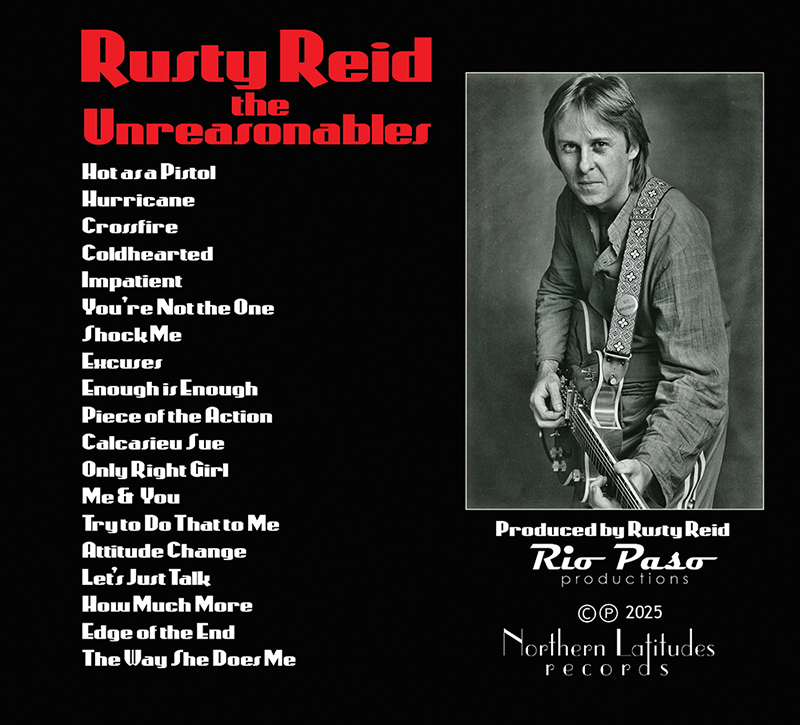
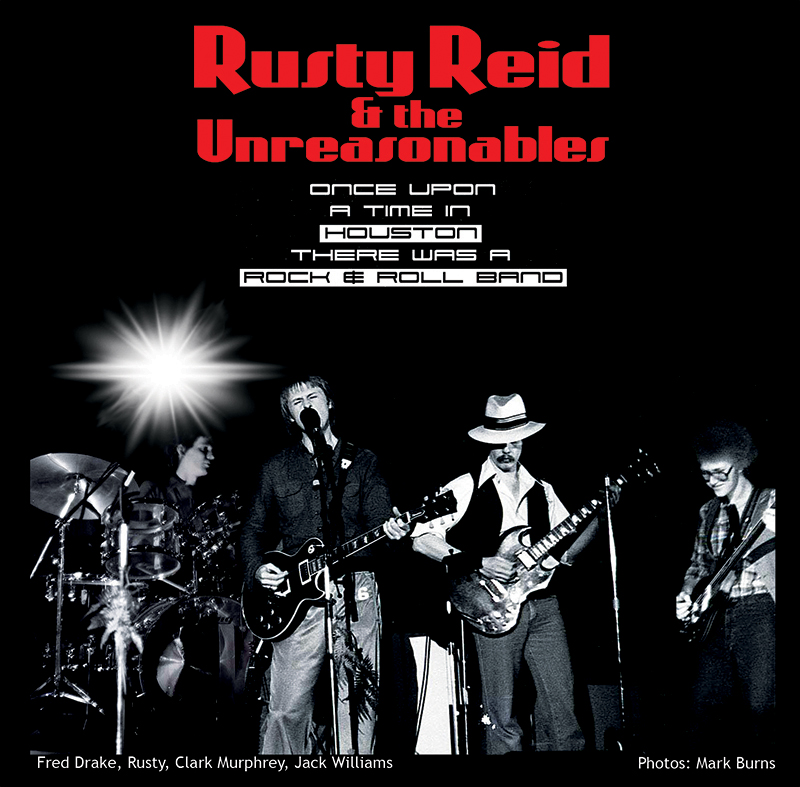
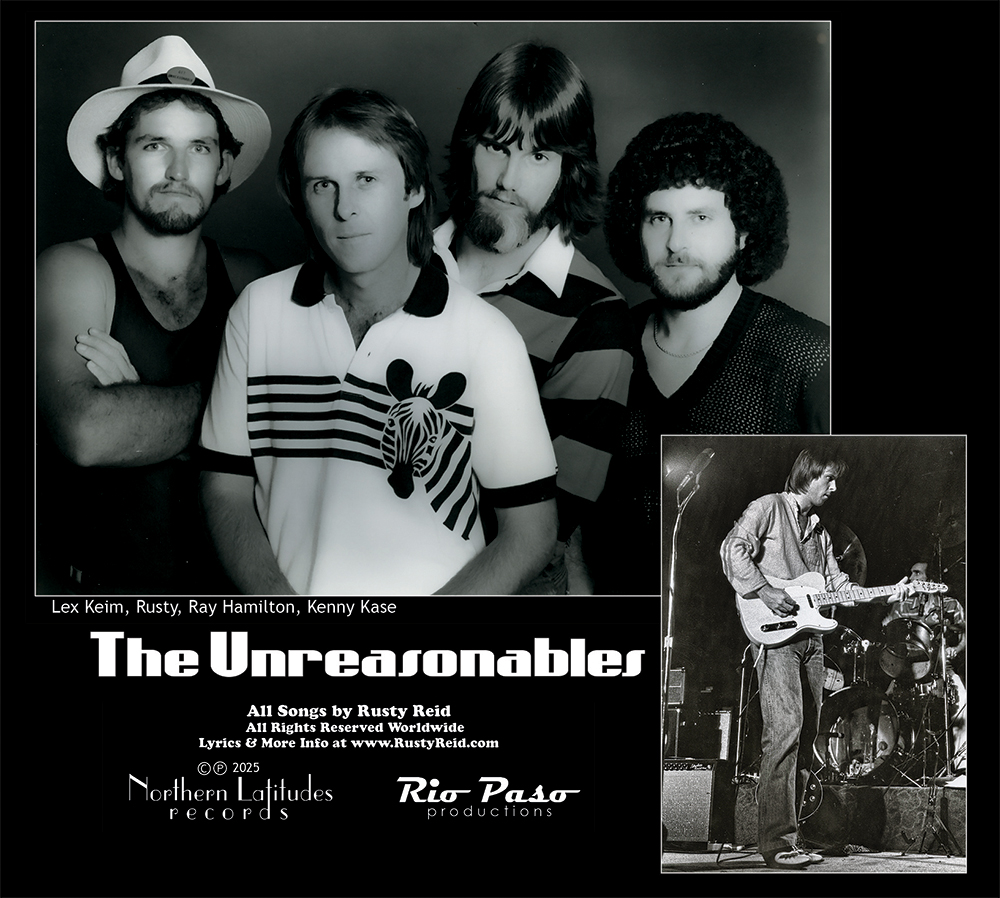












© Copyright Rio Paso Music Productions